


Article details
Machine Hour Rate Calculation: A Key Tool for Accurate Manufacturing Costing
In the manufacturing industry, cost control and operational efficiency are essential for maintaining profitability and competitiveness. One of the most important techniques used in cost accounting and production planning is Machine Hour Rate Calculation. It helps industries determine the actual cost of operating a machine per hour, allowing businesses to estimate product costs accurately, optimize production processes, and improve decision-making.
Machine Hour Rate (MHR) is widely used in industries such as automotive, heavy engineering, fabrication, machining, plastics, foundry, aerospace, and industrial manufacturing. It provides a scientific method for allocating machine-related expenses to products based on machine usage.
Understanding machine hour rate calculation is extremely important for production engineers, cost engineers, manufacturing managers, and business owners because machine costs form a major portion of manufacturing expenses.
What is Machine Hour Rate?
Machine Hour Rate is the cost incurred for operating a machine for one hour. It includes both fixed and variable expenses associated with the machine.
The formula is:
Machine Hour Rate = Total Machine Operating Cost / Total Effective Machine Hours
The purpose of calculating machine hour rate is to determine how much it costs to run a machine during production. This information helps organizations:
Estimate product manufacturing costs
Prepare accurate quotations
Analyze machine utilization
Improve pricing strategies
Control production expenses
Compare manufacturing alternatives
Evaluate profitability
Importance of Machine Hour Rate Calculation
1. Accurate Product Costing
Machine hour rate helps manufacturers allocate machine-related expenses accurately to products. Without proper costing, organizations may underprice or overprice products.
2. Better Quotation Preparation
Many engineering and fabrication companies prepare customer quotations based on machine operating costs. Accurate machine hour rates ensure competitive and profitable pricing.
3. Cost Control
Machine cost analysis helps identify areas where operational expenses can be reduced, such as electricity consumption, maintenance costs, or idle time.
4. Production Planning
Production managers use machine hour rates to select cost-effective manufacturing methods and optimize machine utilization.
5. Investment Decisions
Machine cost calculations help management evaluate whether investing in new equipment or automation will be financially beneficial.
Components of Machine Hour Rate
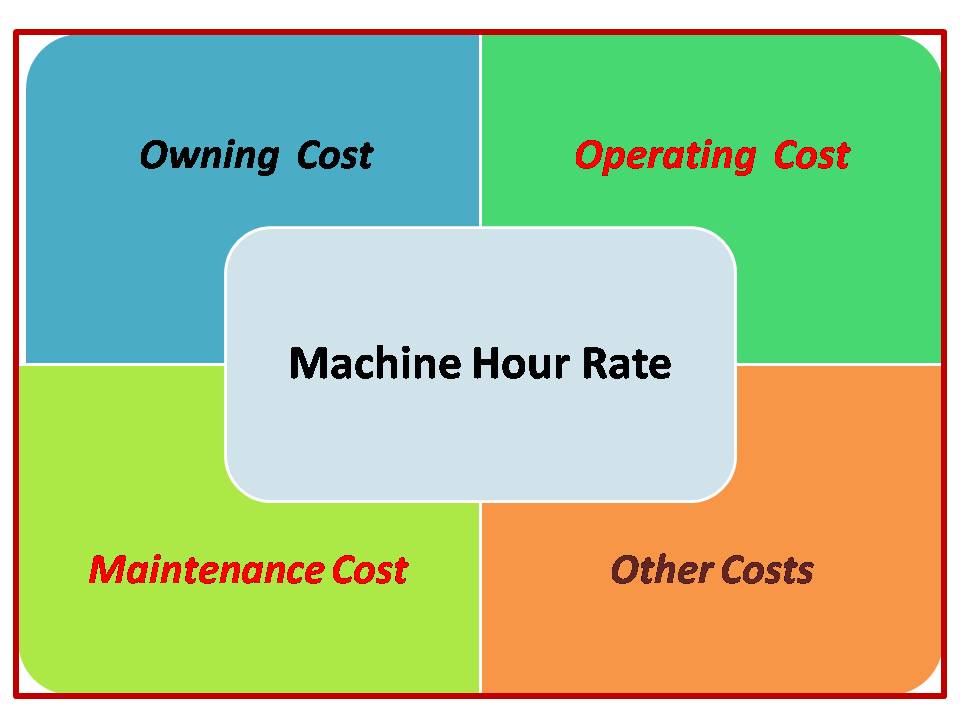
Machine hour rate consists of several cost elements. These are generally classified into:
A. Fixed Costs
Fixed costs remain constant regardless of machine usage.
Depreciation
Depreciation represents the reduction in machine value over time due to wear and tear.
Formula:
Depreciation per Year = (Machine Cost – Scrap Value) / Useful Life
Example:
Machine Cost = ₹20,00,000
Scrap Value = ₹2,00,000
Useful Life = 10 years
Depreciation = ₹1,80,000 per year
Interest on Investment
When capital is invested in machinery, interest cost must also be considered.
Insurance
Insurance cost protects machinery against damage, fire, or accidents.
Rent or Space Cost
Machines occupy factory space, and rental or facility costs may be allocated proportionately.
Taxes
Property taxes and equipment taxes are included in machine-related expenses.
B. Variable Costs
Variable costs change according to machine operation.
Power Consumption
Electricity cost is one of the most important machine operating expenses.
Formula:
Power Cost = Machine Power Rating × Running Hours × Electricity Rate
Example:
Machine Power = 20 kW
Electricity Rate = ₹8 per kWh
Running Time = 1 hour
Power Cost = ₹160 per hour
Maintenance and Repairs
Regular maintenance expenses include:
Lubrication
Spare parts
Repairs
Servicing
Preventive maintenance
Consumables
Machines consume items such as:
Cutting tools
Coolants
Welding electrodes
Grinding wheels
Oils and lubricants
Operator Wages
If a machine requires dedicated operators, labor costs are included.
Setup Cost
Machine setup time for changing tools, fixtures, or jobs contributes to machine operating expenses.
Types of Machine Hour Rates
1. Simple Machine Hour Rate
Only machine-related expenses are included.
2. Comprehensive Machine Hour Rate
Includes both machine costs and operator wages.
3. Composite Machine Hour Rate
Used when multiple machines work together as a production unit.
Steps in Machine Hour Rate Calculation
Step 1: Determine Total Annual Fixed Costs
Collect all annual fixed expenses:
Depreciation
Insurance
Interest
Rent
Taxes
Example:
Expense | Annual Cost |
|---|---|
Depreciation | ₹1,80,000 |
Insurance | ₹20,000 |
Interest | ₹50,000 |
Rent Allocation | ₹60,000 |
Taxes | ₹10,000 |
Total Fixed Cost = ₹3,20,000
Step 2: Calculate Annual Variable Costs
Example:
Expense | Annual Cost |
|---|---|
Power | ₹2,40,000 |
Maintenance | ₹1,20,000 |
Consumables | ₹80,000 |
Operator Salary | ₹3,60,000 |
Total Variable Cost = ₹8,00,000
Step 3: Determine Effective Machine Hours
Suppose:
Total working days = 300
Working hours/day = 8
Total available hours = 2400 hours
Less:
Maintenance downtime = 200 hours
Setup time = 100 hours
Idle time = 100 hours
Effective machine hours = 2000 hours
Step 4: Calculate Total Annual Cost
Total Cost = Fixed Cost + Variable Cost
= ₹3,20,000 + ₹8,00,000
= ₹11,20,000
Step 5: Calculate Machine Hour Rate
Machine Hour Rate:
₹11,20,000 / 2000
= ₹560 per hour
Therefore, the machine operating cost is ₹560/hour.
Applications of Machine Hour Rate
Manufacturing Cost Estimation
Machine hour rates help estimate product manufacturing cost accurately.
CNC Machining Costing
CNC machines involve high capital investment, making MHR critical for costing operations.
Welding and Fabrication
Fabrication shops calculate machine hour rates for welding machines, cutting machines, and bending machines.
Injection Molding
Plastic industries use machine hour rates to estimate molding costs.
Job Work Industries
Job work companies quote prices based on machine operating time.
Factors Affecting Machine Hour Rate
Several factors influence machine hour rate calculation:
Machine Efficiency
Highly efficient machines reduce production time and lower unit cost.
Capacity Utilization
Low utilization increases machine hour rate because fixed costs are spread over fewer hours.
Automation Level
Automation may increase investment cost but reduce labor expenses.
Power Consumption
Energy-efficient machines lower operating costs.
Maintenance Quality
Poor maintenance increases downtime and repair expenses.
Production Volume
Higher production volume generally reduces machine cost per unit.
Machine Hour Rate in Modern Manufacturing
Modern industries use advanced software systems for machine costing and monitoring.
ERP Integration
Enterprise Resource Planning (ERP) systems integrate machine costs with production planning and inventory management.
IoT-Based Monitoring
Smart sensors monitor machine utilization, power consumption, and downtime in real time.
Industry 4.0
Digital manufacturing enables accurate tracking of machine efficiency and predictive maintenance.
AI-Based Cost Optimization
Artificial Intelligence helps optimize production schedules and reduce machine operating costs.
Common Mistakes in Machine Hour Rate Calculation
Ignoring Idle Time
Failure to consider downtime results in underestimated costs.
Excluding Maintenance Costs
Maintenance is a major expense and must be included.
Incorrect Depreciation
Using unrealistic machine life affects costing accuracy.
Not Updating Electricity Rates
Power tariffs change regularly and impact operating cost.
Ignoring Tooling Cost
Consumables and tooling expenses significantly affect machining operations.
Advantages of Machine Hour Rate Method
Accurate cost allocation
Better pricing decisions
Improved budgeting
Enhanced profitability analysis
Effective production control
Scientific overhead distribution
Better investment planning
Limitations of Machine Hour Rate
Despite its advantages, machine hour rate has some limitations:
Difficult to calculate for complex operations
Requires accurate data collection
Cost fluctuations affect calculations
Not suitable for highly manual operations
Time-consuming for small industries
However, despite these challenges, it remains one of the most effective methods for machine cost allocation.
Future Trends in Machine Costing
The future of machine hour rate calculation is evolving with digital manufacturing technologies.
Smart Manufacturing
Machines equipped with IoT sensors provide real-time operating cost data.
Cloud-Based Costing Systems
Cloud software enables centralized machine cost monitoring.
Predictive Analytics
AI predicts maintenance costs and machine breakdowns.
Sustainable Manufacturing
Energy-efficient machines reduce carbon footprint and operating costs.
Digital Twins
Virtual machine simulations help optimize productivity and costing.
Conclusion
Machine Hour Rate Calculation is a fundamental tool in manufacturing cost engineering and production management. It provides organizations with a clear understanding of machine operating expenses and helps improve cost control, pricing accuracy, and production efficiency.
In today’s competitive industrial environment, accurate machine costing is essential for maintaining profitability and making informed business decisions. Companies that effectively calculate and monitor machine hour rates can optimize resource utilization, reduce operational waste, and achieve long-term manufacturing excellence.
As industries continue adopting automation, smart manufacturing, and Industry 4.0 technologies, machine hour rate calculation will become even more accurate, data-driven, and strategically important for sustainable industrial growth.


 1 Hrs
1 Hrs 

