

Article details
What Is Power in an AC Circuit?
Alternating current (AC) circuits are widely used in homes, industries, commercial buildings, and electrical equipment. In an AC circuit, voltage and current change continuously with time. The power consumed or transferred depends on the voltage, current, and phase difference between them.
AC circuit power is generally divided into three types: active power, reactive power, and apparent power. These quantities help engineers evaluate electrical energy consumption, equipment performance, and power system efficiency.
Types of Power in an AC Circuit
1. Active Power
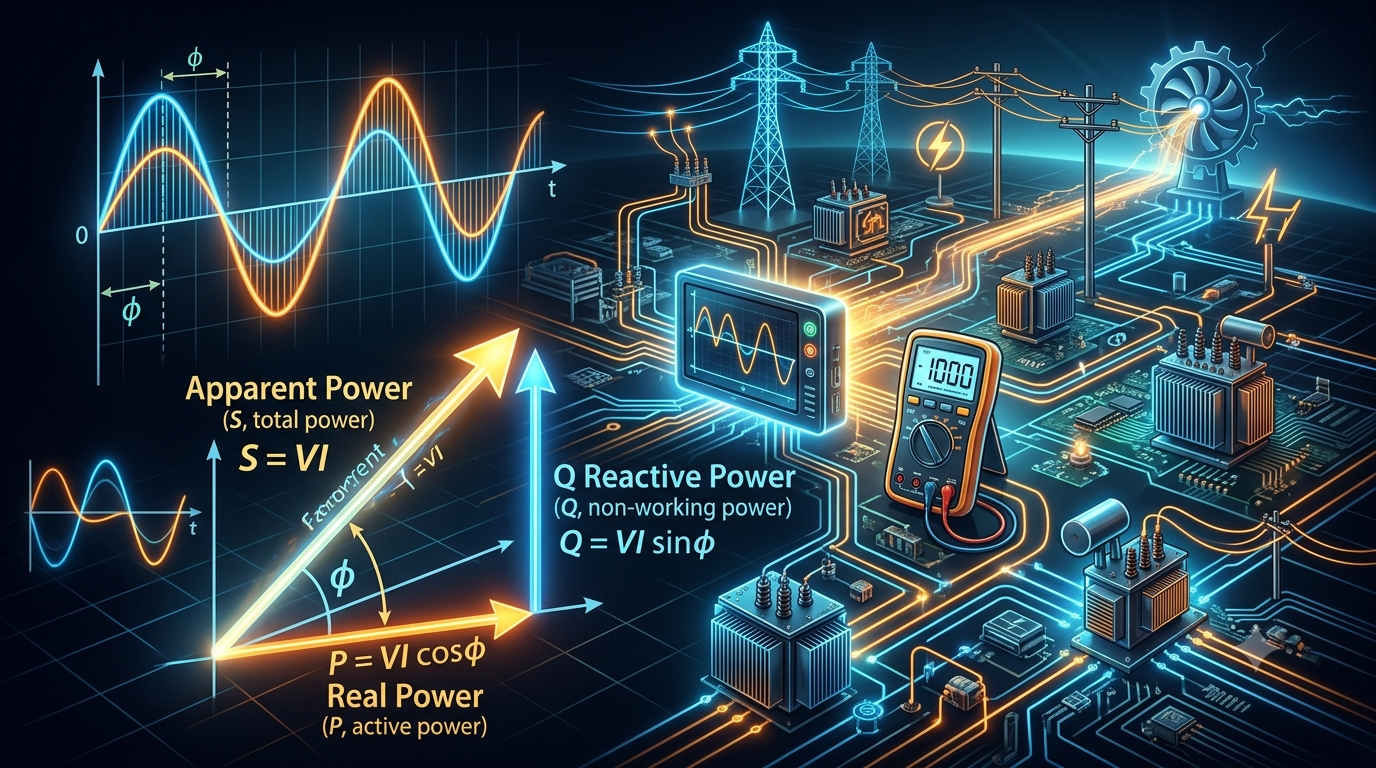
Active power, also called real or true power, is the power that performs useful work in an electrical circuit. It operates equipment such as heaters, lighting systems, motors, and industrial machinery.
Active power is measured in watts (W) or kilowatts (kW).
Formula:
P = V × I × cos φ
Where:
P = Active power (W)
V = RMS voltage (V)
I = RMS current (A)
cos φ = Power factor
φ = Phase angle between voltage and current
In a purely resistive circuit, voltage and current are in phase, so the power factor is 1. This means all the supplied electrical power is converted into useful work or heat.
2. Reactive Power
Reactive power is the power that moves back and forth between the source and reactive components, such as inductors and capacitors. It does not produce net useful work over a complete AC cycle, but it is essential for maintaining magnetic and electric fields in equipment such as motors, transformers, and capacitors.
Reactive power is measured in volt-amperes reactive (VAR) or kilovolt-amperes reactive (kVAR).
Formula:
Q = V × I × sin φ
Where Q represents reactive power.
Excessive reactive power demand can increase current flow and cause additional losses in electrical distribution systems. Capacitor banks and other power factor correction devices are commonly used to manage reactive power.
3. Apparent Power
Apparent power represents the total electrical power supplied to an AC circuit. It combines active power and reactive power and is especially important when selecting transformers, generators, cables, and other electrical equipment.
Apparent power is measured in volt-amperes (VA) or kilovolt-amperes (kVA).
Formula:
S = V × I
The relationship between the three types of power is expressed as:
S² = P² + Q²
This relationship forms the basis of the power triangle, which illustrates the connection between active, reactive, and apparent power.
Power Factor in AC Circuits
Power factor indicates how effectively electrical power is converted into useful work. It is the ratio of active power to apparent power.
Formula:
Power Factor = P / S = cos φ
A power factor close to 1 indicates efficient utilization of supplied power. A low power factor means more current may be required to deliver the same active power, potentially increasing losses and equipment loading.
Example of AC Power Calculation
Consider a single-phase AC circuit operating at 230 V, drawing 10 A, with a power factor of 0.8.
Apparent power:
S = 230 × 10 = 2,300 VA = 2.3 kVA
Active power:
P = 230 × 10 × 0.8 = 1,840 W = 1.84 kW
Reactive power:
Q = 230 × 10 × sin φ
Since cos φ = 0.8, sin φ = 0.6.
Q = 230 × 10 × 0.6 = 1,380 VAR = 1.38 kVAR
Therefore, the circuit has 1.84 kW of active power, 1.38 kVAR of reactive power, and 2.3 kVA of apparent power.
Applications of AC Circuit Power
Understanding AC power is essential for electrical system design, industrial motor operation, transformer sizing, energy consumption analysis, and power factor correction. Engineers use these calculations to improve efficiency, reduce electrical losses, and ensure equipment operates within its rated capacity.
Conclusion
AC circuit power is an important concept in electrical engineering. Active power performs useful work, reactive power supports the operation of inductive and capacitive equipment, and apparent power represents the total supplied power. Understanding their formulas and relationships helps engineers design reliable electrical systems, calculate loads, and improve overall power efficiency.
