

Article details
As urban populations expand and water scarcity intensifies globally, municipal wastewater treatment plants (WWTPs) are transitioning from simple disposal facilities into advanced water reclamation centers. Traditional Conventional Activated Sludge (CAS) processes—which rely on secondary clarifiers and gravity settling tanks to separate treated water from biological solids—require large land footprints, are vulnerable to sludge bulking, and often produce effluent that requires extensive tertiary treatment prior to non-potable or potable reuse.
Membrane Bioreactor (MBR) technology represents a major evolutionary step in environmental engineering. By combining the biological degradation of activated sludge with physical, pressure-driven membrane filtration (typically microfiltration or ultrafiltration), MBR systems completely replace secondary clarifiers and tertiary media filters. The result is a compact, highly reliable process that yields near-drinking-quality effluent suitable for aquifer recharge, industrial cooling, and urban irrigation.
2. Technical Mechanism: Biological Kinetics and Physical Separation
The core mechanism of an MBR system relies on the synergy between suspended-growth biological treatment and membrane separation.
A. Uncoupling Hydraulic Retention Time (HRT) and Sludge Retention Time (SRT)
In conventional gravity clarifiers, increasing the Mixed Liquor Suspended Solids (MLSS) concentration leads to poor settling and solids carryover. CAS systems typically operate at MLSS levels of $3,000 \text{ to } 5,000 \text{ mg/L}$.
Because membranes present an absolute physical barrier to suspended solids, MBR systems completely uncouple Hydraulic Retention Time (HRT) from Sludge Retention Time (SRT):
Operating MLSS: MBRs operate at elevated MLSS concentrations ranging from $8,000 \text{ to } 12,000 \text{ mg/L}$ (and up to $15,000 \text{ mg/L}$ in industrial configurations).
Reduced Footprint: Higher biomass density increases volumetric organic loading rates, reducing the required bioreactor basin volume by $50\%\text{ to }70\%$ compared to CAS.
Nitrification Efficiency: Extended SRTs (typically 15 to 30 days) foster slow-growing nitrifying bacteria (Nitrosomonas and Nitrobacter), ensuring complete ammonia oxidation even under cold-weather conditions.
B. Membrane Pore Size and Effluent Quality
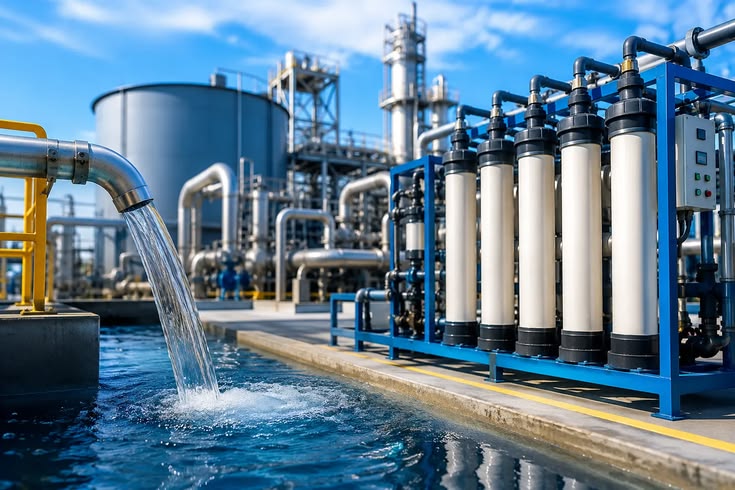
MBR modules utilize either Microfiltration (MF: 0.1 – 0.4 µm) or Ultrafiltration (UF: 0.01 – 0.04 µm) membranes, arranged in hollow fiber or flat sheet configurations.
Pathogen Retention: UF membranes achieve physical removal of suspended solids, $6\text{-log}$ ($99.9999\%$) reduction of bacteria (e.g., E. coli), and $4\text{-log}$ reduction of viruses and protozoan cysts (Cryptosporidium and Giardia).
Effluent Quality: Produces consistent turbidity levels ($< 0.2 \text{ NTU}$) and Total Suspended Solids ($\text{TSS} < 1 \text{ mg/L}$), creating an ideal feed stream for downstream Reverse Osmosis (RO) membranes or direct disinfection.
3. Membrane Fouling Dynamics and Operational Controls
Membrane fouling—the accumulation of organic, inorganic, and biological foulants on or within the membrane structure—is the primary operational challenge in MBR engineering. Fouling increases hydraulic resistance, causing trans-membrane pressure (TMP) to rise for a given flux rate.
A. Types of Fouling
Reversible Fouling: Deposition of a removable cake layer of sludge flocs on the membrane surface, managed by physical scouring and backwashing.
Irreversible Fouling: Pore blocking and adsorption of Soluble Microbial Products (SMP) and Extracellular Polymeric Substances (EPS) inside membrane pores, requiring chemical cleaning.
Irrecoverable Fouling: Long-term structural damage or permanent chemical scaling that decreases baseline membrane permeability over its 7- to 10-year service life.
B. Engineering Controls for Fouling Prevention
Coarse Bubble Air Scouring: In submerged MBRs, dedicated air blowers discharge coarse bubbles directly beneath membrane cassettes. The rising air-water mixture creates high shear forces across the membrane surface, continuously scouring away accumulated cake layers.
Relaxation and Backwashing: Filtration runs follow cyclic patterns (e.g., 9 minutes of suction followed by 1 minute of relaxation). Hollow-fiber systems periodically reverse flow (backwash) using clean permeate to push out trapped particles.
Chemical Cleaning Regimens:
Maintenance Clean: Performed weekly using low-concentration Sodium Hypochlorite ($\text{NaOCl}$, $200–500 \text{ mg/L}$) or Citric Acid ($0.2–0.5\%$) to eliminate biofouling and inorganic scaling.
Recovery Clean: Executed 1–2 times per year using high-strength chemical soaking when TMP exceeds operational thresholds ($\approx 30–50 \text{ kPa}$).
4. System Comparison: CAS vs. MBR Performance
Engineering Parameter | Conventional Activated Sludge (CAS) | Membrane Bioreactor (MBR) |
Footprint Requirement | Baseline ($100\%$) | High Compactness ($30–50\%$ of CAS land area) |
Operating MLSS | $3,000 - 5,000 \text{ mg/L}$ | $8,000 - 12,000 \text{ mg/L}$ |
Effluent Turbidity | $1.0 - 5.0 \text{ NTU}$ | $< 0.2 \text{ NTU}$ |
Effluent TSS | $10 - 30 \text{ mg/L}$ | $< 1 \text{ mg/L}$ |
BOD5 Removal | $85 - 95\%$ | $> 98\%$ |
Disinfection Needs | Requires high-dose Chlorination or UV | Physical pathogen retention; minimal polish required |
Specific Energy Consumption | $0.3 - 0.5 \text{ kWh/m}^3$ | $0.7 - 1.2 \text{ kWh/m}^3$ (Higher due to aeration scouring) |
Conclusion
Membrane Bioreactors have set a new benchmark in environmental engineering and municipal wastewater treatment. By integrating biological activated sludge kinetics with advanced ultrafiltration physical separation, MBR technology eliminates the land footprint and settling instabilities of traditional secondary clarifiers. Despite higher operational energy requirements for membrane air scouring, the ability of MBR systems to consistently produce high-purity, pathogen-free effluent makes them an essential technology for modern water reclamation, urban sustainability, and circular water management strategies.
