


Article details
Automotive engines are the primary power source of vehicles and play a critical role in transportation systems worldwide. Over the decades, engine technology has evolved significantly to meet increasing demands for higher performance, improved fuel economy, lower emissions, and better driving comfort.
Traditional internal combustion engines were mainly focused on generating power and speed. However, modern automotive engineering now emphasizes fuel efficiency, environmental sustainability, intelligent control systems, and alternative energy solutions.
Advancements in automotive engine design have resulted in lighter, more powerful, cleaner, and smarter engines. Technologies such as turbocharging, direct fuel injection, hybrid systems, variable valve timing, and electric propulsion are revolutionizing the automotive industry.
Fundamentals of Automotive Engines
Automotive engines convert the chemical energy of fuel into mechanical energy through combustion processes.
The power generated by an engine depends on:
Fuel combustion efficiency
Air-fuel mixture quality
Compression ratio
Engine speed
Thermal efficiency
The thermal efficiency of an engine is generally represented as:
\eta = \frac{Work\ Output}{Heat\ Input}
Modern engine advancements focus on increasing efficiency while reducing fuel consumption and emissions.
Evolution of Automotive Engines
1. Naturally Aspirated Engines
Earlier engines relied on atmospheric pressure to supply air into the combustion chamber.
Advantages:
Simple construction
Lower maintenance
Reliable operation
Limitations:
Lower power output
Reduced efficiency at high altitudes
Higher fuel consumption compared to modern systems
2. Turbocharged Engines
Turbocharging is one of the most important advancements in engine technology.
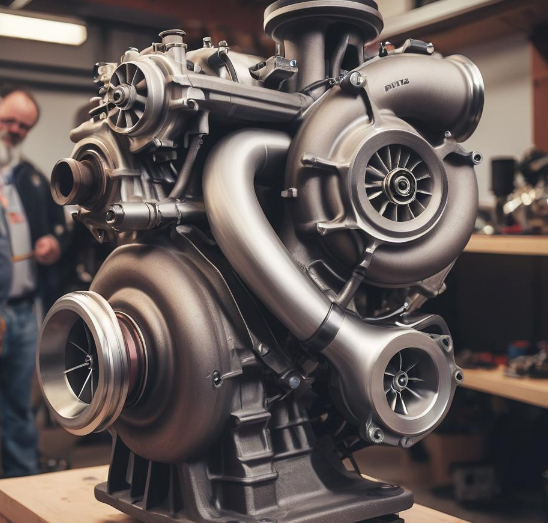
A turbocharger uses exhaust gases to compress incoming air, allowing more fuel to burn efficiently and produce greater power.
Advantages:
Increased power output
Better fuel efficiency
Reduced engine size
Lower emissions
Turbocharged engines are widely used in modern passenger cars, sports vehicles, and commercial vehicles.
Direct Fuel Injection Technology
Direct fuel injection systems spray fuel directly into the combustion chamber at high pressure.
Benefits include:
Improved combustion efficiency
Better fuel economy
Higher engine performance
Reduced exhaust emissions
Faster throttle response
Gasoline Direct Injection (GDI) and Common Rail Direct Injection (CRDI) systems are common examples used in modern automobiles.
Variable Valve Timing (VVT)
Variable Valve Timing technology adjusts valve opening and closing timing according to engine operating conditions.
Advantages:
Improved engine efficiency
Better fuel economy
Increased power at different speeds
Reduced emissions
Smoother engine operation
Many modern engines use advanced VVT systems for optimal performance.
Hybrid Engine Technology
Hybrid vehicles combine an internal combustion engine with an electric motor.
Types of hybrid systems:
Mild hybrid
Full hybrid
Plug-in hybrid
Advantages:
Lower fuel consumption
Reduced emissions
Improved acceleration
Energy recovery during braking
Enhanced urban driving efficiency
Hybrid technology has become a major step toward sustainable transportation.
Electric Vehicle (EV) Propulsion Systems
One of the most revolutionary advancements in automotive engineering is the development of electric vehicles.
Electric propulsion systems use:
Electric motors
Battery packs
Power electronics
Regenerative braking systems
Advantages:
Zero tailpipe emissions
High energy efficiency
Low operating costs
Quiet operation
Instant torque delivery
Companies such as Tesla, Toyota, and BMW are leading developments in electric mobility.
Advanced Combustion Technologies
Modern engines use advanced combustion methods to improve efficiency and reduce pollution.
Homogeneous Charge Compression Ignition (HCCI)
HCCI combines features of gasoline and diesel engines.
Advantages:
High thermal efficiency
Low nitrogen oxide emissions
Reduced fuel consumption
Lean Burn Engines
Lean burn technology uses excess air during combustion.
Benefits:
Better fuel economy
Reduced fuel consumption
Lower carbon emissions
Lightweight Materials in Engine Design
Modern engines use lightweight materials such as:
Aluminum alloys
Magnesium alloys
Composite materials
High-strength steel
Advantages:
Reduced vehicle weight
Improved fuel efficiency
Better acceleration
Lower emissions
Lightweight engine construction also improves vehicle handling and performance.
Engine Control Units (ECU)
Electronic Control Units are intelligent systems that monitor and control engine operations.
ECUs manage:
Fuel injection
Ignition timing
Air-fuel ratio
Emission control
Turbocharger operation
Advantages:
Improved engine performance
Better fuel efficiency
Reduced emissions
Enhanced reliability
Modern vehicles rely heavily on sensors and electronic systems for precise engine management.
Emission Control Technologies
Environmental regulations have driven the development of cleaner engine technologies.
Important emission control systems include:
Catalytic converters
Exhaust gas recirculation (EGR)
Diesel particulate filters (DPF)
Selective catalytic reduction (SCR)
These systems help reduce:
Carbon monoxide
Nitrogen oxides
Hydrocarbon emissions
Particulate matter
Hydrogen Internal Combustion Engines
Hydrogen-powered engines are emerging as an alternative clean energy solution.
Advantages:
Near-zero carbon emissions
Fast refueling
High energy density
Hydrogen technology may play an important role in future sustainable transportation systems.
Artificial Intelligence and Smart Engine Systems
Artificial intelligence and machine learning are improving automotive engine performance through:
Predictive maintenance
Real-time diagnostics
Adaptive fuel management
Autonomous driving integration
Smart engine systems can optimize performance based on driving conditions and driver behavior.
Challenges in Modern Engine Development
Despite major advancements, several challenges remain:
High development costs
Battery limitations in EVs
Charging infrastructure
Thermal management issues
Environmental regulations
Rare material dependency
Continuous innovation is required to overcome these challenges.
Future Trends in Automotive Engines
Future automotive engine technologies may include:
Fully electric vehicles
Hydrogen fuel cell systems
Autonomous vehicle integration
Solid-state batteries
Advanced hybrid systems
Carbon-neutral fuels
The automotive industry is moving toward sustainable and intelligent mobility solutions.
Conclusion
Advancements in automotive engine design and performance have significantly improved vehicle efficiency, power, reliability, and environmental sustainability. Technologies such as turbocharging, direct injection, hybrid systems, electric propulsion, and intelligent control systems are transforming the future of transportation.
As the world moves toward cleaner and smarter mobility, modern automotive engines will continue to evolve with greater efficiency, lower emissions, and advanced digital integration. These innovations will shape the next generation of sustainable transportation systems.