


Article details
Whether you're designing HVAC systems, automotive radiators, or industrial boilers, heat exchangers are the unsung heroes of thermal engineering. They enable efficient energy transfer between fluids, often under extreme conditions, and are critical to everything from power generation to food processing. In this post, we’ll explore the fundamentals of heat exchanger analysis, key equations, and special cases like condensers and boilers—all tailored for aspiring mechanical engineers.
Why Heat Exchangers Matter
Heat exchangers are devices that allow thermal energy to be transferred between two or more fluids at different temperatures without mixing them. Their applications span:
Power plants (steam condensers, feedwater heaters)
Automotive systems (radiators, intercoolers)
Chemical processing (reactor jackets, distillation columns)
HVAC systems (air conditioners, heat pumps)
Understanding how they work—and how to model them—is essential for engineers working in design, simulation, or manufacturing.
Assumptions for Simplified Analysis
To make heat exchanger analysis manageable, engineers rely on several simplifying assumptions:
Uniform Heat Transfer Coefficient: Thermal conductivity is consistent throughout the exchanger.
Steady-State Conditions: No time-dependent changes in temperature or flow.
Constant Specific Heats: Fluid properties remain stable.
Two-Fluid Interaction: No external heat sources or sinks.
One-Dimensional Heat Transfer: Neglects radial or multidimensional effects.
Perfect Insulation: No heat loss to the environment.
These assumptions allow us to apply thermodynamic principles with precision and clarity.
Core Equations: The First Law in Action
At the heart of heat exchanger analysis lies the first law of thermodynamics, which ensures energy conservation:

Where:
Q: Rate of heat transfer
m: Mass flow rate
Cp: Specific heat capacity
Tin, Tout: Inlet and outlet temperatures
To simplify, we define heat capacity rate:

This leads to a compact form:

This equation is crucial for sizing heat exchangers and predicting outlet temperatures during design and simulation.
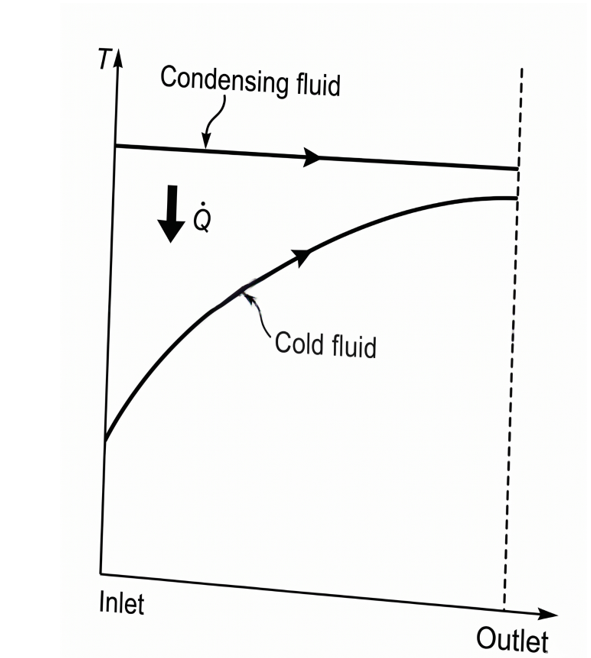
Temperature Profiles: Heater vs. Boiler
Visualizing temperature variation helps engineers understand how heat flows through the exchanger. Two common cases:
(a) Heater

Hot fluid: Often condensing steam
Cold fluid: Gains heat
Profile: Cold fluid temperature rises; hot fluid temperature drops
(b) Boiler

Hot fluid: Provides heat
Cold fluid: Undergoes phase change (boiling)
Profile: Cold fluid temperature remains constant during boiling; hot fluid temperature drops
These profiles guide decisions on flow arrangement (counterflow vs. parallel flow), surface area, and insulation.
Special Cases: Condensers and Boilers
In systems involving phase change—like steam generation or condensation—the heat transfer equation simplifies dramatically:

Where:
hfg: Enthalpy of vaporization
m: Mass flow rate of the phase-changing fluid
This equation is especially relevant in:
Steam turbines (condensers)
Refrigeration cycles (evaporators)
Chemical reactors (boilers)
Phase-change heat exchangers are designed to handle large energy transfers with minimal temperature change, making them highly efficient.


 2 Hrs
2 Hrs 


