


Article details
When a vertical bar hangs under its own weight, every cross-section carries the weight of the material below it. This creates a varying axial force along the length, producing an axial stress that changes from zero at the free end to a maximum at the top. As a result, the bar elongates due to its own weight.
Assumptions
Bar is vertical, prismatic (constant cross-section)
Material is homogeneous, isotropic, and obeys Hooke’s law
Self-weight is the only load
Temperature effects are neglected
Elastic limit is not exceeded
Notation
Length = ( L )
Cross-sectional area = ( A )
Young’s modulus = ( E )
Density = ( ρ )
Acceleration due to gravity = ( g )
Unit weight ( γ = ρ g )
Axial Force at a Section
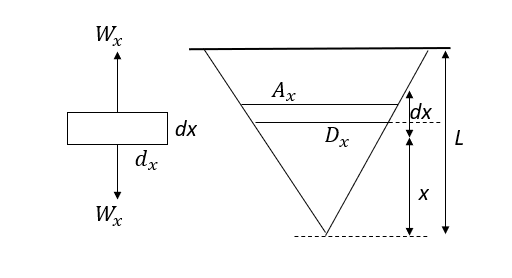
Consider a section at a distance ( x ) from the bottom (free end).
The force at this section equals the weight of the portion below it:
P(x) = γ A x
Stress at the Section

Stress increases linearly from bottom (0) to top ((\gamma L)).
Strain at the Section
Using Hooke’s law,

Elemental Extension
An elemental length ( dx ) at distance ( x ) elongates by:

Total Elongation of the Bar

Key result: The extension due to self-weight is independent of cross-sectional area.
Maximum Stress at the Top

Important Observations
Stress varies linearly along the length.
Elongation depends on length squared ((L^2)).
Cross-sectional area does not affect total extension.
Longer, lighter, and more flexible materials show greater self-weight extension.
This effect becomes significant in long vertical members like cables, rods, towers, and drill strings.
Special Case: Uniform Bar with External Load ( P )
If an external tensile load ( P ) is also applied at the bottom:

Engineering Applications
Long hanging rods and cables
Elevator and crane cables
Drill pipes in oil & gas wells
Tall vertical members and tie rods
Suspension system elements