

Article details
Battery energy storage systems
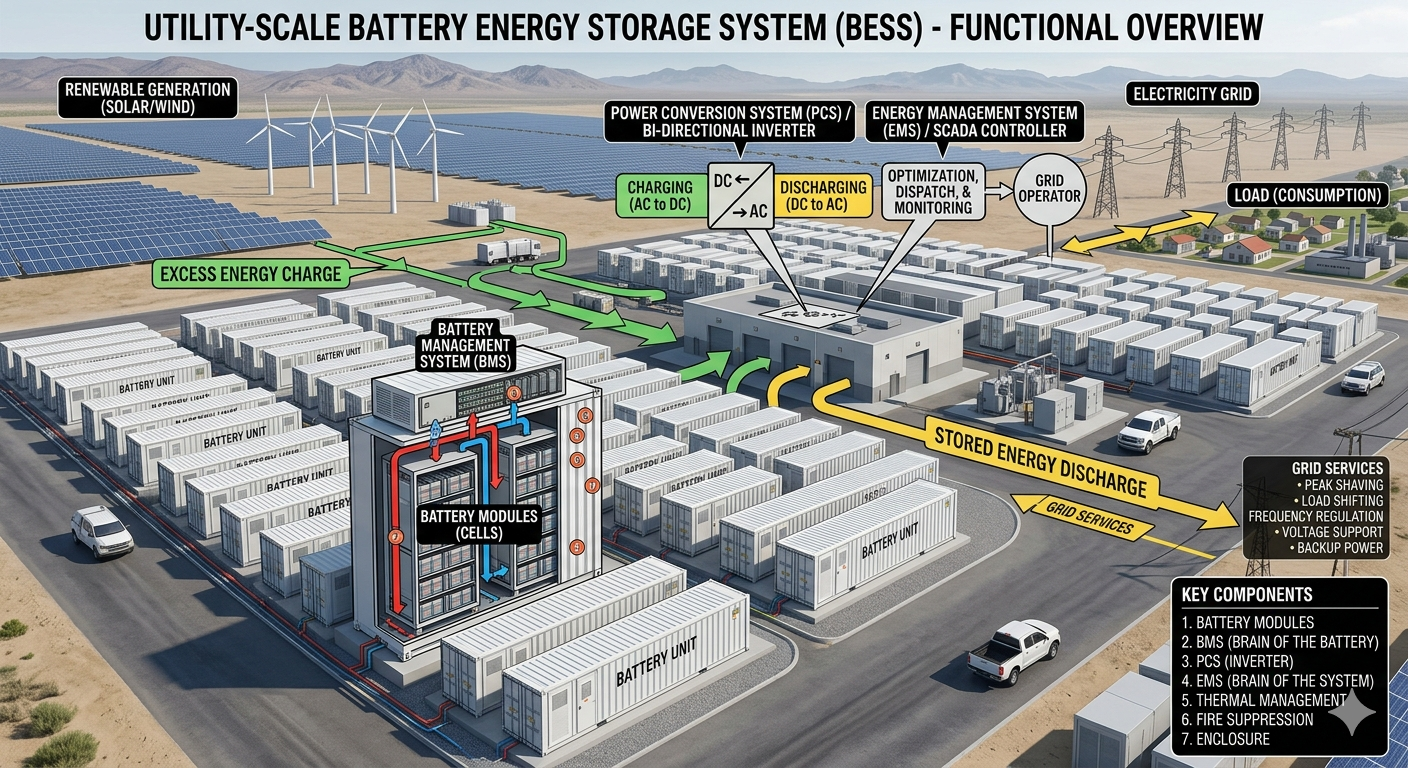
Battery energy storage systems (BESS) allow for energy storage in batteries for later use. India has committed to achieve 50 per cent of installed capacity from non-fossil-fuel-based sources by 2030. While planning for the increase in the share of renewable energy (RE) in the energy mix, it is critical to consider the impact of the intermittent nature of RE and its impact on the grid. Having BESS along with RE ensures that excess power generated is stored and used later, thus making RE reliable and mitigating the impact of its intermittent nature. Odisha should plan for RE along with BESS to ensure grid stability, reduced curtailment of RE, etc.
At the national level, various initiatives have been undertaken to ensure BESS deployment. These include the publishing of the National Framework for the Promotion of Energy Storage Systems 2023, which clearly identifies quantum of need for BESS and provides viability gap funding of 40 per cent, guidelines for competitive bidding for renewable and BESS projects, BESS obligation targets for states, etc. At the state level, apart from highlighting the importance of BESS in the RE policy, GRIDCO put out a tender for 500 MW of Energy Storage Capacity in March 2024, connected to the Central Transmission or state transmission utility. This note covers the deployment of BESS and battery manufacturing required for BESS deployment.
Opportunities for 2030
Jobs overview
If Odisha deploys BESS in proportion to the Energy Storage Obligation of 4 per cent by 2030, it would generate employment for approximately 16,000 people in 2030 for activities across business development, design, construction, commissioning and operations and maintenance (O&M). Business development includes activities such as DPR preparation and viability assessment. The design stage includes battery sizing and configuration and balance of systems. Construction and commissioning includes installation, testing and grid connections, while O&M includes maintenance of battery and HVAC systems and electrical wiring.
If Odisha attracts manufacturers to supply batteries to meet the Energy Storage Obligation, approximately 200 jobs would be created in battery manufacturing, covering R&D, testing, engineering, production, product engineering, maintenance, marketing, sales and services.
The total employment in BESS would be approximately 16,000 FTE.
Market opportunity
Total annual revenue in 2030 is estimated to be USD 42 million.
For battery manufacturing, the total investment required would be USD 60 million, assuming battery prices of USD 80 per kWh.
The total market opportunity is INR 600 crore (USD 80 million).
Investment opportunity
The total investment required to deploy BESS, including battery manufacturing, is approximately INR 4,000 crore (USD 500 million).
Why should Odisha invest in BESS deployment?
Through the use of BESS, the intermittency and variability of renewable power can be addressed by ensuring backup power during non-generating hours, accelerating renewable energy deployment and reducing curtailment.
During peak hours, reliance on coal can be reduced by using stored energy, leading to lower greenhouse gas emissions.
Benefits to DISCOMs and customers
Peak shaving and valley filling: Supplying power from BESS during peak demand reduces power purchase costs and tariffs. Charging BESS during low load periods helps flatten the load curve.
Distribution transformer deferral: BESS can defer investments in transformer upgrades by supporting peak loads that occur only seasonally.
Consumer benefits: BESS can relieve system congestion during peak hours, improving reliability and power quality.
Inspiration from a success story
Tata AutoComp Gotion Green Energy Solutions Pvt. Ltd. inaugurated a 9 GWh BESS manufacturing plant in Pune in 2023. The joint venture between Tata AutoComp and Chinese battery manufacturer Gotion targets both electric vehicle and BESS markets, while strengthening R&D capabilities through partnerships with organisations such as ISRO, CSIR-CECRI and CMET.
Who could support in scaling BESS deployment?
Role of departments
GRIDCO and Department of Energy: Integration of BESS into grid planning, identification of co-located projects and promotion of safety standards tailored to Indian climatic conditions.
Odisha Skills Development Authority: Development of training programmes and curricula to address skill gaps in battery manufacturing and BESS deployment.
Industries Department: Provision of plug-and-play manufacturing facilities and policies supporting green manufacturing.
MSME Department: Promotion of Odisha as a manufacturing destination and support for technology demonstration and scaling.
Science and Technology Department: Collaboration with R&D centres to advance battery technology innovation.
Role of the private sector: The private sector plays a central role in design, engineering, procurement, deployment and O&M of BESS, as well as strengthening domestic battery cell manufacturing and R&D for alternative chemistries.
Role of local administration and civil society organisations: Facilitation of stakeholder dialogue and collaboration across research organisations and industry.
Overcoming challenges to scale BESS deployment
High upfront costs: Rising lithium-ion battery prices, high GST and customs duties increase the levelised cost of storage. Viability gap funding and supportive state policies can improve financial viability.
Dependency on imports: Battery costs are vulnerable to global commodity price fluctuations due to reliance on imported minerals. Material innovation, recycling and reuse can reduce dependency.
Safety standards: Existing standards are not fully tailored to tropical climates. State-led initiatives can help institutionalise climate-appropriate safety standards.
Risk-proofing the scale-up of BESS deployment
Environmental risk: Improper disposal of batteries poses environmental risks. Guidelines on second-life use and strict implementation of Battery Waste Management Rules are essential.
Annexure 1: Scoping of the BESS deployment value chain
The scope of the value chain includes battery manufacturing and deployment of BESS across business development, design, construction, commissioning and operations and maintenance.
Jobs and market estimation
Employment figures are calculated using coefficients developed from a case study of a 10 MW / 10 MWh plant.
Table 1: Coefficients across various activities in BESS deployment

Source: Tyagi et al. 2023
Market opportunity estimation
The total BESS requirement is estimated at 4,717 MWh based on national projections, energy storage obligations and performance assumptions.
Annexure 2: Methodology
Employment coefficient: Derived from surveys with battery manufacturers, resulting in an estimate of 0.00027 FTE per kWh.
Market opportunity estimation: Assumes average battery prices of USD 80 per kWh by 2030.
Investment opportunity estimation: Based on national estimates for scaling battery manufacturing capacity.
References
Central Electricity Authority. 2022. Report on Twentieth Electric Power Survey of India.
Colthorpe, Andy. 2023. Tata AutoComp-Gotion JV supplies first BESS units to Tata Power project in Pune, India. Energy Storage News.
Deorah, Shruti M., et al. 2020. Estimating the Cost of Grid-Scale Lithium-Ion Battery Storage in India. Berkeley Lab.
Ministry of Power. 2023. National Framework for Promoting Energy Storage Systems.


 Aug 29, 2026