


Article details
Boiling is one of the most efficient modes of heat transfer and plays a critical role in numerous engineering applications, including power plants, refrigeration systems, chemical processing industries, nuclear reactors, and heat exchangers. Unlike simple convection, boiling involves a phase change from liquid to vapor, allowing large amounts of heat to be transferred with relatively small temperature differences.
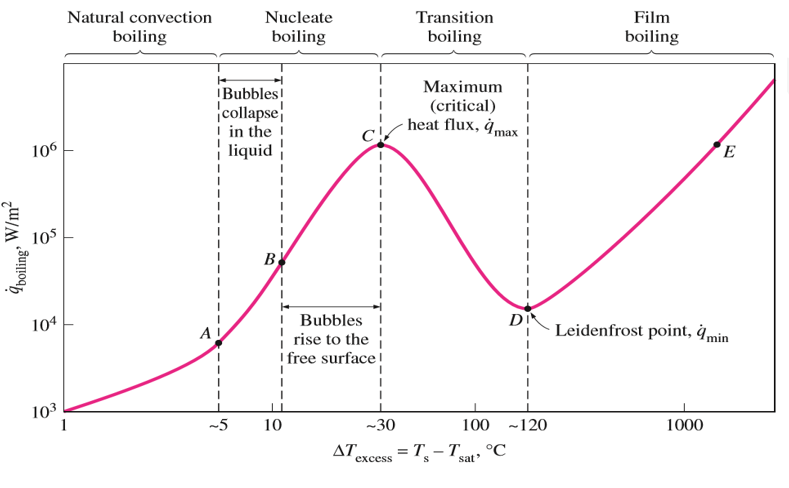
The behavior of boiling heat transfer is commonly represented by the boiling curve, which illustrates the relationship between the heat flux supplied to a heated surface and the excess temperature of that surface above the saturation temperature of the liquid. Understanding the various boiling regimes is essential for designing safe and efficient thermal systems.
What is Boiling?
Boiling is the process in which a liquid changes into vapor when its temperature reaches the saturation temperature corresponding to the prevailing pressure. During boiling, vapor bubbles are formed within the liquid and rise to the surface.
The rate of heat transfer during boiling depends on factors such as:
Surface temperature
Liquid properties
System pressure
Surface characteristics
Heat flux supplied
The Boiling Curve
The boiling curve is a graphical representation of the heat flux (q) versus the temperature difference between the heated surface and the saturation temperature of the liquid.
The temperature difference is given by:
ΔT = Ts − Tsat
where:
Ts = Surface temperature
Tsat = Saturation temperature of the liquid
The boiling curve consists of several distinct regions, each representing a different boiling regime.
Major Boiling Regimes
1. Natural Convection Region
In the initial stage, the surface temperature is only slightly higher than the saturation temperature of the liquid.
Characteristics:
No bubble formation occurs.
Heat transfer takes place mainly through natural convection currents.
Heat transfer coefficient is relatively low.
Heat flux increases gradually with temperature difference.
Applications:
Low-temperature heating systems.
Initial stages of heating water.
2. Onset of Nucleate Boiling (Incipient Boiling)
As the surface temperature increases further, tiny vapor bubbles begin to form at microscopic cavities on the heated surface.
Characteristics:
First appearance of vapor bubbles.
Bubbles form and collapse rapidly.
Significant increase in heat transfer rate.
Beginning of nucleate boiling.
Importance:
Marks the transition from natural convection to highly efficient boiling heat transfer.
3. Nucleate Boiling Region
Nucleate boiling is considered the most desirable and efficient boiling regime.
Characteristics:
Large numbers of vapor bubbles form and detach continuously.
Vigorous mixing of liquid occurs.
Extremely high heat transfer coefficients.
Heat transfer rate increases rapidly with surface temperature.
Advantages:
High thermal efficiency.
Excellent cooling capability.
Stable operating condition.
Applications:
Steam generators.
Industrial boilers.
Nuclear reactor cooling systems.
High-performance heat exchangers.
Critical Heat Flux (CHF)
As heat flux continues to increase, the boiling curve reaches a maximum point known as the Critical Heat Flux (CHF) or Burnout Point.
Characteristics:
Maximum heat transfer rate achievable during nucleate boiling.
Surface becomes partially covered with vapor.
Further increase in heat input causes a sudden decline in heat transfer efficiency.
Importance:
CHF represents the safe upper operating limit for many thermal systems. Exceeding this point can lead to overheating and equipment damage.
4. Transition Boiling Region
Beyond the critical heat flux point, the system enters the transition boiling regime.
Characteristics:
Unstable boiling behavior.
Intermittent vapor film formation.
Heat transfer coefficient decreases significantly.
Surface temperature rises sharply.
Problems:
Reduced cooling effectiveness.
Potential risk of thermal damage.
Difficult to maintain stable operation.
Engineering systems are generally designed to avoid operating in this region.
Leidenfrost Point
As surface temperature increases further, the heat transfer rate reaches a minimum value known as the Leidenfrost Point.
Characteristics:
Stable vapor layer begins to form.
Liquid droplets float on the vapor cushion.
Heat transfer reaches its minimum value.
A common example is water droplets dancing on a very hot frying pan.
5. Film Boiling Region
At extremely high surface temperatures, a continuous vapor film completely separates the liquid from the heated surface.
Characteristics:
Stable vapor blanket covers the surface.
Heat transfer occurs primarily through conduction and radiation across the vapor layer.
Heat transfer coefficient is much lower than nucleate boiling.
Surface temperature becomes very high.
Applications:
High-temperature industrial furnaces.
Specialized thermal processing operations.
Disadvantages:
Poor cooling performance.
High thermal resistance.
Risk of equipment failure if uncontrolled.
Significance of the Boiling Curve
The boiling curve provides valuable information for engineers and designers.
Design Optimization
Helps determine the most efficient operating temperature range for boilers, heat exchangers, and cooling systems.
Safety Assessment
Allows identification of the critical heat flux limit to prevent burnout and overheating.
Performance Evaluation
Enables comparison of different heating surfaces, fluids, and operating conditions.
Energy Efficiency
Assists in maximizing heat transfer while minimizing energy consumption.
Factors Affecting the Boiling Curve
Several parameters influence boiling behavior:
Surface Characteristics
Rough surfaces promote nucleate boiling.
Smooth surfaces may delay bubble formation.
Pressure
Higher pressure increases saturation temperature.
Shifts the boiling curve.
Fluid Properties
Surface tension
Density
Thermal conductivity
Latent heat of vaporization
Surface Orientation
Horizontal and vertical surfaces exhibit different boiling characteristics.
Presence of Impurities
Impurities can alter bubble formation and heat transfer performance.
Engineering Applications
Power Plants
Boiling is used to generate steam for turbine operation and electricity production.
Nuclear Reactors
Efficient boiling heat transfer removes heat from reactor cores and maintains safe operating temperatures.
Refrigeration and Air Conditioning
Boiling of refrigerants absorbs heat from the surrounding environment.
Chemical Processing
Used in distillation, evaporation, and concentration processes.
Electronics Cooling
Advanced boiling techniques are employed to cool high-power electronic devices and data centers.
Conclusion
Boiling heat transfer is a highly effective mechanism for transferring large amounts of thermal energy. The boiling curve provides a comprehensive understanding of how heat transfer changes with surface temperature and identifies the different boiling regimes, including natural convection, nucleate boiling, transition boiling, and film boiling. Among these, nucleate boiling offers the highest heat transfer performance and is preferred in most engineering applications. Understanding the critical heat flux and other boiling phenomena is essential for designing safe, reliable, and energy-efficient thermal systems.
As industries continue to demand higher efficiency and better thermal management, the study of boiling regimes and boiling curves remains a fundamental aspect of mechanical, chemical, and thermal engineering.