

Article details
Introduction
Corrosion is one of the major challenges faced by industries that operate with metallic structures, pipelines, storage tanks, offshore platforms, and underground equipment. When metals interact with their surrounding environment, chemical or electrochemical reactions can gradually damage their surfaces. This process can reduce equipment strength, cause leakage, increase maintenance costs, and create serious safety risks.Cathodic protection is an effective corrosion-control technique used to protect metal structures from deterioration. It works by changing the electrochemical conditions on a metal surface to reduce its tendency to corrode.Cathodic protection is widely applied in oil and gas facilities, marine structures, water distribution systems, power plants, and industrial infrastructure. Understanding corrosion mechanisms and protection methods helps engineers improve equipment reliability, extend service life, and reduce operational expenses.
What Is Corrosion?
Corrosion is the gradual deterioration of a metal due to chemical or electrochemical reactions with its surrounding environment. It commonly occurs when metals are exposed to moisture, oxygen, chemicals, salts, or other corrosive substances.
For example, iron reacts with oxygen and water to form rust. This reaction gradually weakens the metal and can affect the performance of structures and equipment.
Corrosion can occur in different forms depending on the material, environmental conditions, and operating conditions.
Common Types of Corrosion
1. Uniform Corrosion
Uniform corrosion occurs evenly across the exposed surface of a metal. It gradually reduces the material thickness and is commonly observed in pipelines, tanks, and steel structures.
2. Galvanic Corrosion
Galvanic corrosion occurs when two different metals are electrically connected in the presence of an electrolyte. The more active metal corrodes faster, while the less active metal receives some protection.
3. Pitting Corrosion
Pitting corrosion creates small holes or cavities on a metal surface. Although the affected area may appear small, the damage can penetrate deeply and cause unexpected equipment failure.
4. Crevice Corrosion
Crevice corrosion develops in narrow spaces where moisture and corrosive substances become trapped. It can occur beneath gaskets, joints, deposits, and metal connections.
5. Stress Corrosion Cracking
Stress corrosion cracking occurs when tensile stress and a corrosive environment act together. It can cause cracks to develop and spread through metal components.
What Is Cathodic Protection?
Cathodic protection is an electrochemical technique used to prevent or reduce corrosion in metallic structures. It works by making the metal surface act as a cathode in an electrochemical cell.In a natural corrosion process, metal atoms lose electrons and become metal ions. Cathodic protection supplies electrons to the structure, reducing the oxidation reaction responsible for metal loss.The technique is particularly useful for structures exposed to soil, seawater, freshwater, and other conductive environments.Its main objective is to reduce corrosion activity and protect important infrastructure throughout its operating life.
Working Principle of Cathodic Protection
Cathodic protection works on the principle of electrochemical reactions. Corrosion generally involves anodic and cathodic areas on a metal surface.
At the anodic area, metal atoms release electrons and enter the surrounding electrolyte as ions. This process results in material loss.
At the cathodic area, reduction reactions take place using electrons supplied through the electrochemical system.
Cathodic protection shifts the protected structure towards cathodic behaviour by supplying additional electrons. This reduces the rate of metal dissolution and helps prevent corrosion.
For effective protection, the structure must have an electrical connection to the protection system, and the surrounding environment must provide a suitable ionic conduction path.
Types of Cathodic Protection Systems
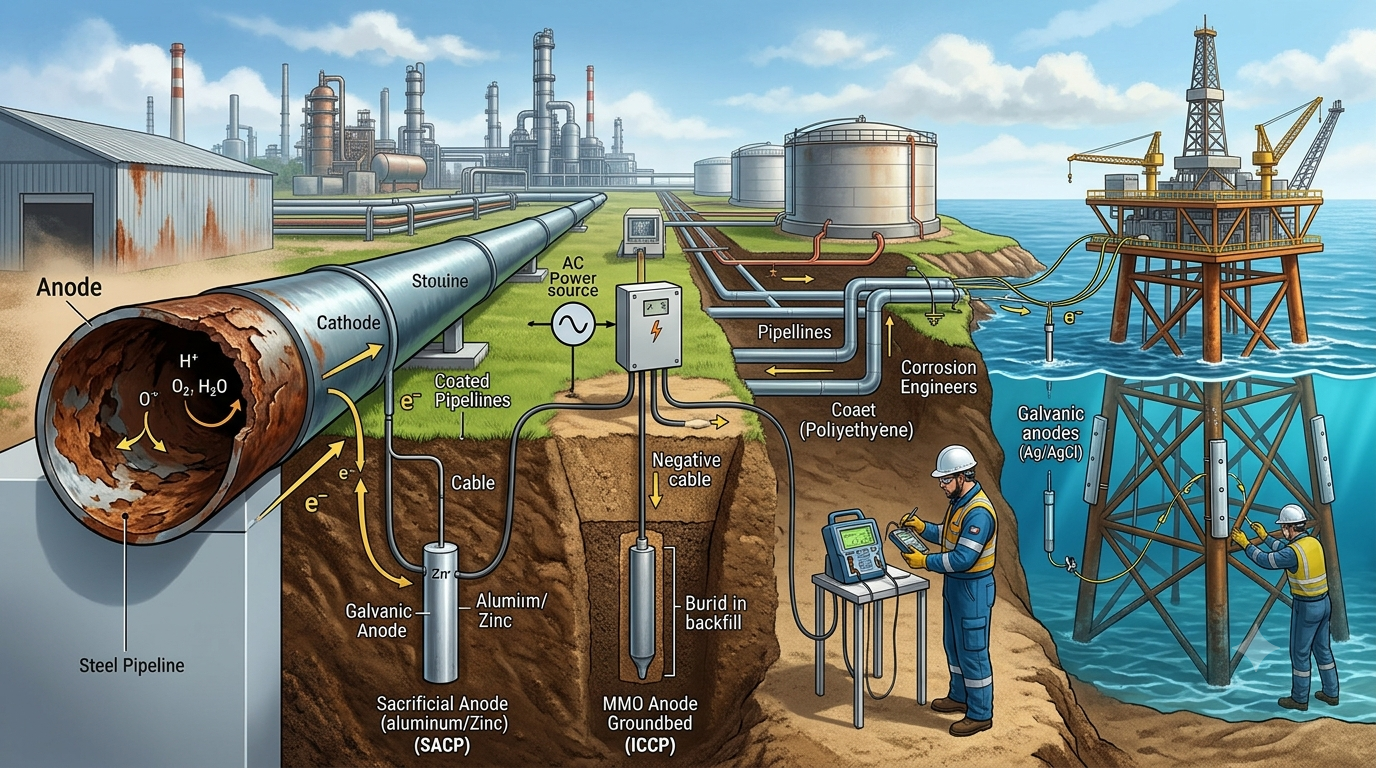
Cathodic protection systems are generally divided into two main categories: sacrificial anode systems and impressed current systems.
1. Sacrificial Anode Cathodic Protection (SACP)
Sacrificial anode cathodic protection uses a more electrochemically active metal connected to the structure that needs protection.
Common sacrificial anode materials include magnesium, zinc, and aluminium alloys.
The anode corrodes preferentially and releases electrons. These electrons flow towards the protected metal structure, making it the cathode and reducing its corrosion rate.
Key features:
Does not require an external electrical power supply.
Has a relatively simple installation arrangement.
Requires periodic inspection and anode replacement.
Suitable for smaller structures and applications with lower current requirements.
This method is commonly used for water heaters, underground pipelines, marine equipment, and storage tanks.
2. Impressed Current Cathodic Protection (ICCP)
Impressed current cathodic protection uses an external DC power source to supply protective current to a metal structure.
The system generally consists of a rectifier, anode groundbed, electrical cables, and the protected structure.
The rectifier converts alternating current (AC) into direct current (DC). The DC current is supplied through relatively inert anodes and flows through the electrolyte towards the protected structure.
Key features:
Suitable for large structures and long-distance pipelines.
Protective current can be adjusted according to requirements.
Can provide higher current output than sacrificial anode systems.
Requires electrical power and regular monitoring.
ICCP systems are widely used in large storage tanks, offshore structures, underground pipelines, and industrial facilities.
Important Components of a Cathodic Protection System
A cathodic protection installation consists of several components that work together to control corrosion.
1. Anodes: Anodes supply protective current to the metal structure. They may be sacrificial metals or relatively inert materials used in impressed current systems.
2. Cathode: The cathode is the metallic structure being protected, such as a pipeline, storage tank, or ship hull.
3. Electrolyte: An electrolyte is a medium that conducts electricity through the movement of ions. Soil, seawater, and groundwater can act as electrolytes.
4. Electrical Connections: Cables and connections provide a path for electron flow between the anode, power source, and protected structure.
5. Reference Electrodes: These electrodes help measure the electrical potential of the protected structure and determine whether the system is providing sufficient protection.
6. Rectifier: In impressed current systems, a rectifier converts AC power into DC power and controls the current supplied to the protection system.
Factors Affecting Cathodic Protection Performance
The performance of a cathodic protection system depends on several environmental and engineering factors.
Soil and Water Resistivity: Low-resistivity environments allow electrical current to flow more easily, while high-resistivity environments can increase system resistance.
Temperature: Temperature changes can influence electrochemical reactions and corrosion rates.
Protective Coatings: Paints and specialised coatings reduce direct contact between metal surfaces and corrosive environments, lowering current requirements.
Anode Material: The selection of anode material affects current output, consumption rate, and system operating life.
Structure Size: Large pipelines and storage tanks generally require more protective current than smaller metallic components.
Environmental Conditions: Salinity, moisture, dissolved oxygen, and chemical composition influence corrosion activity and protection requirements.
Engineers evaluate these factors before selecting and designing a suitable cathodic protection system.
Applications of Cathodic Protection in Different Industries
Cathodic protection is used in several industries where metallic structures are continuously exposed to corrosive environments.
1. Oil and Gas Industry
Underground pipelines, offshore platforms, subsea pipelines, and storage tanks require corrosion protection to maintain safe operations. Cathodic protection helps reduce metal deterioration and prevent leakage caused by corrosion.
2. Marine and Shipbuilding Industry
Ships, offshore structures, harbour facilities, and submerged equipment are exposed to seawater, which can accelerate corrosion. Sacrificial anodes and impressed current systems help protect these structures.
3. Water Supply and Wastewater Treatment
Water distribution pipelines, treatment plant equipment, and underground storage tanks use cathodic protection to reduce corrosion and extend their operating life.
4. Construction and Infrastructure
Steel reinforcement in concrete structures, bridges, foundations, and underground metallic components can experience corrosion due to moisture and chemical exposure. Cathodic protection helps improve structural durability.
5. Power Generation Industry
Power plants contain cooling water systems, underground pipelines, condensers, and storage facilities. Corrosion protection helps maintain equipment reliability and reduce unexpected maintenance requirements.
Cathodic Protection System Design and Installation
Designing an effective cathodic protection system requires a detailed engineering assessment. Engineers must consider the structure, surrounding environment, electrical requirements, and expected operating life.
The major design activities include:
Inspecting the structure and identifying areas exposed to corrosion.
Evaluating soil or water resistivity and environmental conditions.
Calculating the required protective current.
Selecting suitable sacrificial or impressed current anodes.
Determining anode quantity, placement, and spacing.
Designing electrical connections and power supply arrangements.
Installing reference electrodes and monitoring points.
Testing the system to verify its performance.
Proper installation is essential because incorrect anode positioning, poor electrical connections, or unsuitable current settings can reduce protection effectiveness.
Monitoring and Maintenance of Cathodic Protection Systems
Regular monitoring ensures that cathodic protection systems continue to perform effectively throughout their service life.
Engineers use different inspection and testing methods to evaluate system performance.
Potential Measurement: Measures the electrical potential between the protected structure and a reference electrode.
Close Interval Potential Survey (CIPS): Used mainly for buried pipelines to identify changes in protection levels along the pipeline route.
Direct Current Voltage Gradient (DCVG): Helps identify coating defects and locations where protective current may be escaping from a pipeline.
Anode Inspection: Checks sacrificial anode consumption, physical condition, and electrical connections.
Rectifier Inspection: Verifies output voltage, current, electrical connections, and operating condition in impressed current systems.
Inspection frequency depends on system design, environmental conditions, operating requirements, and applicable engineering standards.
Advantages of Cathodic Protection
Cathodic protection offers several benefits for industries operating metallic equipment and infrastructure.
Reduced Corrosion: Helps control electrochemical corrosion and minimise metal loss.
Extended Equipment Life: Protects pipelines, tanks, and other structures from premature deterioration.
Improved Safety: Reduces the risk of corrosion-related leakage and structural damage.
Lower Maintenance Costs: Helps minimise frequent repairs, replacements, and unplanned shutdowns.
Better Asset Reliability: Supports continuous operation of critical industrial infrastructure.
Long-Term Protection: When properly designed and maintained, the system can provide protection throughout the intended service life of an asset.
Limitations and Challenges of Cathodic Protection
Although cathodic protection is effective, it also has certain limitations that engineers must consider.
Sacrificial anodes gradually consume themselves and require replacement.
Impressed current systems depend on a reliable electrical power supply.
Incorrect current settings may cause overprotection and unwanted effects such as coating disbondment or hydrogen-related damage in susceptible materials.
Electrical interference from nearby structures can affect system performance.
Poor coatings and damaged electrical connections can increase current demand.
Regular inspection and specialist technical knowledge are necessary.
Cathodic protection should therefore be considered as part of a complete corrosion management strategy, often combined with protective coatings, material selection, inspection, and maintenance.
Conclusion
Cathodic protection is an important corrosion-control method that helps industries protect metallic structures from electrochemical deterioration. By controlling the electrical reactions occurring on metal surfaces, it reduces corrosion and improves the reliability of critical infrastructure.Both sacrificial anode and impressed current systems offer effective protection when selected according to environmental conditions and engineering requirements. Proper system design, installation, monitoring, and maintenance are essential for achieving long-term performance.As industries continue to invest in pipelines, offshore facilities, marine structures, and industrial infrastructure, cathodic protection remains an essential part of modern corrosion engineering and asset integrity management.
