

Article details
A chiller plant sized to exactly match a building's peak load looks efficient on paper, every piece of equipment genuinely necessary, nothing sitting idle as spare capacity. It also means a single compressor failure, a single pump failure, or routine maintenance on the wrong day can take the entire building's cooling offline. Redundancy exists specifically to prevent that outcome, and understanding how it's actually classified and implemented is what separates a plant that gracefully tolerates a failure from one where any single fault becomes a genuine emergency.
The Redundancy Classification System
Redundancy is typically described using a notation that captures how much spare capacity sits behind the actual required load, and this notation shows up constantly in plant design discussions, so understanding what each term actually means matters.
N represents the bare minimum capacity genuinely required to meet the load, with no spare capacity at all. A plant with exactly enough chiller capacity to meet peak demand, and nothing more, is an N configuration, meaning any single failure directly results in the plant being unable to meet its full load.
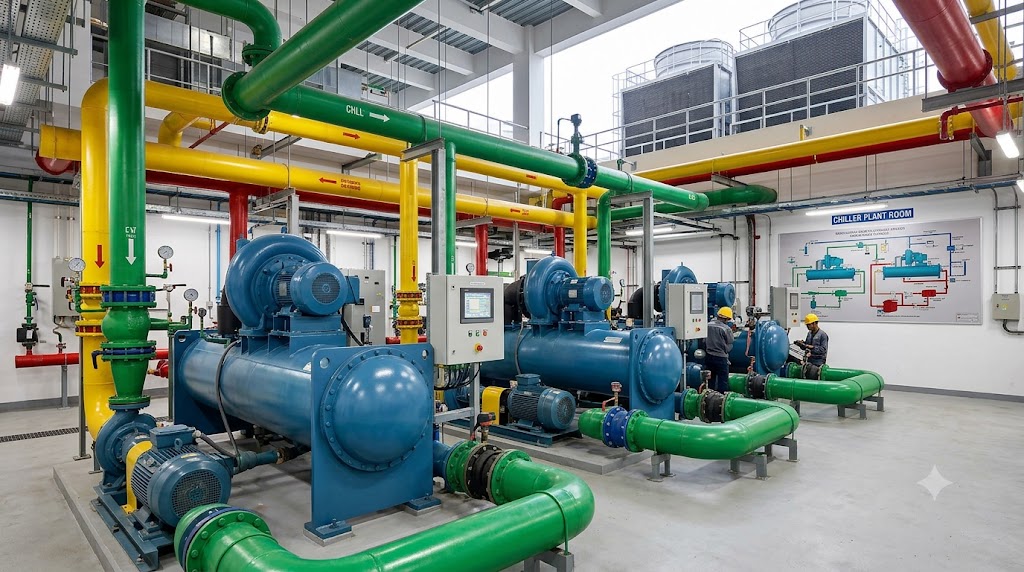
N plus 1 adds exactly one additional unit of backup capacity beyond what's minimally required. A plant with enough chillers to meet peak load, plus one additional standby chiller with similar capacity, can lose any single chiller to failure or maintenance and still meet the building's full load using the remaining units. This is widely considered the practical sweet spot for most commercial applications, covering the single most statistically likely failure scenario, one unit going down, without the considerably higher cost of fully duplicating the entire plant.
2N goes considerably further, installing a genuinely separate, fully independent second system alongside the primary one, such that a complete failure anywhere within the primary system doesn't affect the second system's ability to operate entirely on its own. This level of redundancy is generally reserved for genuinely mission critical applications, certain data centers, hospitals, and similarly high-stakes facilities, where even a brief loss of cooling carries consequences severe enough to justify the substantial additional cost.
Grouped redundancy configurations, sometimes written as a notation like four groups of N plus 1, describe an arrangement where a single shared standby unit backs up multiple separate equipment groups rather than each group having its own dedicated backup, a way of achieving meaningful redundancy across a larger plant without the cost of providing individual backup capacity for every single group independently.
Why Rotation, Not Just Standby Presence, Matters
Simply having a standby chiller or pump sitting idle, ready to activate if needed, is not actually sufficient on its own. A critical, often underappreciated detail of genuinely effective redundancy design is rotating which unit serves as lead and which serves as standby on a regular schedule, rather than always relying on the same primary unit while a separate unit sits permanently idle as backup.
This rotation accomplishes two genuinely distinct things. It prevents the specific mechanical problems that come from true inactivity, seized seals, flat spotted bearings, and motor insulation degradation are all real risks for equipment that sits completely unused for extended periods, meaning a standby unit that never actually runs can quietly become unreliable exactly when it's finally needed. And it actively verifies that the standby unit, along with its associated valves, controls, and variable frequency drives, genuinely functions correctly, catching a hidden fault during a routine, low-stakes rotation rather than discovering that same fault only during an actual emergency failure of the primary unit, when there's no longer time or margin to address it.
How Automatic Failover Actually Gets Detected and Executed
A genuinely well-designed redundant system needs to detect a failure reliably and respond automatically, without depending on a person noticing and manually intervening, particularly for failures that might occur outside normal working hours.
Failure detection commonly relies on a mismatch between what the building automation system has commanded and what it's actually observing back from the equipment, a pump commanded to run that current sensing equipment reports isn't actually drawing the expected current, for instance, is a reliable automated signal that something has genuinely gone wrong, distinct from simply assuming correct operation because a command was sent.
Once a failure is detected, a properly designed sequence disables the failed unit from automated control entirely, preventing the system from repeatedly trying to use equipment that's already proven unreliable, and starts the standby unit in its place. Critically, well designed sequences also include a path back, maintaining a start command at the originally failed unit and automatically resuming normal rotation once that unit demonstrates it has genuinely returned to normal operation, rather than requiring a manual reset before the plant can return to its normal redundancy posture.
Why Bringing a Standby Chiller Online Still Requires Careful Sequencing
Activating standby capacity isn't simply a matter of starting the backup equipment immediately the moment a failure is detected. A genuinely robust sequence checks for faults at the standby chiller, its pumps, and its valve actuators first, confirming the backup equipment is actually ready before committing to it, then proceeds through opening motorized isolation valves and starting standby pumps in a deliberate, verified order, exactly the kind of careful staging sequence covered in the low flow trip problem, where getting this order wrong can cause a startup failure of its own, defeating the entire purpose of having redundancy in the first place.
This is a genuinely important point often missed in redundancy planning, a standby unit that's present but brought online carelessly during an actual emergency can fail to start correctly or can trigger the same kind of low flow trip covered elsewhere in this series, precisely when the plant can least afford yet another failure. Redundancy capacity and redundancy sequencing are both necessary, and neither one alone is sufficient without the other.
A Genuine Design Trade Off Worth Naming
Redundancy, at any level beyond bare minimum N, carries real cost, additional equipment, additional space, additional maintenance burden for units that spend a meaningful portion of their service life not actively serving load. This connects directly back to total cost of ownership for HVAC equipment, the decision about how much redundancy a specific plant genuinely needs depends on weighing that added cost against the real, quantifiable cost of a cooling failure for that specific application, a data center or hospital facing a vastly different failure cost calculation than a typical office building, which is exactly why redundancy levels genuinely vary so considerably across different building types rather than defaulting to one universal standard.
The Practical Takeaway
Chiller plant redundancy is a genuine design decision with real, quantifiable levels, N, N plus 1, 2N, and grouped variations, each representing a different, deliberate trade-off between cost and failure tolerance. But the equipment capacity itself is only half the picture, rotation schedules that keep standby equipment genuinely ready rather than quietly degrading from disuse, reliable automated failure detection, and careful, verified sequencing when bringing standby equipment online are equally essential. A plant with impressive redundancy on paper but poor rotation practice or careless failover sequencing can still fail exactly when it matters most, which is why genuinely effective redundancy design treats capacity, rotation, and sequencing as three equally necessary parts of the same strategy, not just the equipment counts alone.