

Article details
In the study of optics, coherent sources play a pivotal role in understanding the behavior of light waves and the phenomenon of interference. Coherence refers to the property of light waves where they maintain a constant phase relationship over time. Understanding coherent sources and their behavior is essential for various applications in optics, including interferometry, holography, and telecommunications.
Superposition
The principle of superposition of waves is a fundamental concept in physics, particularly in the study of wave phenomena. It states that when two or more waves intersect or overlap in space, the resulting wave at any point is the algebraic sum of the individual wave displacements at that point. In simpler terms, the principle of superposition asserts that waves can pass through each other without being altered or destroyed, and their effects simply add together.
When multiple light waves of identical frequency and amplitude, but with a consistent phase difference, move together in the same direction and overlap, they create a light pattern where the light intensity isn't evenly spread out across space. This uneven distribution of light intensity, resulting from the combination of light waves, is termed interference.
Constructive interference is the term for interference that occurs when the intensity reaches a maximum. In this instance, one wave's crest meets another wave's crest and one wave's trough meets another wave's trough.

Destructive interference is the term for interference that occurs when the intensity is at its lowest. In this instance, one wave's crest meets another's trough, and one wave's trough meets another wave's crest.

Thus, we obtain alternating, equally-width dark and bright bands when two or more light waves interfere. Interference fringes are the name given to these bands. The interference phenomenon aligns with the principle of energy conservation.
Coherent Sources:
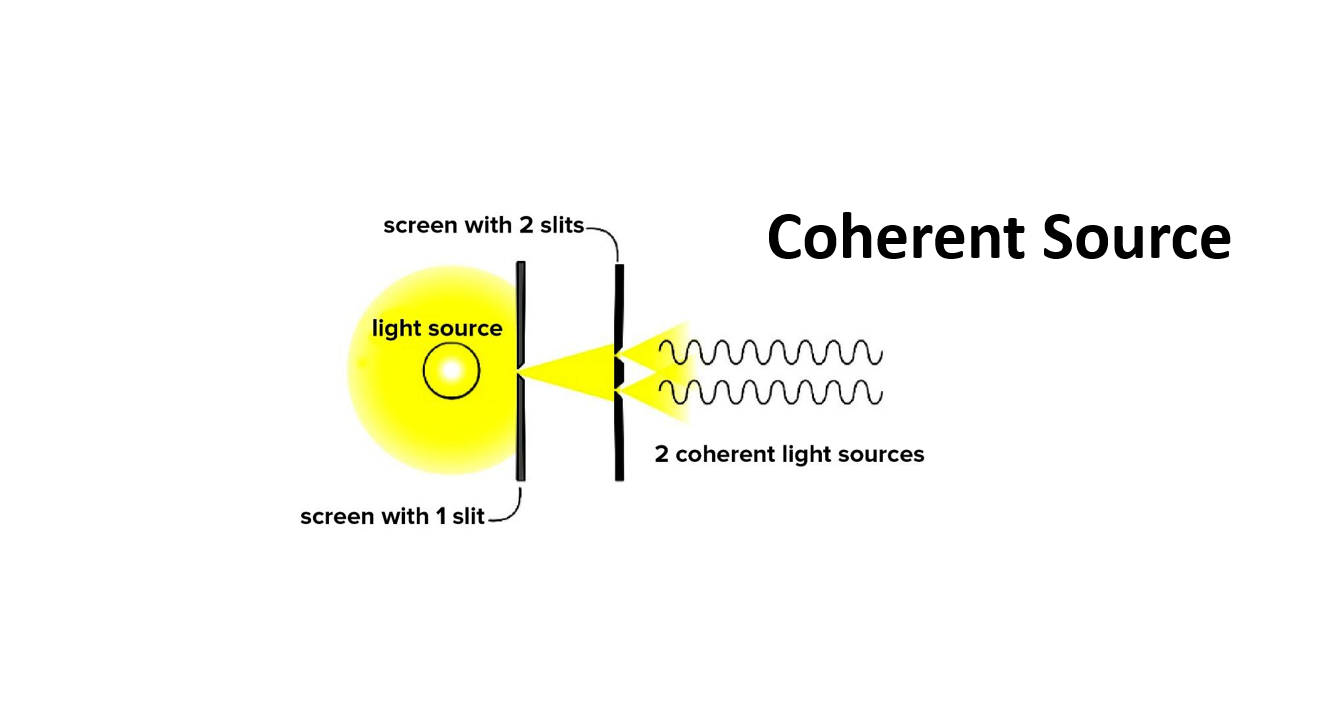
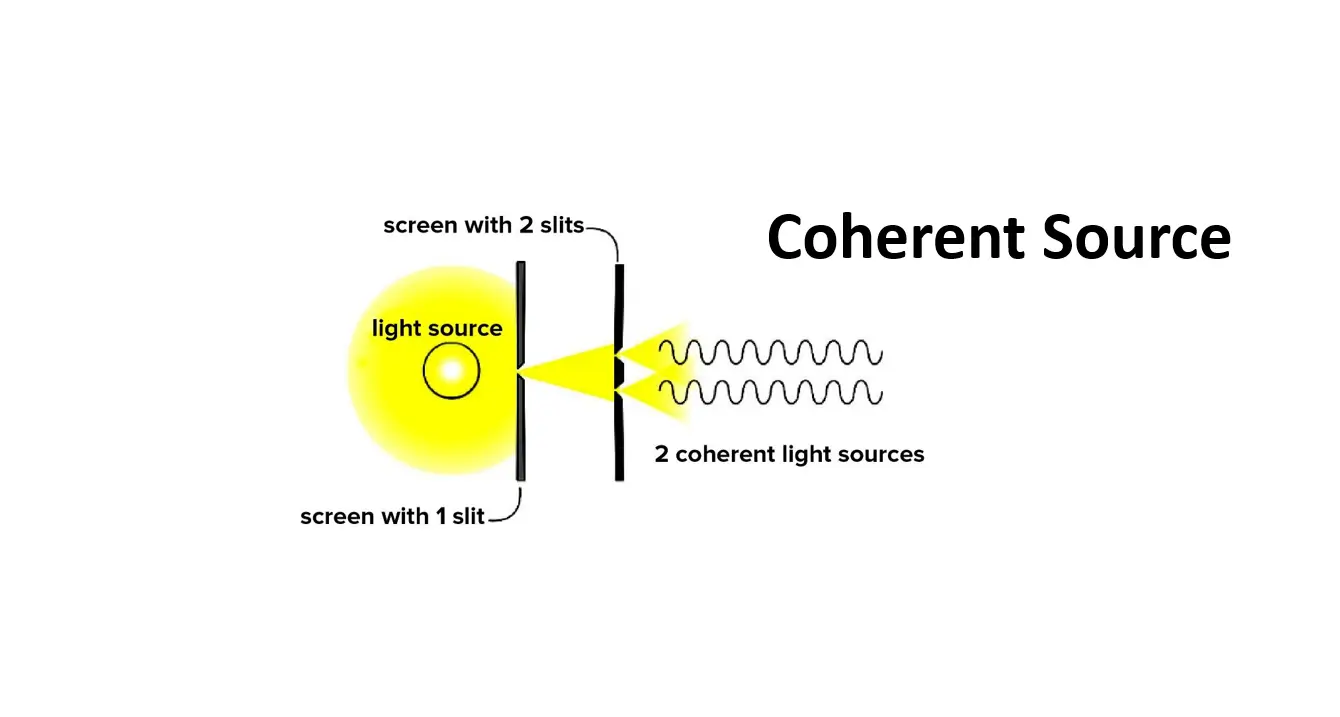
Two sources are said to be coherent if they continuously emit light waves of same wavelength, same frequency, same amplitude having zero or constant phase difference.

Ensuring that the sources' phase, amplitude, and phase difference are all the same makes coherent sources essential for interference. Because of this, interference patterns—whether constructive or destructive—can be dependable and consistent.
One crucial aspect of the concept of interference is coherence. When two or more electromagnetic waves are coherent, their phase relationships to one another are stable and predictable. Broadly speaking, the phase difference between two electromagnetic waves can fluctuate or shift over time. There are two separate ideas of coherence spatial and temporal coherence.
Temporal Coherence
Two waves are considered temporally coherent if they exhibit the same propagation characteristics at two distinct moments in time.
Spatial Coherence
Two waves are deemed to be spatially coherent if they exhibit the same propagation characteristics at various sites in space.
One classic example that demonstrates the phenomenon of coherence and interference is Young's double-slit experiment. In this experiment, a coherent light source, such as a laser, is directed at a barrier with two narrow slits. Behind the barrier, a screen records the pattern formed by the light passing through the slits.
When the slits are illuminated by coherent light, interference patterns emerge on the screen due to the superposition of waves from the two slits. Regions of constructive interference, where waves reinforce each other, produce bright fringes, while regions of destructive interference, where waves cancel each other out, result in dark fringes.

Coherent sources find numerous applications in various fields, ranging from metrology to telecommunications. In interferometry, coherent sources are used to measure small displacements, changes in length, and surface profiles with high precision. Interferometric techniques, such as Michelson interferometry, utilize coherence to analyze optical interference patterns and extract valuable information about the properties of materials and structures.
In telecommunications, coherent light sources are essential for optical communication systems, where they enable high-speed transmission of information over long distances. Coherent optical communication relies on the phase coherence of light waves to encode and decode data accurately, facilitating the transfer of vast amounts of information in fiber optic networks.


 Aug 29, 2026


