


Article details
The Compton Effect, discovered by Arthur H. Compton in 1923, is a fundamental phenomenon in quantum mechanics that provides profound insights into the nature of light and matter interaction. It describes the scattering of X-rays or gamma rays by charged particles, typically electrons, resulting in a shift in the wavelength of the incident radiation. This phenomenon played a crucial role in the development of quantum mechanics and has numerous applications in various scientific and technological fields.
Understanding the Compton Effect:
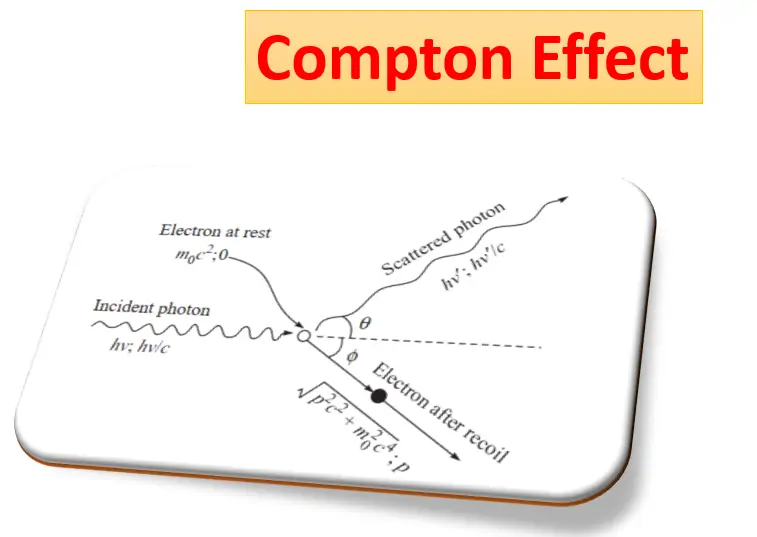
The Compton Effect arises from the interaction between electromagnetic radiation and charged particles, primarily electrons. When a high-energy photon collides with an electron, it transfers a portion of its energy and momentum to the electron, causing the photon to scatter at an angle relative to its initial direction. This process results in a change in the wavelength (or energy) of the scattered photon.
When a low atomic weight element, like carbon, scatters a monochromatic X-ray beam, it is found that the scattered X-rays, at all angles, have maximum intensities at two wavelengths: the original wavelength and a slightly longer wavelength. The wavelength shift solely depends on the scattering angle and is unaffected by the incident beam's wavelength and the scattering material. The name of this phenomenon is called as Compton effect.

Using Planck and Einstein's quantum theory of radiation, Compton was able to explain this occurrence. He thought of the incident X-rays as a stream of photons, each with momentum ℎ𝜈⁄𝑐 and energy ℎ𝜈. The scattering process is viewed as an elastic collision between an originally at rest "free" electron and a photon. A portion of the photon energy is passed to the electron which recoils after the impact. As a result, the scattered photon has a higher wavelength due to its lower frequency and smaller energy.

Let  be the electron's rest mass, p be its recoil momentum, and
  be the frequency of the scattered photon. The electron has
  energy at rest and
  energy after recoil, according to the theory of relativity. Now, we will apply conservation of energy:


 …(1)
…(1)
Applying the conservation of momentum law both along and perpendicular to the incident photon's direction:

And

Now, rearranging the above equations:


Now, taking the square of the above two equations and adding them up:


Comparing the above equation and equation 1, we have:

 …(2)
…(2)
Now, write the above equation in terms of wavelength:


The aforementioned formula demonstrates that the Compton shift in wavelength only depends on the scattering angle and is independent of the incident photon's wavelength (or energy). The Compton wavelength of the electron is denoted by the quantity  . Its value is 0.0242 Å.
Compton Scattering in Medical Imaging:
One prominent application of the Compton Effect is in medical imaging techniques such as Computed Tomography (CT) scans. In CT imaging, X-ray photons are directed towards the patient's body, where they interact with the tissues and organs. Some of these photons undergo Compton scattering when they collide with electrons within the patient's body.
By analyzing the scattered X-ray photons, radiologists can reconstruct detailed images of the internal structures, allowing for the detection of abnormalities, tumors, and other medical conditions. The intensity and direction of the scattered photons provide valuable information about the density and composition of the tissues being examined, enabling accurate diagnosis and treatment planning.
Moreover, advancements in CT technology have led to the development of dual-energy CT, which utilizes the Compton Effect to distinguish between different materials based on their energy-dependent attenuation properties. This allows for improved tissue characterization and enhanced diagnostic capabilities, particularly in the detection of contrast agents and foreign objects within the body.


 Aug 29, 2026


