

Article details
Introduction to Coulomb’s Law
Coulomb’s law is a fundamental principle of electrostatics that explains the force of attraction or repulsion between two electrically charged objects. It helps engineers and students understand how electric charges interact and how these interactions influence electrical systems.
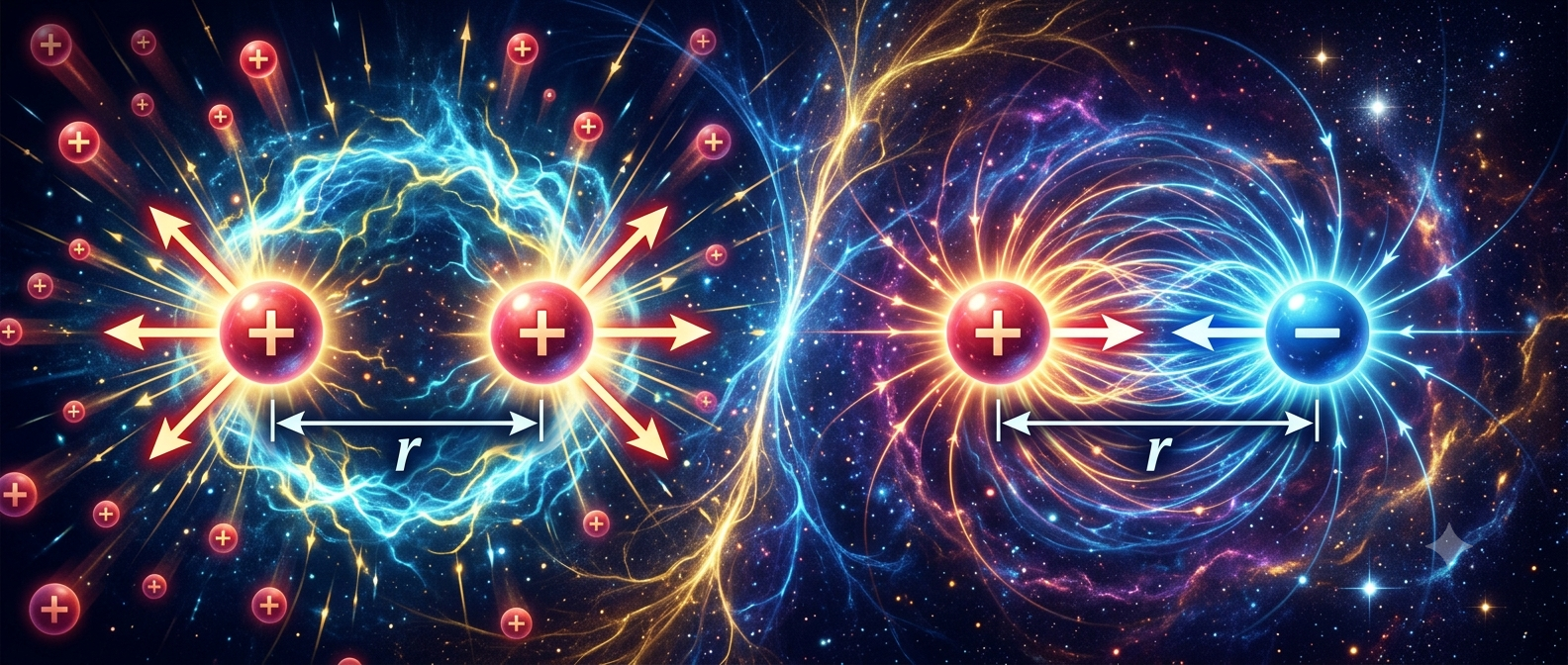
The law states that the electrostatic force between two point charges depends on the magnitude of the charges and the distance separating them. Like charges repel each other, while opposite charges attract each other. This principle is essential in electrical engineering, electronics, physics, and the design of electrostatic devices.
What Is Coulomb’s Law?
Coulomb’s law describes the relationship between electric charge, distance, and electrostatic force. When two charged objects are placed near each other, they exert forces on one another, even without direct physical contact.
The strength of this force increases when the charges become larger and decreases as the distance between them increases. The law is most directly applied to point charges or objects whose dimensions are small compared with the distance between them.
Coulomb’s Law Formula
The magnitude of the electrostatic force is calculated using the following formula:
\[ F=k\frac{|q_1q_2|}{r^2} \]
Where:
\(F\) = Electrostatic force, measured in newtons (N)
\(q_1\) = Magnitude of the first charge, measured in coulombs (C)
\(q_2\) = Magnitude of the second charge, measured in coulombs (C)
\(r\) = Distance between the charges, measured in metres (m)
\(k\) = Coulomb’s constant, approximately \(8.99\times10^9\ \text{N·m}^2/\text{C}^2\) in a vacuum
The formula calculates the magnitude of the force. The signs of the charges determine whether the force is attractive or repulsive.
Key Principles of Coulomb’s Law
1. Attraction and Repulsion
The direction of the electrostatic force depends on the signs of the charges. Two positive charges or two negative charges repel each other. A positive charge and a negative charge attract each other.
2. Relationship Between Charge and Force
The electrostatic force is directly proportional to the product of the two charge magnitudes. If one charge doubles while the distance remains constant, the force doubles. If both charges double, the force becomes four times greater.
3. Effect of Distance
Coulomb’s law follows the inverse-square relationship. When the distance between two charges doubles, the force decreases to one-fourth of its original value. If the distance triples, the force becomes one-ninth of its original value.
Example Calculation of Coulomb’s Law
Consider two positive charges of \(2\,\mu C\) and \(3\,\mu C\), separated by a distance of \(0.3\,m\) in a vacuum.
Using Coulomb’s law:
\[ F=8.99\times10^9 \frac{(2\times10^{-6})(3\times10^{-6})}{(0.3)^2} \]
The calculated force is approximately:
\[ F=0.60\,N \]
Since both charges are positive, the force is repulsive. Each charge pushes the other away with an equal magnitude of force in the opposite direction.
Applications of Coulomb’s Law
Coulomb’s law has several practical applications in science and engineering.
Electrical engineering: Helps explain electric charge interactions in electrical components and electrostatic systems.
Electronics: Supports the study of charge behaviour in capacitors, semiconductors, and electronic devices.
Electrostatic painting: Helps explain how charged paint particles are attracted to oppositely charged or grounded surfaces.
Photocopiers and laser printers: Explains the electrostatic attraction involved in transferring toner particles to paper.
Scientific research: Provides a foundation for studying electric fields, atomic structures, and interactions between charged particles.
Limitations of Coulomb’s Law
Coulomb’s law is most straightforward to apply to stationary point charges in a vacuum. It can also be applied to suitable symmetric charge distributions and approximately to small charged objects when their dimensions are much smaller than their separation.
In materials other than a vacuum, the force depends on the electrical properties of the surrounding medium. For moving charges, magnetic effects and the broader principles of electromagnetism may also need to be considered.
