

Article details
What Cryogenic Storage Tanks Are Used For
Cryogenic storage tanks are designed to store fluids at extremely low temperatures, typically below the boiling point of liquefied gases such as nitrogen, oxygen, argon, hydrogen, and liquefied natural gas (LNG). At these temperatures, ordinary materials and conventional tank arrangements behave very differently, so cryogenic service requires specialised design methods.
These tanks are widely used in industrial gas plants, LNG terminals, chemical processing facilities, laboratories, aerospace systems, hospitals, and energy infrastructure. The main engineering challenge is keeping the stored product cold while safely managing heat entering the system from the surrounding environment.
Most cryogenic tanks are either:
- Pressurised tanks for storing liquid gases at controlled pressures
- Atmospheric or low-pressure tanks for large-volume bulk storage
- Transport vessels mounted on trailers, ships, or railcars
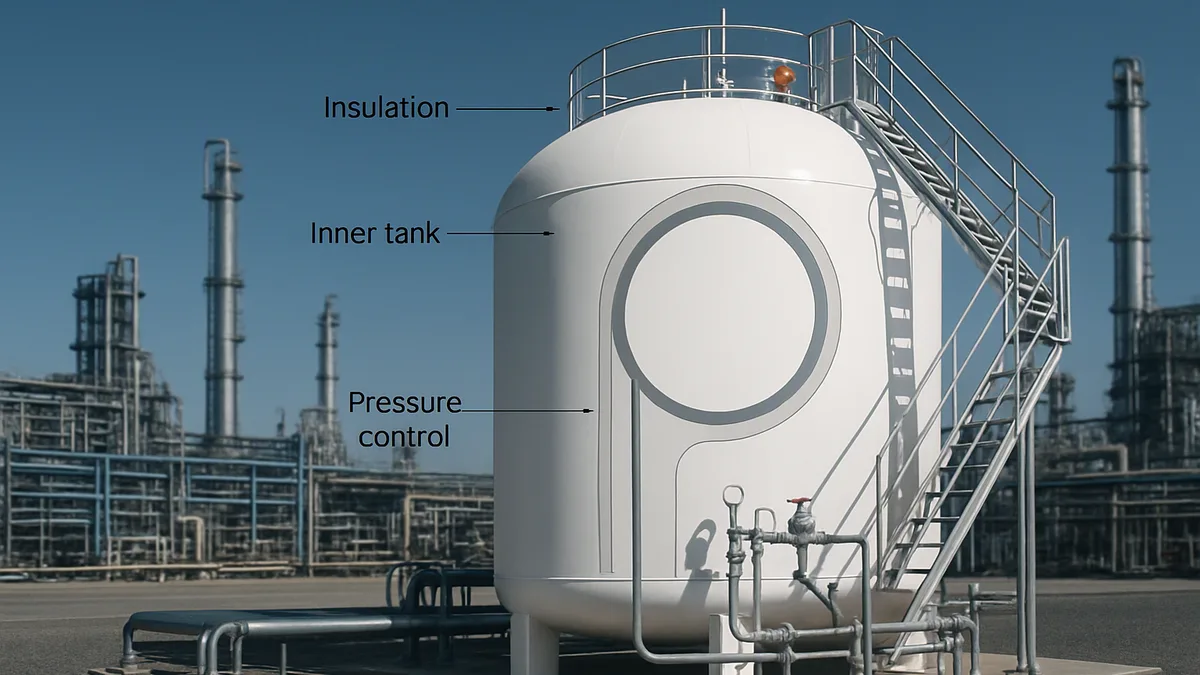
A typical cryogenic storage tank uses a double-wall construction. The inner vessel contains the cryogenic liquid, while the outer vessel provides structural protection and supports the insulation system. The space between the two walls is usually evacuated or filled with insulating material to minimise heat transfer.
Because cryogenic liquids expand significantly when vaporised, even small heat leaks can generate large gas volumes. That makes thermal performance, pressure control, and safety systems central parts of the design.
Key Design Requirements for Cryogenic Tanks
The primary design objective is to maintain the stored fluid below its boiling temperature while preserving structural integrity and safe operating pressure.
Several design requirements drive the overall tank configuration:
- Low heat ingress to reduce boil-off losses
- Mechanical strength at low temperatures
- Controlled thermal contraction and expansion
- Reliable pressure relief capability
- Safe containment during upset conditions
- Compatibility with stored fluids
Unlike ambient-temperature tanks, cryogenic vessels experience large temperature gradients during cooldown and operation. Components shrink as temperatures fall, and different materials contract at different rates. If the design does not account for these thermal strains, cracking, distortion, or support failure can occur.
Tank supports are particularly important. The supports must carry the inner vessel load while minimising heat transfer from the warmer outer shell. Designers often use low-conductivity support structures and carefully analyse contraction movements.
Another important consideration is operating pressure. Even tanks intended for low-pressure storage require pressure management because environmental heat continuously vaporises part of the liquid. This boil-off gas increases internal pressure unless it is vented, reliquefied, or consumed by the process.
Designers also evaluate filling and emptying operations carefully. Rapid cooldown can create thermal shock, while incomplete draining may trap cryogenic liquid in isolated sections. Piping arrangements, vent systems, and instrumentation all need to support controlled operation.
Engineers working on these systems often benefit from broader knowledge of pressure vessel design and process equipment design because cryogenic tanks combine structural, thermal, and process engineering requirements.
Material Selection for Low-Temperature Service
Material selection is one of the most critical parts of cryogenic tank design because many metals lose toughness and become brittle at low temperatures.
Standard carbon steels commonly used in atmospheric service may fracture suddenly in cryogenic applications. Instead, designers choose materials that retain ductility and impact resistance at the intended operating temperature.
Common cryogenic materials include:
- Austenitic stainless steels
- Aluminium alloys
- Nickel steels for certain LNG applications
Austenitic stainless steels are widely used because they maintain toughness at very low temperatures and provide good corrosion resistance. Aluminium alloys are also common due to their low density and good thermal properties.
Material selection depends on several factors:
- Minimum design temperature
- Fluid compatibility
- Weldability
- Thermal expansion behaviour
- Fabrication requirements
- Cost and availability
Welding procedures require particular attention. Weld metal and heat-affected zones must maintain low-temperature toughness comparable to the base material. Cryogenic service often requires impact testing and qualified welding procedures to demonstrate acceptable performance.
Engineers must also consider differential thermal contraction between connected components. For example, stainless steel piping attached to carbon steel structures can generate large stresses during cooldown if movement is restrained.
Good material selection engineering balances mechanical performance, fabrication practicality, corrosion resistance, and lifecycle cost rather than focusing on a single property.
Insulation Systems and Heat Leak Control
Insulation design directly affects operating efficiency because heat entering the tank causes liquid vaporisation. Lower heat leak means lower boil-off rates and reduced product losses.
Heat transfer into a cryogenic tank occurs through:
- Conduction through supports and piping
- Convection from surrounding air
- Thermal radiation from warmer surfaces
Most cryogenic tanks use double-wall construction to reduce these heat transfer mechanisms. The annular space between the inner and outer vessels may contain:
- Vacuum insulation
- Perlite insulation
- Multilayer reflective insulation
- Foam insulation in some applications
Vacuum insulation is highly effective because it greatly reduces convective heat transfer. Multilayer insulation systems use reflective surfaces to minimise radiation heat transfer. Large storage tanks may combine several insulation approaches to achieve acceptable thermal performance.
Supports and penetrations are common sources of heat leak. Even well-insulated tanks can experience significant thermal losses through piping connections, level instruments, or structural members. Designers often use thermal breaks and extended piping sections to reduce conductive heat flow.
Moisture control is another important issue. External condensation or ice formation can damage insulation systems and create corrosion problems on outer surfaces. Proper sealing and vapour barriers help prevent atmospheric moisture ingress.
Insulation performance is usually evaluated in terms of allowable boil-off rate. The acceptable rate depends on product value, operating philosophy, and whether boil-off gas can be recovered or used elsewhere in the process.
Pressure Management and Boil-Off Gas Handling
Even with excellent insulation, some heat enters every cryogenic tank. That heat vaporises part of the liquid inventory and generates boil-off gas.
If pressure rises without control, the tank can exceed its allowable operating limits. Pressure management systems therefore play a central role in cryogenic storage design.
Typical pressure control methods include:
- Pressure relief valves
- Boil-off gas compressors
- Vapour recovery systems
- Pressure-building circuits
- Controlled venting systems
Relief systems protect the tank during abnormal conditions such as fire exposure, overfilling, vacuum loss, or blocked outlets. Relief sizing must account for credible upset scenarios and expected vaporisation rates.
Some systems intentionally maintain pressure within a specified operating band. For example, pressure-building vaporizers may convert a small amount of liquid into gas to maintain delivery pressure during product withdrawal.
Large LNG facilities often recover boil-off gas instead of venting it. The gas may be compressed and returned to the process, used as fuel, or reliquefied. This improves efficiency and reduces emissions.
Vacuum conditions also require consideration. During rapid liquid withdrawal or cooldown, internal pressure can fall below atmospheric pressure. Tanks that are not designed for external pressure may buckle if vacuum protection is inadequate.
Instrumentation is essential for safe operation. Typical systems include:
- Pressure transmitters
- Temperature sensors
- Liquid level measurement
- Gas detection systems
- Emergency shutdown controls
Design Codes and Standards for Cryogenic Storage
Cryogenic storage tanks are typically designed using recognised pressure vessel and storage tank codes. The applicable standard depends on tank size, pressure, fluid type, and jurisdiction.
Commonly applied standards may cover:
- Pressure vessel design rules
- Material qualification requirements
- Low-temperature impact testing
- Relief system sizing
- Welding and inspection procedures
- Storage tank construction
Design codes establish minimum requirements for safety and structural integrity, but engineers still need to apply sound judgement to thermal stresses, operational behaviour, and process integration.
For LNG storage, additional requirements often address containment systems, spill control, and hazard management because of the large stored energy and flammability concerns.
Code compliance usually involves documentation of:
- Design calculations
- Material traceability
- Welding qualifications
- Non-destructive examination results
- Pressure testing records
- Inspection reports
Projects may also require third-party review or regulatory approval depending on location and service conditions.
Safety, Inspection, and Maintenance Considerations
Cryogenic systems present hazards beyond ordinary pressure vessels. Extremely low temperatures can cause severe material embrittlement, rapid gas expansion, oxygen enrichment, and frostbite risks for personnel.
Safe design starts with hazard identification and operational planning. Engineers should evaluate potential scenarios such as:
- Loss of insulation vacuum
- Overpressure events
- External fire exposure
- Liquid leaks and spills
- Oxygen deficiency from gas release
- Brittle fracture of equipment
Facilities commonly use gas detection, emergency shutdown systems, controlled drainage areas, and ventilation systems to reduce operational risk.
Inspection programs focus on both mechanical integrity and insulation performance. Common inspection activities include checking:
- Relief valve condition
- Vacuum integrity
- External corrosion
- Support condition
- Instrumentation calibration
- Evidence of abnormal frost patterns
Abnormal icing or frost may indicate insulation failure or increased heat leak. Early detection helps prevent product losses and structural problems.
Maintenance planning must account for thermal cycling effects over the equipment lifecycle. Repeated cooldown and warmup cycles can fatigue supports, welds, and piping connections.
Process safety management is especially important where large inventories of LNG or industrial gases are stored. Strong operating procedures, training, and emergency planning reduce the likelihood and consequences of incidents. Engineers involved in these facilities may also benefit from understanding broader process safety management practices.
Cryogenic storage tank design combines pressure vessel engineering, materials science, thermal analysis, and process safety into a single system. A successful design is not only structurally sound but also thermally efficient, operable, and maintainable throughout its service life.