

Article details
Albert Einstein proposed the quantum theory of radiation in 1905 in order to explain the photoelectric effect. He also proposed the novel idea that light radiation is made up of tiny particles known as photons. Following the publication of this new theory, physicists were forced to acknowledge that radiation is both a wave and a particle. According to Albert Einstein's theory, mass and energy are related as a function of motion such that:

This is known as Matter-Energy duality.
In the early 20th century, Louis de Broglie proposed a groundbreaking idea that revolutionized our understanding of the dual nature of matter and radiation. Building upon the wave-particle duality established by quantum mechanics, de Broglie suggested that all matter, not just light, exhibits wave-like properties.
Understanding de Broglie's Concept of Matter Waves:
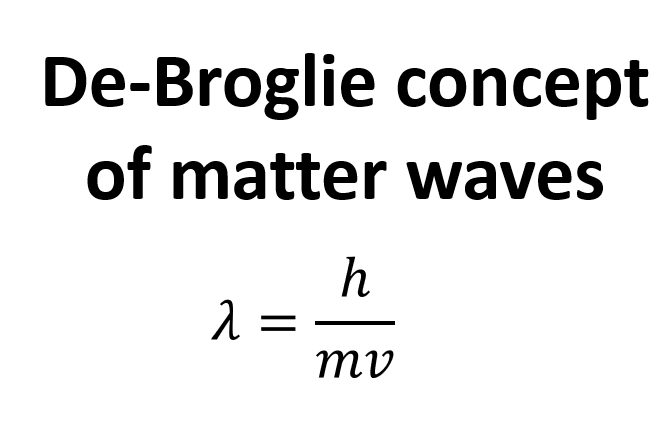
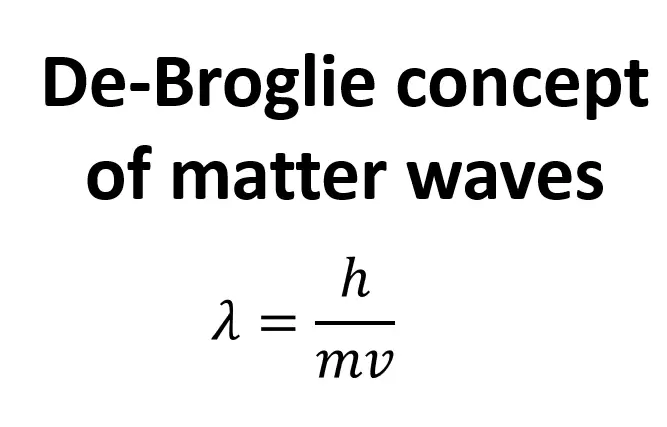
According to de Broglie, particles such as electrons, protons, and even macroscopic objects like baseballs possess wave-like characteristics in addition to their particle-like behavior. The wavelength (λ) associated with a particle is inversely proportional to its momentum (p), as expressed by the de Broglie wavelength equation:

Where:


This equation suggests that the smaller the momentum of a particle, the longer its associated wavelength. Therefore, while macroscopic objects like baseballs have extremely tiny wavelengths due to their large momentum, microscopic particles exhibit more pronounced wave-like behavior. These waves which are associated with the particle are called matter waves.
Comparing matter waves to other types of waves found in physics:
● With the exception of matter waves, every other wave found in nature can be explained by the same differential equation, known as the wave equation.
In terms of space coordinates and time coordinates, this wave equation is real and second order. Conversely, matter waves follow the complex Schrodinger equation, which is first order in time coordinates and second order in space coordinates.
● All waves, with the exception of matter waves, can be represented by a real mathematical function. Conversely, matter waves can typically only be explained by a complex function.
● Any wave that propagates freely in vacuum (space) can be represented as a plane wave with amplitude and phase factors. Every wave has the same phase factor, which is (𝑘𝑥 − 𝜔𝑡) in a single dimension. The phase factor has a complex effect in matter waves. Conversely, "all other waves" only include the actual phase factor function. Although the amplitude of "all other waves" can be measured since it is real, matter waves cannot generally be measured because they are complex.
● Unlike other types of waves, which originate from specific physical sources, matter waves lack a distinct physical origin. Instead, they become associated with individual particles as a result of the particle motion. It's important to note that according to Heisenberg's uncertainty principle, a particle completely at rest cannot be precisely located. In such a state, its de Broglie wavelength becomes infinite, along with its phase velocity, rendering it physically nonsensical.
● The interpretation of the absolute square of the wave function ψ (r, t), which characterizes the particle's state of motion, yields the physical meaning of these complicated matter waves. According to the interpretation, the chance of discovering the particle in a unit volume built around position
  at time t is given by


 Aug 29, 2026

