


Article details
When a structural member such as a bar, rod, or tie is subjected to an axial tensile or compressive load, it undergoes a change in length called axial deflection (elongation or shortening). This behavior is governed by linear elasticity and is fundamental to the design of columns, tie rods, bolts, cables, and structural members.
Basic Assumptions
Material is homogeneous and isotropic
Stress is within elastic limit (Hooke’s law valid)
Cross-section is uniform (unless stated)
Load is purely axial and concentric
Temperature effects are neglected
Fundamental Relations
From Hooke’s law:

Where:
(P) = axial load,
(L) = original length,
(A) = cross-sectional area,
(E) = Young’s modulus,
(\delta) = axial deflection.
Cases of Axial Deflection
1. Uniform Cross-Section, Constant Load
For a prismatic bar with constant area and load:

Elongation is directly proportional to load and length, and inversely proportional to area and stiffness.
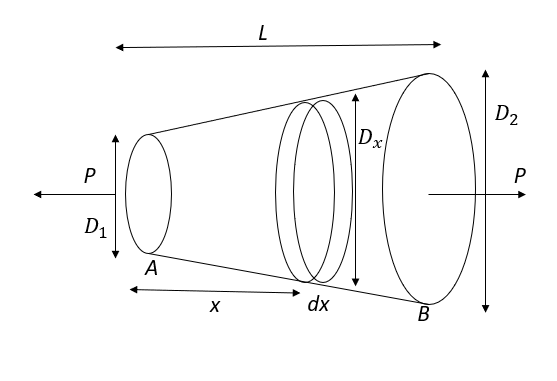
2. Bar with Varying Cross-Section
If the area varies along the length, consider a small element (dx):

This approach is used for tapered or stepped bars.
3. Stepped Bar (Different Areas)
If the bar consists of segments with different areas:

Sum the deflections of each segment.
4. Varying Axial Load
If axial load changes along the length (P(x)):

5. Effect of Self-Weight
For a vertical bar hanging under its own weight:

This deflection is independent of cross-sectional area.
6. Thermal Effect (No External Load)
If temperature changes by (\Delta T):

Where (\alpha) is the coefficient of thermal expansion.
7. Combined Load and Temperature Effect

Important Observations
Longer members experience greater deflection.
Stiffer materials (high (E)) reduce deflection.
Larger cross-sectional area reduces elongation.
Axial deflection is critical in precision assemblies and long tie members.
Engineering Applications
Tie rods and hanger rods
Bolts and fasteners under preload
Suspension cables and rods
Columns and struts under axial compression
Pipelines and drill strings