

Article details
Introduction
Dielectric strength is an important electrical property used to evaluate the performance and reliability of insulating materials. It determines how much electric field a material can withstand before it loses its insulating properties and allows electrical current to pass through it. This property is essential in designing electrical equipment, power systems, electronic devices, and industrial insulation components.
Materials such as rubber, glass, ceramics, plastics, air, and insulating oils are commonly used to prevent unwanted current flow. However, every insulating material has a limit. When the applied voltage exceeds this limit, electrical breakdown can occur, potentially damaging equipment and creating safety risks.
Understanding dielectric strength helps engineers select suitable insulation materials, improve electrical safety, and maintain reliable equipment operation.
What Is Dielectric Strength?
Dielectric strength is the maximum electric field an insulating material can withstand without experiencing electrical breakdown under specified test conditions. It is generally expressed in kilovolts per millimetre (kV/mm) or volts per metre (V/m).
When an insulating material is exposed to an electric field, its internal charges respond to the applied voltage. Under normal conditions, the material restricts the movement of free electrons and prevents significant electrical conduction.
However, when the electric field becomes too strong, the insulating material may no longer resist the movement of electrical charges. This results in electrical breakdown, which can create a conductive path through the material.
For example, air acts as an electrical insulator under normal conditions. However, when the electric field becomes sufficiently strong, air can become ionised and allow an electrical discharge to occur.
Dielectric strength is therefore a key parameter when determining whether an insulating material is suitable for a particular voltage level.
Dielectric Strength Formula
Dielectric strength can be calculated by dividing the breakdown voltage by the thickness of the insulating material.
Formula:
Dielectric Strength = Breakdown Voltage / Insulation Thickness
Where:
Breakdown Voltage: The voltage at which the material loses its insulating capability.
Insulation Thickness: The thickness of the material through which the voltage is applied.
For example, consider an insulating sheet with a thickness of 2 mm that experiences electrical breakdown at 12 kV.
Dielectric Strength = 12 kV / 2 mm
Dielectric Strength = 6 kV/mm
This value indicates the average electric field at breakdown under the specified test conditions. It should not automatically be treated as the maximum safe operating field because actual performance depends on material properties, geometry, temperature, and other environmental factors.
Factors Affecting Dielectric Strength
The dielectric strength of an insulating material depends on several physical, electrical, and environmental conditions.
1. Material Composition
Different materials have different abilities to resist electrical breakdown. Their molecular structure, chemical composition, and internal bonding influence how they respond to an applied electric field.
Materials such as ceramics, glass, polymers, and specialised insulating films are used in different applications because their electrical properties vary. Engineers must select materials according to the required voltage rating, operating conditions, and equipment design.
2. Thickness of the Insulating Material
The thickness of an insulating material influences the voltage it can withstand before breakdown. In many practical situations, a thicker insulation layer can withstand a higher total voltage.
However, dielectric strength is not always constant across different thicknesses. Defects, material structure, electrode geometry, and test conditions can affect the measured value.
Therefore, insulation thickness and dielectric strength should be evaluated together when designing electrical systems.
3. Temperature
Temperature can significantly affect the electrical performance of insulation. High temperatures may change the molecular structure, increase electrical conductivity, accelerate ageing, or weaken the material.
Some insulating materials maintain their properties over a wide temperature range, while others deteriorate more quickly under thermal stress.
Engineers should consider both normal operating temperatures and temporary temperature increases when selecting insulation for motors, transformers, cables, and other electrical equipment.
4. Moisture and Humidity
Moisture can reduce the insulating performance of many materials, particularly when water enters pores, cracks, or surface defects. Contamination on the surface may also create conductive paths.
This is especially important in outdoor electrical installations, humid industrial environments, and equipment exposed to water or condensation.
Suitable material selection, sealing, drying, and regular inspection can help maintain insulation performance.
5. Impurities and Material Defects
Air bubbles, cracks, dust, foreign particles, and manufacturing defects can create local areas of high electric field intensity. These regions may experience partial discharge or breakdown before the surrounding material reaches its expected electrical limit.
High-quality manufacturing, proper handling, and inspection are important for maintaining consistent dielectric performance.
6. Frequency and Duration of Applied Voltage
The frequency and duration of the applied voltage can influence dielectric behaviour. Materials may respond differently to direct current, alternating current, and impulse voltages.
Prolonged electrical stress can also contribute to insulation ageing. Consequently, a material that performs well during a short laboratory test may behave differently under continuous service conditions.
7. Electrode Shape and Test Conditions
The geometry and surface condition of electrodes affect the electric field distribution inside and around the insulating material. Sharp edges can concentrate the electric field and cause breakdown at lower applied voltages than expected.
Testing conditions, including electrode spacing, voltage application rate, sample preparation, and ambient conditions, must therefore be controlled to obtain meaningful results.
How Is Dielectric Strength Measured?
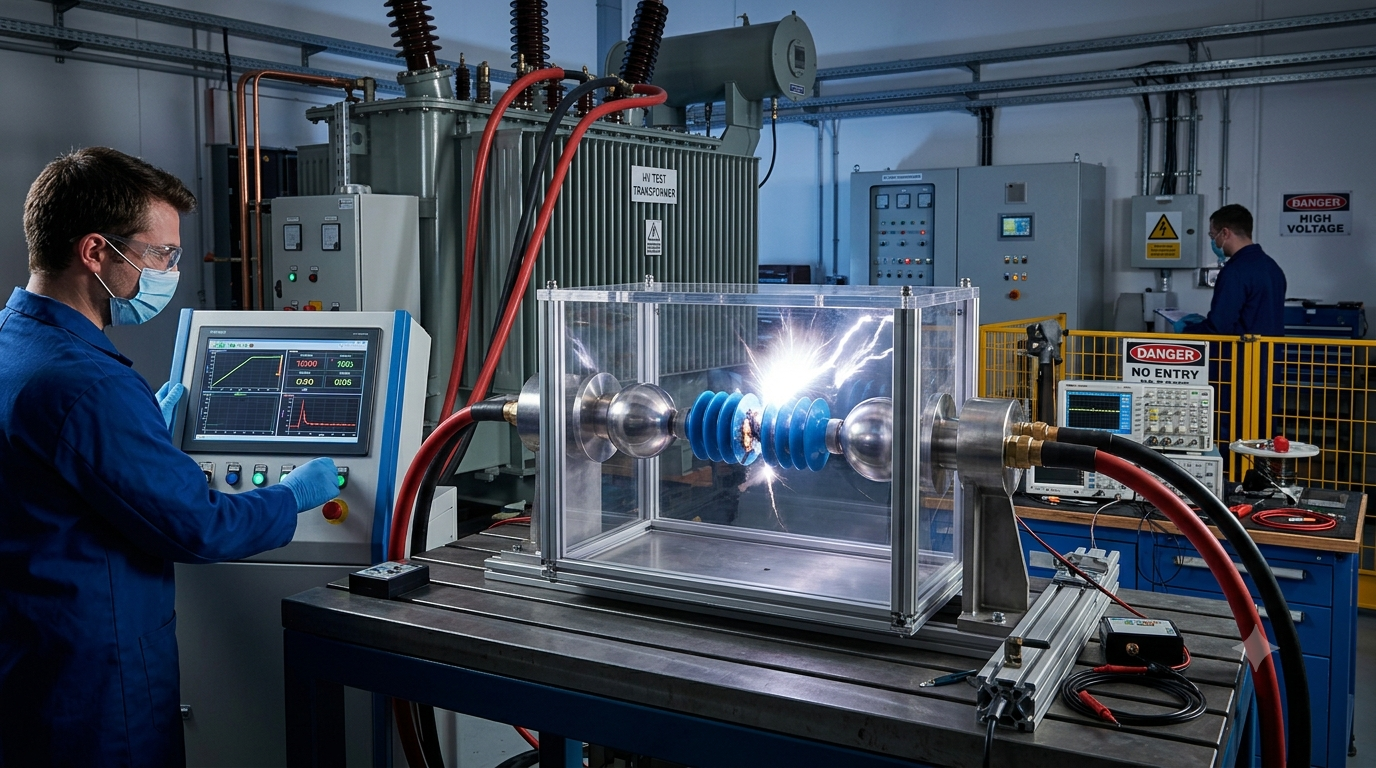
Dielectric strength is commonly determined through a controlled high-voltage test. A sample of the insulating material is placed between electrodes, and an electrical voltage is gradually applied until breakdown occurs or a specified test endpoint is reached.
The breakdown voltage and sample thickness are then used to calculate the dielectric strength.
Step 1: Prepare the Sample
The insulating material is prepared according to the applicable test procedure. Its dimensions, thickness, surface condition, and cleanliness are checked.
Step 2: Position the Electrodes
The sample is placed between suitable electrodes. Correct positioning helps produce a consistent electric field and reduces the influence of unintended gaps or irregularities.
Step 3: Apply the Voltage
A controlled voltage is applied and increased according to the selected testing standard. The test equipment monitors the electrical response of the material.
Step 4: Identify Breakdown
The test continues until electrical breakdown occurs or the specified endpoint is reached. The recorded voltage is used to evaluate the material's electrical withstand capability.
Step 5: Calculate and Record the Result
The breakdown voltage is divided by the specimen thickness to determine the dielectric strength. Multiple samples may be tested to account for variations in material quality.
Testing must be performed using appropriately rated equipment, protective enclosures, and established high-voltage safety procedures.
Dielectric Strength vs. Dielectric Constant
Dielectric strength and dielectric constant are related to electrical insulation, but they describe different properties.
Dielectric strength indicates the electric field a material can withstand before electrical breakdown.
Dielectric constant, also known as relative permittivity, describes how a material affects the electric field and the amount of electrical energy that can be stored in an electric field compared with a vacuum.
A material with a high dielectric constant does not necessarily have high dielectric strength. Engineers must consider both properties when designing capacitors, electrical insulation systems, and electronic components.
Applications of Dielectric Strength
Dielectric strength plays an important role in numerous electrical and industrial applications.
Power Cables and Electrical Wiring
Insulation around conductors prevents current leakage, short circuits, and accidental contact. Dielectric strength helps engineers determine whether cable insulation is appropriate for the intended voltage and operating environment.
Transformers
Transformers use solid insulation and, in many designs, insulating liquids to separate electrically active components. Reliable dielectric performance helps prevent internal breakdown and supports safe power transmission.
Capacitors
Capacitors store electrical energy using an insulating layer between conductive electrodes. The dielectric strength of this layer helps determine the maximum voltage the capacitor can safely withstand.
Electric Motors and Generators
Winding insulation separates adjacent conductors and prevents electrical faults. Adequate dielectric strength is necessary for reliable operation under electrical and thermal stress.
Electronic Devices and Printed Circuit Boards
Insulating substrates, protective coatings, and component materials help prevent unwanted current paths. Their dielectric properties are important in circuit design, especially in high-voltage and high-frequency applications.
Industrial and High-Voltage Equipment
Switchgear, bushings, insulators, and other high-voltage components depend on suitable insulating materials. Dielectric strength testing helps verify material performance and support quality-control procedures.
Why Is Dielectric Strength Important?
Dielectric strength helps engineers evaluate insulation quality, select appropriate materials, and reduce the risk of electrical failures. It also supports equipment reliability, product development, and compliance with relevant testing requirements.
Inadequate insulation can lead to short circuits, equipment damage, electrical fires, and safety hazards. Understanding dielectric strength allows designers to establish suitable insulation thicknesses and operating voltage limits while accounting for real-world conditions.
However, dielectric strength alone is not sufficient to determine the complete performance of an insulation system. Engineers must also evaluate thermal endurance, mechanical strength, moisture resistance, ageing, partial discharge, and the applicable electrical standards.
Conclusion
Dielectric strength is a fundamental property that describes the ability of an insulating material to withstand an electric field without electrical breakdown. It is influenced by material composition, thickness, temperature, moisture, defects, voltage characteristics, and testing conditions.
By measuring dielectric strength and considering other insulation properties, engineers can select appropriate materials for cables, transformers, motors, capacitors, electronic devices, and high-voltage equipment. Proper material selection and testing help improve electrical safety, extend equipment service life, and maintain reliable operation across a wide range of engineering applications.
