


Article details
Imagine an engine so powerful it doesn't even need spark plugs to start a fire. It relies entirely on brute force—squeezing air until it gets so hot it instantly ignites fuel on contact.
That is the magic of the Diesel Cycle.
While standard gasoline cars use the Otto Cycle (which relies on a spark plug to ignite a fuel-air mix), diesel engines play by a completely different set of thermodynamic rules. It’s the reason why semi-trucks, trains, and massive cargo ships rely on diesel to move the world.
Let's break down exactly how this heavy-lifting cycle works, step by step.
The Four Stages of Fire and Force
Physicists and engineers map out engine cycles using a P-V Diagram (Pressure vs. Volume). It tracks exactly what is happening to the gas inside the engine cylinder during a single power loop.
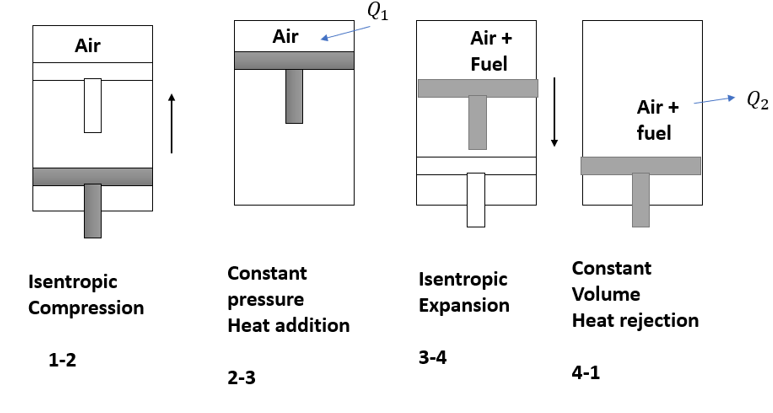
As you look at the diagram, you can trace the mechanical life cycle of a diesel engine stroke:
1. The Big Squeeze (1 → 2: Adiabatic Compression)
The piston moves upward, compressing pure air inside the cylinder. Because it happens so fast, no heat escapes (a process called adiabatic compression). By the time the piston reaches the top, the air is squeezed to about 1/20th of its original volume, skyrocketing temperatures to over 530°C (1,000°F).
2. The Controlled Explosion (2 → 3: Constant Pressure Combustion)
This is where the Diesel cycle separates itself from gasoline engines. Right at peak compression, fuel injectors spray a fine mist of diesel into the superheated air. It ignites instantly.
Because the piston begins to push downward as the fuel burns, the volume expands while the pressure stays roughly constant. On the diagram, you can see this represented by the flat horizontal line moving from point 2 to point 3.
3. Delivering the Punch (3 → 4: Adiabatic Expansion)
The fuel cut-off happens at point 3, but the hot, expanding gases keep forcing the piston down. This is the power stroke—the actual moment that turns chemical energy into the mechanical force that rotates your wheels.
4. Cleansing the Palette (4 → 1: Constant Volume Cooling)
The exhaust valve opens, and the spent heat is instantly rejected out of the system. The pressure plummets back to its baseline at a constant volume, preparing the cylinder to pull in fresh air and start the entire cycle all over again.
Why Diesel Wins on Efficiency
Have you ever wondered why diesel vehicles get significantly better mileage than their gas counterparts? It all comes down to the compression ratio.
The Rule of Thermodynamics: The tighter you can compress your working fluid before igniting it, the more thermal efficiency you get out of the fuel.
Gasoline Engines: Can only compress the air-fuel mix so much. Squeeze it too hard, and it will ignite prematurely (known as "engine knocking"), which can destroy the motor.
Diesel Engines: Squeeze only air. Because there's no fuel present during the compression stroke, diesel engines can safely reach much higher compression ratios, making them roughly 30-35% more fuel-efficient than standard gas engines.
Next time you hear the distinct, heavy rumble of a diesel engine idling, you'll know exactly what's happening inside: an elegant dance of extreme pressure, intense heat, and pure mechanical efficiency.