


Article details
To understand pressure, it helps to realize that we live at the bottom of a vast ocean of air. Whether you are inflating a car tire, checking the weather, or diving underwater, you are interacting with different ways of measuring force.
In physics and engineering, pressure is fundamentally defined as force applied per unit area:
P = F/A
Because the "starting point" for measuring this force can change depending on the context, pressure is categorized into four primary types.
1. Atmospheric Pressure (P_{atm})
Atmospheric pressure is the weight of the Earth's atmosphere pressing down on everything. The higher you go (like climbing a mountain), the less air is above you, so the pressure drops.
The Baseline: At sea level, the standard atmospheric pressure is roughly 101.325 kPa (14.7 psi, or 1 atmosphere).
Real-World Example: Your body is constantly under tons of atmospheric pressure, but you don't get crushed because your internal fluids push outward with the exact same force.
2. Absolute Pressure (P_{abs})
Absolute pressure is measured relative to a perfect vacuum—a space entirely empty of matter where the pressure is absolute zero.
The Formula: Because it includes the weight of the atmosphere, it is calculated as:
P_{abs} = P_{gauge} + P_{atm}
When it's used: Scientists, astronauts, and aerospace engineers use absolute pressure because they deal with environments outside of Earth's normal atmosphere, where baseline conditions change.
3. Gauge Pressure (P_{gauge})
Gauge pressure is measured relative to the local atmospheric pressure. It treats the air around us as "zero."
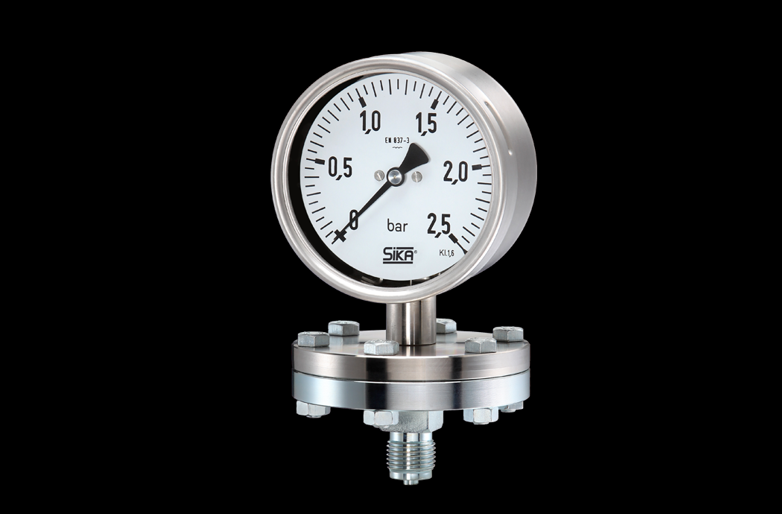
Why it matters: Most pressure gauges (like the one you use for bicycle tires) are calibrated to read zero when they are just sitting out in the open air.
Real-World Example: If your tire gauge reads 32 psi, that is gauge pressure. It means the air inside the tire is pushing out with 32 psi more force than the atmosphere is pushing in. The absolute pressure inside that tire is actually about 46.7 psi.
4. Differential Pressure (ΔP)
Differential pressure is simply the difference in pressure between two distinct points in a system. It doesn't care about a vacuum or the atmosphere; it only cares about the contrast between Point A and Point B.
When it's used: This is vital for measuring fluid flow in pipes or checking if an air filter is clogged. If the pressure before the filter is much higher than the pressure after it, you know the filter is blocked.
Summarizing the Relationships
To visualize how these reference points interact, look at how they stack up against each other:
Type of Pressure | Reference Starting Point | Common Application |
Atmospheric | Earth's sea-level air mass | Weather forecasting, meteorology |
Absolute | Perfect vacuum (Absolute 0) | Altimeters, deep space science, thermodynamics |
Gauge | Ambient atmospheric pressure | Tire pressure, blood pressure monitors, scuba tanks |
Differential | A second specific pressure point | Flow meters, HVAC filter monitoring |