

Article details
Hotels, apartment renovations, and additions to older buildings share a common problem, existing structure that was never designed with ductwork in mind, and cooling or heating needs that still have to be met without tearing the building apart. Two equipment types dominate this space, ductless mini splits and packaged terminal air conditioners, commonly called PTAC units, and while they solve the same basic problem, they arrive at genuinely different trade offs.
How Each System Is Actually Built
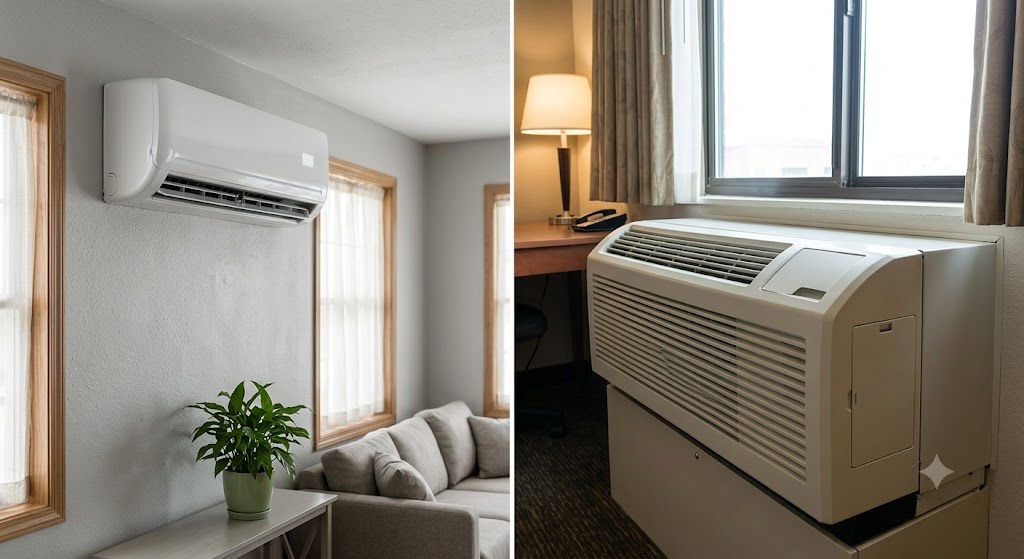
A ductless mini split separates the system into two physical pieces, an indoor unit, typically wall mounted, ceiling mounted, or recessed, and an outdoor condensing unit, connected by refrigerant piping and control wiring run through a small wall penetration. The compressor and condenser live outside, meaning the indoor unit itself is relatively quiet, since the noisiest mechanical components aren't located in the occupied space at all.
A packaged terminal unit, by contrast, houses the entire system, compressor, condenser, evaporator, and fan, in a single self contained cabinet that sits directly in the space being conditioned, typically installed through an exterior wall with the outdoor facing portion of the unit exposed directly to outdoor air. Everything needed to condition the space is contained in that one unit, with no separate outdoor component and no refrigerant piping run between indoor and outdoor sections at all.
Installation: Where the Real Trade Off Begins
This structural difference drives most of the practical trade offs between the two.
A mini split requires a wall penetration for refrigerant lines and wiring, plus a location for the outdoor unit, on a wall, roof, or ground mounted pad, and generally requires a licensed technician to properly evacuate and charge the refrigerant circuit during installation, since the refrigerant connections are made in the field rather than arriving factory sealed. This makes mini split installation more involved than a PTAC, but also considerably more flexible in where the indoor unit can actually be placed relative to the outdoor unit, useful in buildings where exterior wall access is limited or awkward for a specific room.
A PTAC unit installs into a single wall sleeve opening and is essentially self contained, arriving factory charged and requiring no field refrigerant work at all, which makes installation genuinely simpler and faster, a real advantage in large scale retrofit projects like a hotel renovating dozens or hundreds of rooms on a tight schedule. The trade off is that a PTAC has to be located directly on an exterior wall, at the specific point where the unit itself sits, with no flexibility to separate indoor comfort from outdoor equipment placement the way a mini split allows.
Noise: A Genuine, Frequently Cited Difference
Because a PTAC houses its compressor directly in the occupied space, even a well designed unit tends to be audibly noisier than a mini split's indoor unit, which contains only a fan and coil, with the compressor located outside entirely. This is one of the most frequently cited comfort differences between the two, and it matters disproportionately in hospitality applications specifically, where guest comfort and perceived quality genuinely affect satisfaction and reviews in a way that a slightly higher equipment cost for a quieter mini split can often justify.
Efficiency: Generally Favors Mini Splits, With Real Caveats
Mini split systems, particularly variable speed inverter driven models, generally achieve meaningfully higher efficiency ratings than typical PTAC units, partly because separating the compressor from the conditioned space allows for better compressor and coil design without the same tight space constraints a fully self contained PTAC cabinet imposes, and partly because inverter technology is far more commonly available in mini split product lines than in PTAC equipment.
The genuine caveat is that PTAC technology has improved considerably, and higher efficiency PTAC options do exist, so this isn't an absolute rule but a general tendency. For a large scale retrofit weighing total energy cost across many units over years of operation, this efficiency difference is a genuinely significant factor worth evaluating carefully rather than assuming based on reputation alone.
Aesthetics and Guest Experience
In hospitality specifically, a PTAC unit's presence is difficult to fully disguise, it's a visible cabinet sitting in the room, often below a window, with a noticeable grille and controls directly accessible to the guest. A mini split's indoor unit is smaller and can often be positioned less obtrusively, ceiling mounted or higher on a wall, which some hospitality operators consider a meaningful factor in overall room aesthetics and perceived room quality, separate entirely from the equipment's actual performance.
Maintenance Considerations
A PTAC's fully self contained design means service typically involves accessing or removing the single unit itself, which can sometimes be done without extensive specialized refrigeration work depending on the specific failure, and replacement is often as simple as swapping the entire cabinet unit.
A mini split's split architecture means service may require accessing both indoor and outdoor components, and any refrigerant circuit issue genuinely requires a technician qualified to work with refrigerant, though routine indoor unit maintenance, filter cleaning being the most common, is typically straightforward regardless of system type.
When Each Approach Tends to Make Sense
PTAC units tend to fit well when installation speed and simplicity across a large number of rooms is the priority, when budget constraints favor lower upfront equipment and installation cost, and when the specific noise and aesthetic trade offs are acceptable for the application.
Mini splits tend to fit well when guest or occupant comfort, noise level, and long term efficiency are higher priorities than minimizing upfront installation complexity, when exterior wall placement flexibility is genuinely needed, and when the project timeline and budget can accommodate more involved field installation work.
The Practical Takeaway
Neither system is categorically superior. A large hotel renovation on a tight schedule and tight budget, replacing outdated units room by room, often leans PTAC precisely because installation simplicity at scale outweighs the efficiency and noise advantages mini splits offer. A boutique property prioritizing guest experience, or a residential retrofit where noise and long term operating cost matter more than installation speed, often leans mini split instead. The right choice depends on which trade offs actually matter most for the specific project, not on which technology is generally considered more advanced.
EveryEng. For everyone in Engineering.