

Article details
Introduction
Electrical measurements are essential in electrical engineering, electronics, industrial maintenance, and power systems. They help engineers and technicians understand how electrical circuits operate, identify faults, and ensure equipment works safely and efficiently.
Voltage, current, resistance, and power are among the most important electrical quantities. Knowing their units, measurement methods, and basic formulas helps professionals perform accurate testing and troubleshooting.
Common Electrical Quantities and Units
1. Voltage
Voltage is the electrical potential difference between two points in a circuit. It provides the energy needed to move electric charges through a conductor.
Unit: Volt (V)
Measuring instrument: Voltmeter or digital multimeter
Application: Checking battery voltage, power supplies, and electrical equipment.
Voltage is measured by connecting the instrument in parallel with the component being tested.
2. Current
Electric current is the rate at which electric charge flows through a conductor. It helps determine how much electrical current a device or circuit consumes during operation.
Unit: Ampere (A)
Measuring instrument: Ammeter or clamp meter
Application: Checking motor current, circuit loads, and electrical consumption.
An ammeter is connected in series with the circuit, while a clamp meter can measure current without disconnecting the conductor.
3. Resistance
Resistance is the opposition offered by a material to the flow of electric current. It depends on factors such as material type, conductor length, and cross-sectional area.
Unit: Ohm (Ω)
Measuring instrument: Ohmmeter or digital multimeter
Application: Testing resistors, wiring continuity, and electrical components.
Resistance should be measured on a de-energized circuit to avoid inaccurate readings and potential instrument damage.
4. Electrical Power
Electrical power indicates how quickly electrical energy is transferred or consumed by a device.
Unit: Watt (W)
Measuring instrument: Wattmeter or power analyzer
Application: Measuring motor power, equipment consumption, and electrical system performance.
For a DC circuit, electrical power can be calculated by multiplying voltage by current.
Important Electrical Formulas
Electrical formulas help engineers calculate unknown quantities and verify measurement results.
Ohm's Law:
Voltage is equal to current multiplied by resistance.
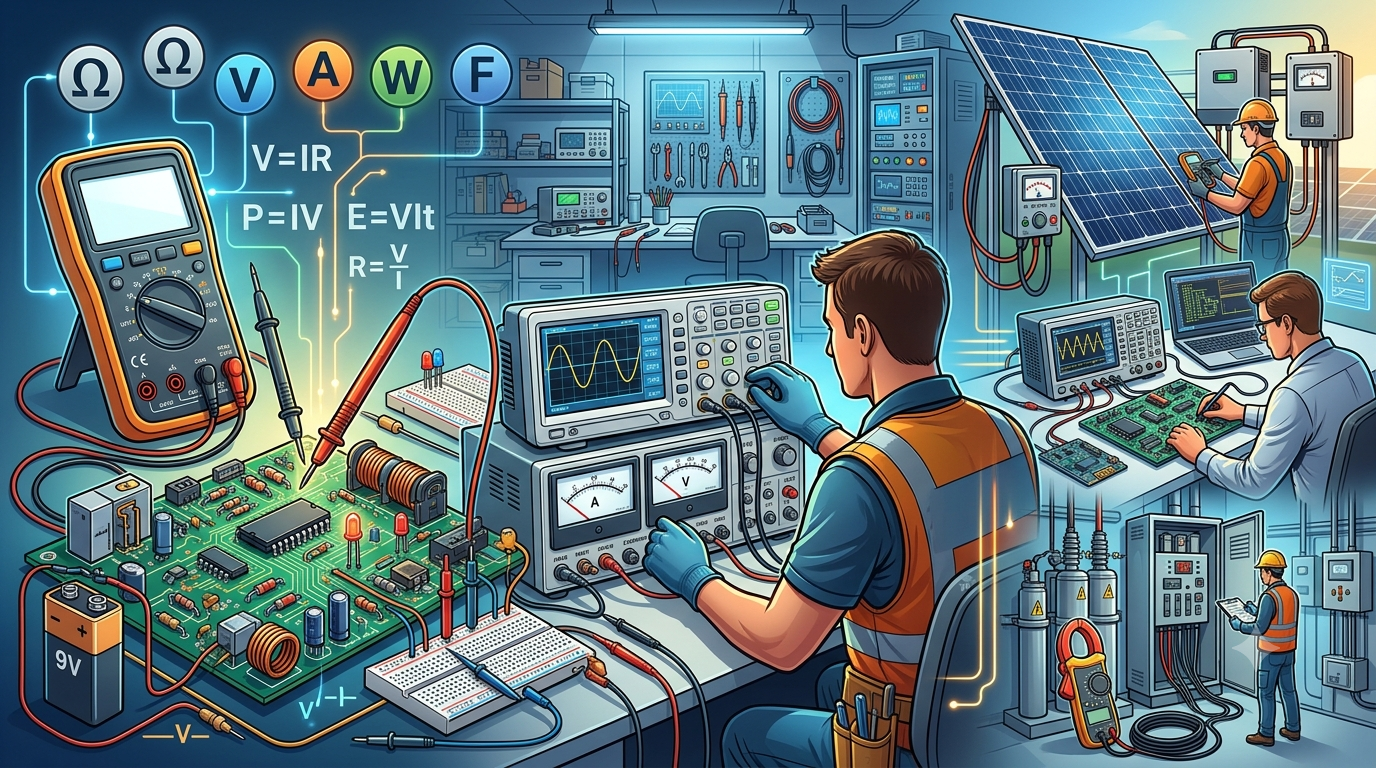
Formula: V = I × R
Current:
I = V / R
Resistance:
R = V / I
Electrical Power:
P = V × I
Where:
V = Voltage in volts
I = Current in amperes
R = Resistance in ohms
P = Power in watts
For example, if a DC circuit operates at 12 V and draws 2 A, its electrical power is 24 W.
Electrical Measuring Instruments
Different instruments are used depending on the quantity being measured and the accuracy required.
Digital multimeter: Measures voltage, current, resistance, and continuity, depending on its features.
Clamp meter: Measures current without directly opening the circuit.
Oscilloscope: Displays electrical signals and helps analyze waveform shape, frequency, and timing.
Wattmeter: Measures electrical power.
Insulation resistance tester: Checks the insulation condition of cables, motors, and other electrical equipment.
Applications of Electrical Measurements
Electrical measurements are widely used in industrial maintenance, power generation, electrical installation, electronics testing, and automation systems. They support preventive maintenance, fault diagnosis, energy monitoring, and quality control.
Accurate readings can help identify overloaded circuits, voltage variations, excessive resistance, and abnormal equipment performance before they lead to costly failures.
