

Article details
Introduction
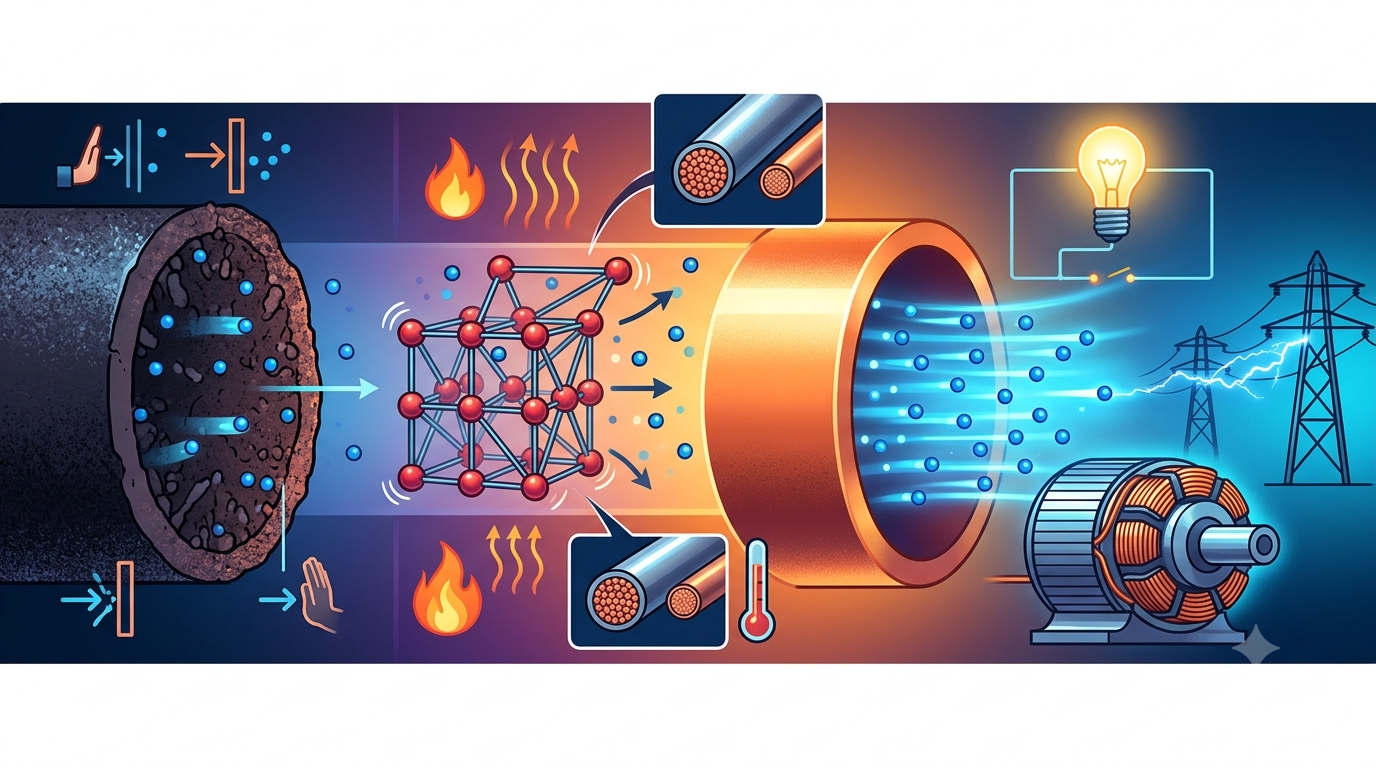
Electrical resistivity and conductivity are two important properties that explain how materials behave when electric current flows through them. These properties help engineers select suitable materials for electrical wiring, electronic components, power transmission systems, motors, generators, and industrial equipment.
Some materials, such as copper and aluminium, allow electric current to flow easily. Others, such as rubber, glass, and plastic, strongly resist the movement of electric charge. This difference is mainly related to their electrical conductivity and resistivity.
Understanding these properties is essential for designing safe, efficient, and reliable electrical systems. Temperature, material composition, and physical structure can also influence how a material conducts electricity.
What Is Electrical Resistivity?
Electrical resistivity is a material property that describes how strongly a material opposes the flow of electric current. It indicates how difficult it is for electric charges to move through a substance when an electric field is applied.
Materials with low resistivity allow current to flow easily, while materials with high resistivity restrict current flow.
For example, copper has low electrical resistivity, making it suitable for electrical cables and motor windings. Rubber has very high resistivity, which makes it useful for insulating electrical wires and protecting people from electric shock.
Formula for Electrical Resistivity
Electrical resistivity can be calculated using the following formula:
\[ \rho = \frac{RA}{L} \]
Where:
(rho) = Electrical resistivity in ohm-metres (Ω·m)
(R) = Electrical resistance in ohms (Ω)
(A) = Cross-sectional area of the conductor in square metres (m²)
(L) = Length of the conductor in metres (m)
This equation shows that resistivity is a property of the material, whereas resistance also depends on the conductor's dimensions.
For a particular material at a fixed temperature, increasing the conductor's length increases its resistance. Increasing its cross-sectional area reduces its resistance.
What Is Electrical Conductivity?
Electrical conductivity describes how easily a material allows electric current to flow through it. It is the reciprocal of electrical resistivity.
Materials with high conductivity offer less opposition to current flow. Copper, silver, gold, and aluminium are examples of conductive metals used in electrical and electronic applications.
Materials with low conductivity, such as glass, rubber, and many plastics, are commonly used as electrical insulators.
Formula for Electrical Conductivity
Electrical conductivity is represented by the Greek letter sigma (σ) and is calculated as:
[ sigma = frac{1}{rho} ]
Where:
(sigma) = Electrical conductivity in siemens per metre (S/m)
(rho) = Electrical resistivity in ohm-metres (Ω·m)
A material with low resistivity has high conductivity, while a material with high resistivity has low conductivity.
For example, copper's high conductivity makes it suitable for carrying current with relatively low energy loss. Insulating materials have very low conductivity, helping prevent unwanted current flow.
Difference Between Resistivity and Conductivity
Resistivity and conductivity describe opposite aspects of a material's electrical behaviour. Resistivity measures opposition to current flow, whereas conductivity measures the ability to carry current.
Property | Electrical Resistivity | Electrical Conductivity |
|---|---|---|
Meaning | Opposition to electric current | Ability to conduct electric current |
Symbol | \(\rho\) | \(\sigma\) |
SI unit | Ohm-metre (Ω·m) | Siemens per metre (S/m) |
Relationship | \(\rho=1/\sigma\) | \(\sigma=1/\rho\) |
High value indicates | Poor electrical conduction | Good electrical conduction |
Low value indicates | Good electrical conduction | Poor electrical conduction |
Common application | Selecting resistance and insulation materials | Selecting wires, cables, and conductors |
Both properties are important in electrical engineering because they help determine the suitability of materials for different applications.
Resistivity and Conductivity of Common Materials
Different materials have different electrical properties because of their atomic structure, available charge carriers, and chemical composition.
The following approximate values are for common materials at around 20°C.
Material | Resistivity (Ω·m) | Conductivity (S/m) |
|---|---|---|
Silver | \(1.59 \times 10^{-8}\) | \(6.29 \times 10^7\) |
Copper | \(1.68 \times 10^{-8}\) | \(5.95 \times 10^7\) |
Aluminium | \(2.65 \times 10^{-8}\) | \(3.77 \times 10^7\) |
Tungsten | \(5.60 \times 10^{-8}\) | \(1.79 \times 10^7\) |
Iron | \(9.71 \times 10^{-8}\) | \(1.03 \times 10^7\) |
Nichrome | Approximately \(1.0 \times 10^{-6}\) | Approximately \(1.0 \times 10^6\) |
Glass | Very high | Very low |
Rubber | Very high | Very low |
Note: Values are approximate and can vary with purity, alloy composition, manufacturing conditions, and temperature. The values for glass and rubber vary widely depending on the material type.
Silver has excellent electrical conductivity, but copper is widely used in electrical wiring because it offers a practical balance of conductivity, cost, and mechanical properties. Aluminium is also popular in power transmission because it is lightweight and conducts electricity effectively.
Factors Affecting Electrical Resistivity and Conductivity
Electrical resistivity and conductivity are influenced by several physical and material-related factors. Understanding these factors helps engineers predict performance under different operating conditions.
1. Temperature
Temperature significantly affects the electrical properties of materials. In most metals, resistivity increases as temperature rises. Increased atomic vibrations interfere with the movement of electrons, making current flow more difficult.
For example, copper wires generally have higher resistance when they become hot. This can increase electrical losses and affect the performance of electrical equipment.
In many semiconductors, resistivity decreases as temperature increases because additional charge carriers become available. However, the exact behaviour depends on the semiconductor material and its composition.
2. Material Composition
The chemical composition and purity of a material influence its electrical properties. Pure metals generally conduct electricity better than many of their alloys because impurities and structural irregularities interfere with electron movement.
For example, copper is an excellent conductor, while nichrome has considerably higher resistivity. Nichrome is useful in heating elements because it produces heat when electric current passes through it.
3. Length and Cross-Sectional Area
The length and cross-sectional area of a conductor affect its resistance, rather than changing its intrinsic resistivity when the material and temperature remain constant.
A longer wire has greater resistance because electrons encounter more material along their path. A thicker wire has lower resistance because it provides a larger area for current flow.
This relationship is expressed as:
\[ R=\rho\frac{L}{A} \]
Engineers use this formula when selecting cable sizes for motors, industrial machinery, electrical panels, and power distribution systems.
4. Material Structure and Impurities
The internal structure of a material influences the movement of electric charges. Defects, impurities, grain boundaries, and alloying elements can increase resistivity by interfering with charge carriers.
In semiconductors, however, carefully controlled impurities can increase conductivity by introducing additional electrons or holes. This process, known as doping, is essential for manufacturing transistors, diodes, integrated circuits, and other electronic components.
5. Physical Conditions
Pressure, mechanical strain, and changes in the physical state of a material can also affect its electrical properties. These effects are especially relevant in specialised applications such as sensors, semiconductor devices, and high-pressure equipment.
For example, strain-sensitive materials can exhibit changes in electrical resistance when stretched or compressed. This principle is used in strain gauges to measure mechanical deformation.
Temperature Coefficient of Resistivity
The temperature coefficient of resistivity describes how much a material's resistivity changes with temperature. It is represented by the symbol \(\alpha\) and is commonly expressed in per degree Celsius (°C⁻¹).
For a moderate temperature change, the resistivity of a material can be estimated using:
[ rho_T= rho_0[1+alpha(T-T_0)] ]
Where:
(rho_T) = Resistivity at the final temperature
(rho_0) = Resistivity at the reference temperature
(alpha) = Temperature coefficient of resistivity
(T) = Final temperature
(T_0\) = Reference temperature
For most metals, the temperature coefficient is positive, meaning resistivity increases with temperature. Many semiconductors exhibit a negative temperature coefficient over certain operating ranges.
This relationship is useful for calculating conductor resistance at different temperatures and estimating electrical losses in operating equipment. It is an approximation and may not be accurate across very large temperature changes.
Practical Example: Calculating Wire Resistance
Consider an aluminium wire with a length of 10 metres and a cross-sectional area of 3 mm². Assume its resistivity at the operating temperature is \(2.65 \times 10^{-8}\) Ω·m.
Using the resistance formula:
[ R=rho frac{L}{A} ]
Convert the cross-sectional area into square metres:
[ A=3 times10^{-6}\text{ m}^2 ]
Substitute the values:
[ R=frac{2.65 times10^{-8}\times10} {3times10^{-6}} ]
Therefore:
[ boxed{R approx0.0883 Omega} ]
The resistance is approximately 0.088 ohms at the assumed temperature.
If the wire becomes hotter, its resistance will generally increase. This example demonstrates how resistivity, length, and cross-sectional area work together to determine the resistance of a conductor.
Applications of Electrical Resistivity and Conductivity
These properties play an important role across several engineering industries.
Electrical Power Systems
Copper and aluminium are used in cables, busbars, transformers, and power transmission systems because of their relatively low resistivity. Selecting suitable conductors helps reduce voltage drop and energy losses.
Electronics and Semiconductor Manufacturing
Semiconductor resistivity and conductivity are controlled to manufacture electronic components. Material properties influence the performance of integrated circuits, sensors, diodes, and transistors.
Heating Equipment
Materials with relatively high resistivity, such as nichrome, are used in electric heaters, ovens, toasters, and industrial heating systems. Their resistance converts electrical energy into heat.
Electrical Insulation
Materials with high resistivity, such as suitable grades of rubber, glass, and plastic, are used to insulate conductors and reduce unwanted current flow. Proper insulation helps protect equipment and people from electrical hazards.
Industrial Testing and Quality Control
Electrical resistivity measurements can help identify material variations, assess metal purity, and monitor certain manufacturing processes. Conductivity testing is also used in material inspection and maintenance applications.
Conclusion
Electrical resistivity and conductivity are fundamental properties that determine how materials respond to electric current. Resistivity describes opposition to current flow, while conductivity indicates how easily current passes through a material. These properties are inversely related and depend on factors such as temperature, composition, impurities, and internal structure.
Understanding them helps engineers select appropriate materials for power transmission, electronic devices, heating systems, and electrical insulation. By applying the relevant formulas and considering real operating conditions, engineers can design systems that are safer, more efficient, and more reliable.
