

Article details
Introduction
A capacitor is an important electrical component used to store and release electrical energy in a circuit. It is widely used in electronic devices, power systems, communication equipment, and industrial applications. Unlike a battery, which stores energy through chemical reactions, a capacitor stores energy in the electric field created between two conductive plates.
Understanding how energy is stored in a capacitor helps engineers and students analyze electrical circuits, select suitable components, and design efficient electronic systems. The amount of energy stored depends mainly on the capacitance of the capacitor and the voltage applied across it.
What Is a Capacitor?
A capacitor is a passive electrical component consisting of two conductive plates separated by an insulating material called a dielectric. The dielectric may be made from ceramic, plastic film, mica, paper, or other insulating materials.
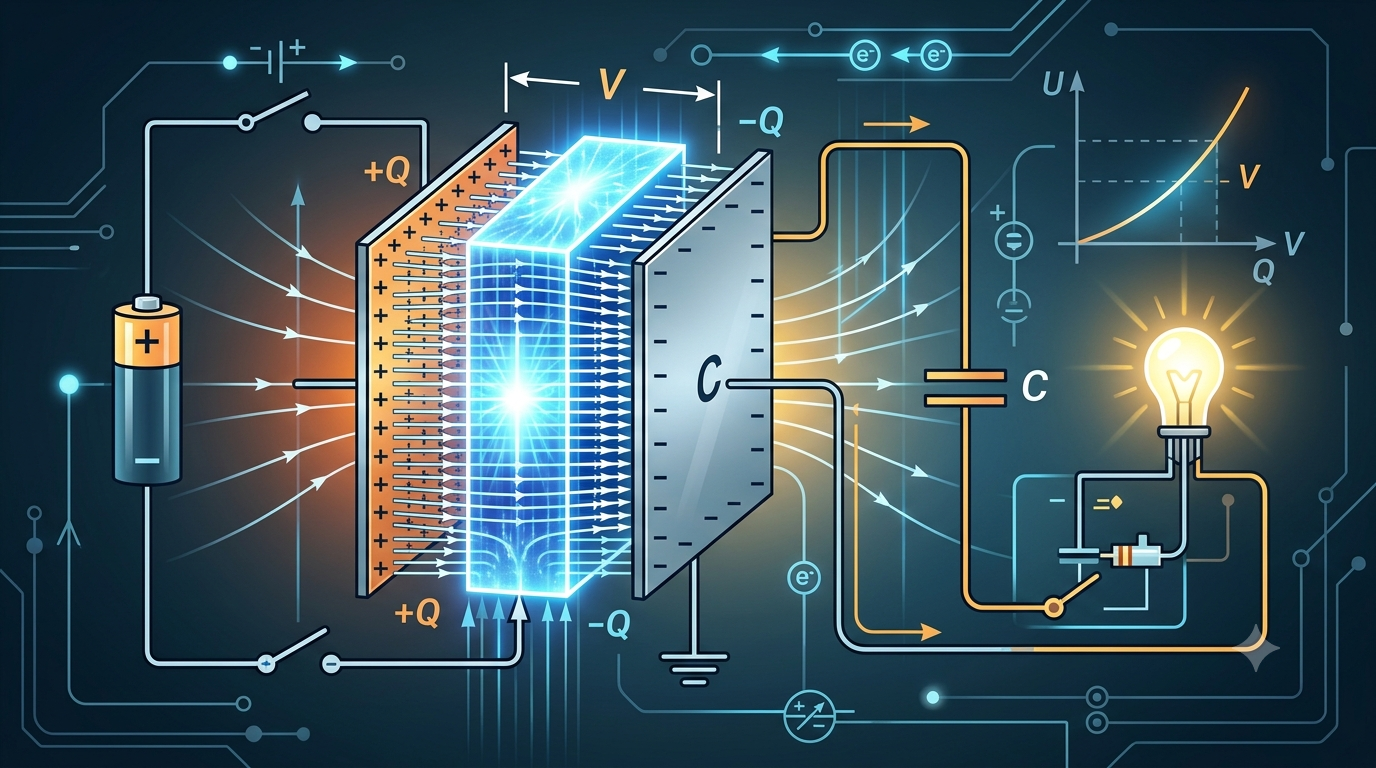
When a voltage is applied across the plates, one plate accumulates a positive charge while the other accumulates an equal negative charge. This separation of electric charges creates an electric field between the plates.
The capacitor stores energy in this electric field. When connected to a suitable circuit, it can release the stored energy and supply electrical power for a short period.
The ability of a capacitor to store electric charge is known as capacitance, measured in farads (F).
How Does a Capacitor Store Energy?
Energy storage in a capacitor takes place when an external voltage source moves electric charges from one plate to the other.
Initially, an uncharged capacitor has no significant voltage across its terminals. When connected to a power supply, electrons accumulate on one plate and are removed from the opposite plate. As charge builds up, the voltage across the capacitor increases.
The power supply must perform work to move additional charge because the growing electric field increasingly opposes further charge separation. This work is stored as electrical potential energy in the electric field.
Once the capacitor reaches the supply voltage, the charging process stops under steady-state conditions in an ideal DC circuit. The capacitor retains its charge and stored energy, provided there is no discharge path or significant leakage.
When the capacitor is connected to a load, the stored energy can flow back into the circuit. The capacitor then gradually discharges as the voltage and charge decrease.
Formula for Energy Stored in a Capacitor
The energy stored in a capacitor can be calculated using the following formula:
E = ½ CV²
Where:
E = energy stored in the capacitor, measured in joules (J)
C = capacitance, measured in farads (F)
V = voltage across the capacitor, measured in volts (V)
This equation shows that stored energy is directly proportional to capacitance and to the square of the voltage.
For example, if the voltage across a capacitor doubles while its capacitance remains constant, the stored energy increases four times. Similarly, increasing capacitance increases the amount of energy stored at the same voltage.
Alternative Energy Formulas
The energy stored in a capacitor can also be calculated using the charge stored on its plates.
E = ½ QV
Where:
Q = electric charge, measured in coulombs (C)
V = voltage across the capacitor, measured in volts (V)
Since the relationship between charge, capacitance, and voltage is Q = CV, the energy equation can also be written as:
E = Q² / 2C
These three equations describe the same stored energy. The appropriate formula depends on which quantities are known.
Example: Calculating Energy Stored in a Capacitor
Consider a capacitor with a capacitance of 100 microfarads (µF) connected to a 12 V DC supply.
Given:
Capacitance, C = 100 µF = 100 × 10⁻⁶ F
Voltage, V = 12 V
Using the formula:
E = ½ CV²
Substituting the values:
E = ½ × 100 × 10⁻⁶ × 12²
E = 0.5 × 0.0001 × 144
E = 0.0072 J
Therefore, the capacitor stores 0.0072 joules of energy, equivalent to 7.2 millijoules.
This example demonstrates how a relatively small capacitor can store a measurable amount of energy even at a low operating voltage.
Factors Affecting Energy Storage in a Capacitor
Several factors influence the amount of energy a capacitor can store.
1. Capacitance
Capacitance represents the ability of a capacitor to store electric charge at a given voltage. A capacitor with a higher capacitance stores more energy than one with a lower capacitance when both operate at the same voltage.
Capacitance depends on the plate area, the distance between the plates, and the properties of the dielectric material.
2. Applied Voltage
Voltage has a significant effect on energy storage because it is squared in the energy equation. Increasing the voltage produces a greater increase in stored energy than an equal proportional increase in capacitance.
However, the voltage must remain within the capacitor's rated limit. Exceeding this limit may cause dielectric breakdown, overheating, leakage, or component failure.
3. Dielectric Material
The dielectric separates the conductive plates and affects the capacitor's capacitance. Materials with a higher relative permittivity can increase capacitance for the same plate geometry.
The dielectric also influences insulation resistance, temperature stability, operating voltage, and energy losses. Selecting a suitable dielectric is essential for reliable capacitor performance.
4. Plate Area and Separation
For a parallel-plate capacitor, capacitance increases with plate area and decreases as the distance between the plates increases, assuming the dielectric remains unchanged.
Larger plate areas generally allow greater charge storage at a given voltage, while smaller plate spacing increases capacitance but must still satisfy insulation and voltage requirements.
Where Is Energy Stored Inside a Capacitor?
The energy of an ideal capacitor is stored in the electric field within the space between its plates, including the dielectric material when present. It is not stored simply as a collection of electrons sitting on the metal plates.
The electric field exists because the plates carry opposite charges and maintain a potential difference. The energy associated with this field can be described in terms of electric energy density.
For a linear dielectric, the energy density is expressed as:
u = ½ εE²
Where:
u = electric energy stored per unit volume
ε = permittivity of the dielectric
E = electric field strength
This relationship helps explain how energy is distributed within the electric field and is useful in the design and analysis of electrical components.
Applications of Energy Stored in Capacitors
Capacitors are used in a wide range of electrical and electronic systems because they can charge and discharge quickly.
Power Supply Filtering
Capacitors smooth voltage variations in power supplies by storing charge when voltage rises and releasing it when voltage falls. This helps reduce unwanted ripple in DC output.
Camera Flashes
Electronic camera flashes use capacitors to accumulate electrical energy and release it rapidly to produce a brief, intense flash of light.
Electric Motors
Capacitors are used in certain single-phase motors to provide starting torque or improve operating performance. Their role depends on the motor design and circuit arrangement.
Energy Storage and Power Electronics
Capacitors support short-duration energy delivery in inverters, converters, switching circuits, and other power electronic systems. Specialized capacitor banks can also help manage transient loads and voltage fluctuations.
Electronic Timing and Signal Circuits
Capacitors charge and discharge through resistors in timing circuits. This behavior is used in oscillators, pulse circuits, filters, and signal-processing applications.
Capacitors Compared with Batteries
Capacitors and batteries both store energy, but their operating principles differ. Capacitors store energy in an electric field, whereas batteries primarily store energy through electrochemical processes.
Capacitors can generally charge and discharge much faster than batteries and are useful when rapid power delivery is required. However, conventional capacitors usually store less total energy than batteries of comparable size.
Batteries are better suited to supplying energy over extended periods, while capacitors are useful for short bursts of power, voltage stabilization, and rapid energy transfer. Supercapacitors occupy an intermediate position, offering much higher capacitance than conventional capacitors.
