

Article details
Introduction
Electric vehicles (EVs) are becoming an important part of modern transportation as industries and consumers look for cleaner and more energy-efficient mobility solutions. However, understanding how electric vehicle charging works requires basic knowledge of electrical quantities such as voltage, current, power, and energy.
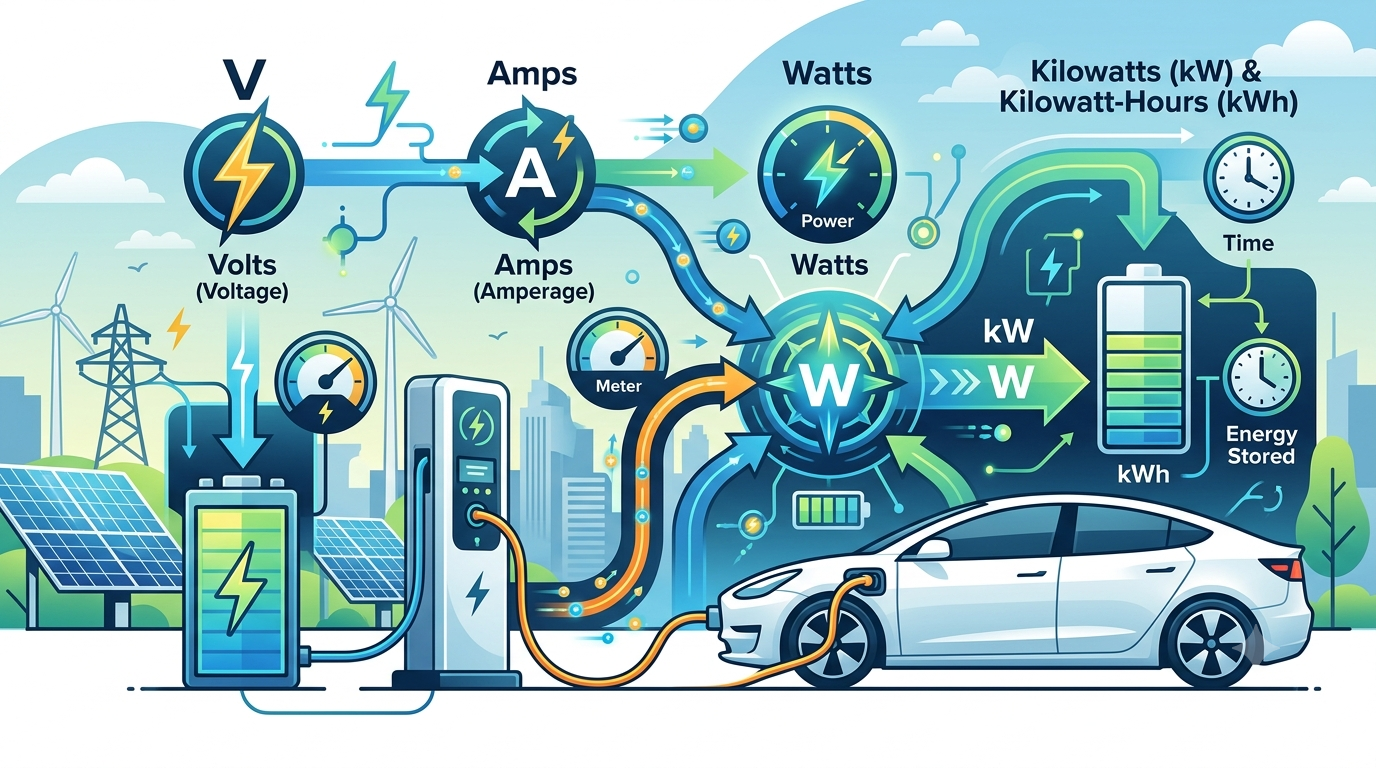
These terms are closely related, but each describes a different aspect of electricity. Voltage determines the electrical pressure that drives current, current represents the flow of electric charge, power indicates how quickly electrical energy is transferred, and energy measures the total amount of electricity consumed or stored.
Understanding these concepts helps EV owners choose suitable chargers, estimate charging times, compare charging stations, and manage electricity costs. It is also valuable for electrical engineers, technicians, EV charging infrastructure designers, and professionals involved in electric mobility.
This article explains the relationship between volts, amps, watts, kilowatts, and kilowatt-hours, along with their applications in electric vehicle charging.
What Is EV Charging Power?
EV charging power describes the rate at which electrical energy is transferred from a charging station to an electric vehicle. It is generally measured in watts (W) or kilowatts (kW).
A higher charging power can deliver more energy in a given period, potentially reducing the time required to charge an EV battery. However, the actual charging speed also depends on the vehicle's battery capacity, charging system, temperature, and maximum supported charging rate.
For example, a 7.4 kW charger can theoretically deliver more power than a 3.7 kW charger under comparable operating conditions. If the vehicle supports both charging levels, the higher-power charger can generally charge the battery faster.
EV charging power is determined primarily by voltage and current. Understanding how these quantities work together makes it easier to evaluate different charging systems.
What Is Voltage in EV Charging?
Voltage, measured in volts (V), represents the electrical potential difference between two points. It provides the electrical pressure that drives current through a circuit.
In electric vehicle charging, voltage affects how much power can be transferred at a given current.
For example, if two charging systems operate at different voltages but carry the same current, the higher-voltage system can deliver more power under the same operating conditions.
Common Charging Voltages
EV charging systems use different voltage levels depending on the charging method, vehicle design, and electrical supply.
230 V AC: Commonly used for single-phase residential charging in many countries.
400 V AC three-phase supply: Commonly used for higher-power AC charging installations in many regions.
400 V DC battery systems: Used by many electric vehicles and supported by compatible DC fast chargers.
800 V DC battery systems: Used by some EV platforms to support high-power charging and potentially reduce current for a given power level.
These values represent common examples rather than universal requirements. Actual supply voltages and vehicle battery voltages vary by country, manufacturer, and system design.
Why Voltage Matters
Voltage influences the amount of current needed to deliver a specific charging power. At a given power level, increasing voltage generally reduces the required current.
Lower current can help reduce resistive heating and electrical losses in cables and other components, provided the system is properly designed.
However, a higher voltage does not automatically mean faster charging. The vehicle, charger, battery management system, and electrical installation must all support the required operating conditions.
What Are Amps in EV Charging?
Amps, or amperes (A), are the units used to measure electrical current. Current represents the rate at which electric charge flows through a conductor.
During EV charging, current flows from the electrical supply through the charger and charging cable to the vehicle's charging system.
The amount of current affects charging power, cable requirements, and the heating produced by electrical resistance.
How Current Affects Charging
Consider two charging systems operating at 230 V.
A system supplying 10 A delivers approximately 2.3 kW under simple single-phase AC assumptions.
A system supplying 16 A delivers approximately 3.68 kW under the same assumptions.
The second system can transfer more power because it supplies a higher current at the same voltage.
These calculations assume a suitable AC supply and a power factor close to 1. Actual power may differ depending on the charging equipment and electrical conditions.
Maximum Current and Safety
EV chargers and vehicles have specified current limits. Charging equipment communicates with the vehicle and operates within the limits supported by the charging system.
The cable, connector, circuit breaker, wiring, and other electrical components must also be rated for the intended current.
Higher current can increase resistive heating, making correct cable sizing, suitable protection devices, and professional installation essential.
What Are Watts and Kilowatts?
Watts measure electrical power. One watt represents one joule of energy transferred per second.
Kilowatts are commonly used to describe EV charging power because charging systems often operate at power levels of several thousand watts.
One kilowatt equals 1,000 watts.
For example:
1,000 W = 1 kW
3,700 W = 3.7 kW
7,400 W = 7.4 kW
11,000 W = 11 kW
50,000 W = 50 kW
Charging power depends on voltage, current, and the type of electrical supply.
Power Formula for Single-Phase AC
For a single-phase AC circuit, real electrical power can be calculated using:
P = V × I × PF
Where:
P = real power in watts
V = voltage in volts
I = current in amperes
PF = power factor
If the power factor is close to 1, the formula can be approximated as:
P ≈ V × I
For example, a charger operating at 230 V and 16 A with a power factor close to 1 delivers approximately:
230 × 16 = 3,680 W
Therefore, the approximate charging power is 3.68 kW.
Power Formula for Three-Phase AC
For a balanced three-phase AC system, real power is calculated using:
P = √3 × V × I × PF
Where V is the line-to-line voltage and I is the line current.
For example, a balanced three-phase supply operating at 400 V and 16 A with a power factor of 1 provides approximately:
1.732 × 400 × 16 = 11,085 W
This is approximately 11.1 kW.
Actual EV charging power depends on the vehicle's onboard charger, the available electrical supply, and equipment limits.
DC Charging Power
For a DC charging system, power can generally be calculated using:
P = V × I
For example, a DC charging system operating at 400 V and 125 A delivers:
400 × 125 = 50,000 W
Therefore, the power is 50 kW.
In practice, DC charging power changes as the battery charges and as the vehicle's battery management system adjusts voltage and current.
What Are Kilowatt-Hours?
A kilowatt-hour (kWh) is a unit of energy. It measures the amount of electricity consumed or delivered over a period of time.
Although kilowatts and kilowatt-hours sound similar, they represent different quantities.
Kilowatt (kW): Measures the rate of energy transfer.
Kilowatt-hour (kWh): Measures the total amount of energy transferred.
For example, a charger operating at 7 kW for one hour delivers approximately 7 kWh of energy under ideal constant-power conditions.
If it operates at the same power for two hours, it delivers approximately 14 kWh.
The basic energy formula is:
Energy (kWh) = Power (kW) × Time (hours)
This formula is useful for estimating charging energy, electricity consumption, and charging costs.
Example of Energy Consumption
Suppose an EV charges at an average power of 7 kW for three hours.
Energy delivered:
7 × 3 = 21 kWh
The charging session delivers approximately 21 kWh before accounting for charging losses and other variations.
If electricity costs $0.20 per kWh, the estimated electricity cost for this amount of energy would be:
21 × $0.20 = $4.20
The actual cost depends on the electricity tariff, charging losses, and any additional charging fees.
Difference Between Volts, Amps, Watts, Kilowatts, and Kilowatt-Hours
These electrical quantities are connected, but each serves a different purpose.
Quantity | Unit | Meaning | Application in EV Charging |
|---|---|---|---|
Voltage | Volt (V) | Electrical potential difference | Determines the voltage available to the charging system |
Current | Ampere (A) | Rate of electric charge flow | Influences power transfer and cable current requirements |
Power | Watt (W) | Rate of energy transfer | Describes the instantaneous charging power |
Power | Kilowatt (kW) | 1,000 watts | Common unit for charger ratings |
Energy | Kilowatt-hour (kWh) | Energy delivered over time | Measures charging energy and battery capacity |
Understanding the distinction between power and energy is particularly important when comparing EV chargers. A charger rated at 50 kW can potentially deliver energy much faster than a 7 kW charger, but the total energy stored in the battery is measured in kWh.
How Voltage, Current, and Power Work Together
Voltage and current work together to determine electrical power. If one quantity increases while the other remains constant, power generally increases under the applicable circuit conditions.
For a simplified DC system, the relationship is:
P = V × I
This relationship helps explain why different charging systems can deliver different power levels.
For example:
200 V × 25 A = 5 kW
400 V × 25 A = 10 kW
400 V × 50 A = 20 kW
These examples illustrate the mathematical relationship between voltage, current, and power. They do not represent guaranteed charging rates for any particular vehicle.
In real EV charging, the charger and vehicle continuously regulate current and voltage according to system limits and battery conditions.
Why Higher Voltage Can Help
For the same power, a higher voltage generally allows a lower current. Lower current can reduce resistive losses in conductors because these losses increase with the square of the current.
This can be beneficial for high-power charging systems, where cable heating, conductor size, and energy efficiency are important design considerations.
Nevertheless, higher-voltage systems require suitable insulation, connectors, protective devices, and electrical safety measures.
AC Charging vs. DC Charging
Electric vehicles can be charged using alternating current (AC) or direct current (DC).
The main difference is where the conversion from AC electricity to DC electricity takes place.
AC Charging
In AC charging, electricity is supplied to the vehicle as alternating current. The vehicle's onboard charger converts this AC electricity into DC electricity suitable for the battery.
AC chargers are widely used at homes, workplaces, and locations where vehicles remain parked for several hours.
Common AC charging power levels include approximately 3.7 kW, 7.4 kW, 11 kW, and 22 kW, depending on the electrical supply and vehicle capabilities.
The actual charging power may be limited by the onboard charger even when the charging station can supply more.
DC Fast Charging
In DC fast charging, conversion takes place inside the charging station. The station supplies regulated DC electricity to the vehicle's battery system through a compatible charging interface.
DC fast chargers can deliver substantially higher power than typical residential AC chargers.
Depending on the equipment and vehicle, charging stations may offer power levels such as 50 kW, 150 kW, 250 kW, or higher.
However, the charging station's advertised rating does not guarantee that every vehicle will receive that power throughout the charging session.
Battery temperature, state of charge, vehicle limits, and charging-station capacity all influence actual performance.
Factors Affecting EV Charging Speed
The rated power of a charger is only one part of the charging process. Several factors determine how quickly an EV battery receives energy.
1. Charger Power Rating
A charger with a higher power rating can potentially transfer energy more quickly, provided the vehicle and electrical supply support it.
2. Battery Capacity
Battery capacity is measured in kilowatt-hours. A larger battery generally requires more energy to reach the same percentage increase in charge.
For example, adding 20 kWh to a battery represents a larger percentage of a 40 kWh battery than of an 80 kWh battery.
3. Vehicle Charging Limit
Every EV has a maximum AC charging rate and a maximum DC charging rate. These limits vary by model and may differ significantly.
A vehicle that supports 11 kW AC charging will not necessarily charge faster when connected to a 22 kW AC charger.
4. Battery State of Charge
Many EVs reduce charging power as the battery approaches a high state of charge. This helps manage battery conditions and protect battery performance.
Consequently, charging from 10% to 50% may be faster than charging from 80% to 100%.
5. Battery Temperature
Battery temperature affects charging performance. When the battery is too cold or too hot, the vehicle may limit the charging rate.
Some EVs use battery preconditioning to bring the battery closer to a suitable temperature before fast charging.
6. Electrical Supply and Installation
The available electrical supply can limit the power delivered by an AC charger. Wiring capacity, circuit protection, phase availability, and site electrical demand must all be considered.
For DC charging installations, grid connection capacity and the charger's internal power limits also influence performance.
7. Charging Losses
Not all electricity drawn from the supply is stored in the battery. Some energy is lost as heat in cables, power electronics, the onboard charger, and the battery itself.
Auxiliary systems may also consume energy during charging. Therefore, the energy drawn from the electricity supply can be greater than the increase in stored battery energy.
How to Estimate EV Charging Time
Charging time can be estimated by dividing the required energy by the average charging power.
Charging time (hours) = Energy required (kWh) ÷ Average charging power (kW)
For example, suppose an EV needs 30 kWh of additional energy and charges at an average power of 7.5 kW.
Charging time:
30 ÷ 7.5 = 4 hours
The estimated charging time is four hours under constant-power assumptions.
Actual charging may take longer because of charging losses, power fluctuations, temperature conditions, and battery management limits.
Example: Charging a 60 kWh Battery
Consider an EV with a 60 kWh battery that needs to charge from 20% to 80%.
The energy increase is approximately:
60 × (0.80 − 0.20) = 36 kWh
If the vehicle receives an average charging power of 7.2 kW, the ideal charging time is:
36 ÷ 7.2 = 5 hours
This is a simplified estimate. The actual time depends on usable battery capacity, charging efficiency, and operating conditions.
How to Calculate EV Charging Cost
EV charging costs depend on the amount of electricity consumed and the applicable electricity tariff.
The basic formula is:
Charging cost = Energy consumed (kWh) × Electricity rate per kWh
For example, if an EV draws 40 kWh from the electricity supply and the electricity rate is $0.18 per kWh:
40 × $0.18 = $7.20
The estimated electricity cost is $7.20, excluding any additional charging fees.
To estimate the cost of charging a battery, account for charging losses by using the energy drawn from the supply rather than assuming that every unit purchased is stored in the battery.
Public charging stations may use different pricing models, including per-kWh rates, time-based fees, session charges, or combinations of these.
Importance of Electrical Ratings in EV Charger Selection
Choosing an appropriate EV charger requires more than comparing advertised kilowatt ratings.
The vehicle's supported charging power, available electrical supply, daily driving requirements, installation cost, and charging location should all be considered.
For residential charging, a lower-power AC charger may be sufficient when the vehicle remains parked overnight. Drivers who need to add more energy in a shorter period may benefit from a higher-power installation if their vehicle and electrical supply support it.
For commercial buildings, workplaces, and public charging hubs, designers must also consider simultaneous charging demand, load management, electrical distribution capacity, and future expansion.
A properly designed charging installation balances charging speed, safety, cost, and energy efficiency.
Safety Considerations for EV Charging
EV charging equipment must be installed and operated according to applicable electrical codes and manufacturer instructions.
Important safety considerations include:
Use charging equipment that is compatible with the vehicle and electrical supply.
Ensure that wiring, connectors, and protective devices are correctly rated.
Arrange installation and inspection through qualified electrical professionals.
Avoid damaged cables, loose connections, and unsuitable extension leads.
Keep connectors and charging equipment within their specified environmental and operating limits.
Follow manufacturer guidance for fault indications, maintenance, and emergency shutdown.
High-power and high-voltage charging systems require particular care because electrical faults can create serious risks.
