


Article details
In the vast world of manufacturing, metal casting remains one of the oldest and most vital processes. While there are many ways to classify casting, one of the most significant distinctions is based on the lifespan of the mould itself.
This article explores Expendable Mould Casting, also known as Temporary Moulds. As the name suggests, these moulds are transient; they are created for a single pour and must be destroyed to remove the final metal casting.
What is Expendable Mould Casting?
In expendable mould casting, a new mould is required for every single casting produced. Unlike "permanent mould" processes (like die casting), where a metal mould is reused thousands of times, expendable moulds are made of materials like sand, plaster, or ceramics held together by binders.
The mould is sacrificed (broken apart) to retrieve the solidified metal part.
Types of Expendable Moulds
Based on the classification in the provided text, here is a detailed breakdown of the specific techniques used in this category.
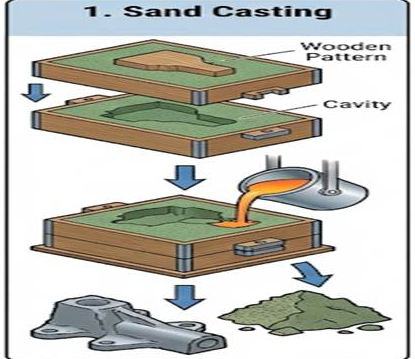
1. Sand Casting

Sand casting is the workhorse of the foundry industry, accounting for a massive percentage of all metal castings produced globally.
The Process: A pattern (replica of the object) is pressed into a mixture of sand and a binder (usually clay and water, known as "Green Sand"). The pattern is removed, leaving a cavity. Molten metal is poured in, and once solid, the sand is shaken away.
Why use it? It is incredibly versatile. It can create tiny components or massive engine blocks weighing several tons. It is also the most cost-effective method for low-to-medium production runs.
2. Full Moulding (Lost Foam Casting)

Full moulding, often referred to as Evaporative Pattern Casting or Lost Foam, is a unique process that eliminates the need to remove the pattern from the mould.
The Process: The pattern is made from expanded polystyrene foam (similar to Styrofoam). This foam pattern is surrounded by sand. When the hot molten metal is poured, it instantly vaporizes the foam and fills the space the foam previously occupied.
Why use it? It allows for complex geometries without "draft angles" (tapering needed to pull a pattern out). There are no parting lines (seams), resulting in a cleaner final product.
3. Investment Casting (Lost Wax)

When precision and surface finish are paramount, engineers turn to Investment Casting. This is an ancient technique dating back thousands of years.
The Process: A wax pattern is created and then dipped repeatedly into a ceramic slurry to build a hard shell. The shell is heated to melt out the wax (hence "Lost Wax"), leaving a perfect hollow ceramic cavity. Metal is poured into this hot shell.
Why use it? It produces parts with excellent surface finish and dimensional accuracy. It is widely used for turbine blades, medical implants, and jewelry.
4. CO2 Moulding

This is a variation of sand casting that focuses on how the sand is hardened (cured).
The Process: Instead of using clay and heat to bond the sand, the sand is mixed with Sodium Silicate (liquid glass). Once the mould is formed, Carbon Dioxide ($CO_2$) gas is passed through it.
The Chemistry: The $CO_2$ reacts with the sodium silicate to form a silica gel, which instantly hardens the sand into a rigid block.
Why use it? It provides a much harder and stronger mould than standard green sand. It is excellent for creating large cores and moulds where dimensional stability is critical.
5. Steel Moulding

While often grouped under general sand casting, "Steel Moulding" is frequently distinguished because casting steel requires specific conditions compared to iron or non-ferrous metals.
The Challenge: Steel melts at very high temperatures (over $1600^\circ\text{C}$). Ordinary sand might fuse to the casting (burn-on) or fail.
The Process: Steel moulding utilizes highly refractory sands (like pure silica, zircon, or chromite sand) and specific high-temperature binders. The "facing sand" (the layer touching the metal) is specially prepared to resist the extreme heat and chemical attack of molten steel.
Advantages of Expendable Moulds
Why choose a process where you have to destroy your tool every time?
Material Versatility: You can cast almost any metal, including metals with extremely high melting points (like superalloys) that would melt a reusable metal mould.
Complex Geometry: Methods like Investment and Full Moulding allow for intricate internal channels and shapes that are impossible with permanent moulds.
Low Initial Cost: For low production volumes or prototyping, making a pattern for sand casting is significantly cheaper than machining a steel die for die casting.
Conclusion
Expendable mould casting is the backbone of heavy industry and precision manufacturing alike. Whether it is the rough, heavy-duty nature of Sand and Steel moulding or the high-precision artistry of Investment casting, these temporary moulds provide the flexibility needed to turn liquid metal into the solid parts that drive our world.