


Article details
Explosive welding is a highly specialized, solid-state welding process that utilizes the controlled detonation of chemical explosives to fuse two or more metals. Unlike traditional fusion welding, which relies on melting the base materials, explosive welding relies on immense pressure and high velocity to create a metallurgical bond. This technique is particularly valuable for joining large surface areas and bonding dissimilar metals that are otherwise unweldable.
Welding Setup

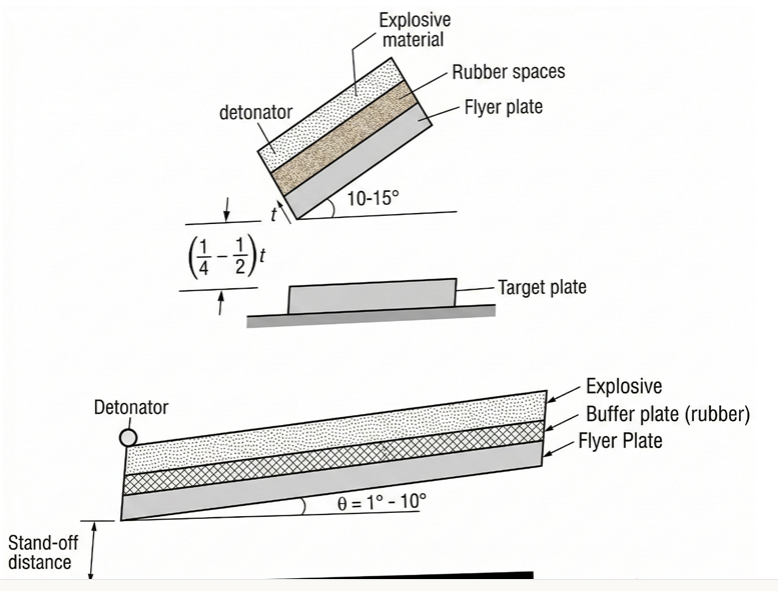
The success of an explosive weld depends heavily on the precise geometric arrangement of the components before detonation. The primary elements of the setup include:
The Target Plate: This is typically the thicker of the two metals being joined and rests firmly on a solid base or anvil.
The Flyer Plate: The thinner metal plate that will be propelled into the target plate.
Buffer Layer: A protective layer (often made of rubber) placed between the explosive material and the flyer plate to prevent the intense heat of the explosion from damaging the metal surface.
The Explosive Charge and Detonator: A carefully measured layer of explosive material is spread across the buffer layer, with a detonator positioned at one specific end to initiate the reaction.
Spatial Parameters
To achieve the correct impact dynamics, the plates are not placed flush against each other.
Inclination Angle: The flyer plate is usually positioned at a slight angle relative to the target plate, typically ranging from
 .
.Stand-off Distance: A specific gap, known as the stand-off distance, is maintained between the plates. This empty space is crucial as it gives the flyer plate enough room to accelerate to the required high velocity before striking the target plate.
Joining Mechanism:
The welding process happens in a fraction of a second. When the detonator is triggered, the explosive charge burns progressively across the surface of the flyer plate.
As the explosion propagates, it violently drives the flyer plate downward. Because of the initial inclination and the moving detonation wave, the plates do not collide all at once. Instead, they impact at a localized point that travels rapidly across the surface.
Under the extreme velocity and localized pressure at this collision point, the solid metals briefly exhibit plastic, fluid-like behavior. The immense force squeezes the surface layers of both metals, ejecting a high-velocity "fluid jet" of material just ahead of the joining front. This jetting action is highly beneficial; it violently scrubs away surface oxides and impurities, exposing completely pure metal. As the clean surfaces are slammed together under astronomical pressure, they form a strong, wavy, interlocking solid-state bond.
Industrial Applications
Because it is a cold-welding process, explosive welding does not suffer from the heat-affected zone (HAZ) issues common in traditional welding, making it highly versatile:
Cladding Dissimilar Metals: Its most prominent application is cladding thick, inexpensive slabs of metal (like carbon steel) with thin layers of expensive, corrosion-resistant metals (like titanium or stainless steel). These clad plates can be massive, reaching dimensions of up to 6m X 2m, which can later be rolled into thinner, usable sections.
Heat Exchangers and Boilers: It is widely used to create reliable tube-to-tubesheet joints in heat exchangers. The explosive is placed inside the tube; upon detonation, the tube expands outward, fusing tightly with the hole in the header plate. It is also used to permanently seal leaking tubes in high-pressure boilers.
Pipe Joining: Used to create robust joints between sections of piping, especially in environments where conventional welding is impractical.
Safety and Limitations
While incredibly effective, explosive welding is inherently dangerous due to its reliance on high explosives. The process generates massive shockwaves and noise, meaning it is usually performed outdoors in remote areas or inside heavily reinforced blast chambers. Furthermore, the handling, storage, and execution of the explosives require highly trained and experienced personnel to ensure strict safety protocols are met.