


Article details
When materials are subjected to axial tensile or compressive loads, they deform and may ultimately fail. Understanding how and why failure occurs is essential for safe design of rods, columns, bolts, struts, and structural members. The mode of failure depends on the type of material, nature of loading, and state of stress.
Failure in Tension
When a member is pulled by an axial tensile force, the material experiences tensile stress and elongates.
Ductile Materials in Tension
Ductile materials such as Mild Steel undergo significant plastic deformation before failure.
Characteristics:
Large elongation before fracture
Noticeable necking (reduction in cross-section)
Failure occurs after yielding
Fracture surface is cup-and-cone shaped
Failure process:
Elastic deformation
Yielding
Plastic deformation with necking
Fracture
This warning behavior makes ductile materials safer in structural applications.
Brittle Materials in Tension
Brittle materials like Cast Iron, glass, and ceramics fail suddenly without noticeable deformation.
Characteristics:
Very small elongation
No necking
Sudden fracture
Flat fracture surface perpendicular to load
These materials cannot absorb much energy before failure.
Failure in Compression
Under compressive loads, materials shorten. The failure mode differs significantly from tension.
Ductile Materials in Compression
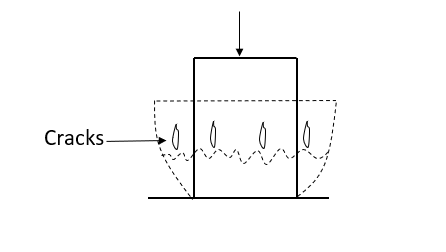
Ductile materials rarely fail by crushing. Instead, they bulge or barrel due to lateral expansion.
Characteristics:
No sudden fracture
Significant plastic deformation
Failure due to excessive deformation rather than breakage
Brittle Materials in Compression
Brittle materials are much stronger in compression than in tension.
Characteristics:
Failure occurs by crushing or shear cracks
Cracks form at approximately 45° to the load direction due to shear stress
Sudden failure without warning
This is why materials like cast iron are preferred in compressive members such as columns and machine bases.
Comparison of Failure in Tension and Compression
Aspect | Ductile Material (Tension) | Brittle Material (Tension) | Ductile Material (Compression) | Brittle Material (Compression) |
|---|---|---|---|---|
Deformation | Large | Very small | Large | Small |
Necking | Yes | No | No | No |
Warning before failure | Yes | No | Yes | No |
Failure mode | Cup-and-cone fracture | Sudden crack | Bulging/barreling | Shear/crushing |
Strength | Moderate | Low | High | Very high |
Reasons for Different Behavior
In tension, atomic bonds are pulled apart → brittle materials crack easily.
In compression, atoms are pushed together → brittle materials resist better.
Ductile materials can rearrange their structure through plastic flow.
Engineering Significance
Understanding failure modes helps engineers:
Select suitable materials for tensile or compressive loads
Design safer structures with proper factor of safety
Predict fracture behavior
Avoid sudden catastrophic failures
Examples:
Steel cables in tension
Cast iron columns in compression
Bolts under tensile preload
Machine frames under compressive loads