

Article details
The First Law of Thermodynamics is a fundamental principle of energy conservation applied to thermodynamic systems. It states that energy can neither be created nor destroyed; it can only be transformed from one form to another. This law establishes the relationship between heat, work, and the internal energy of a system.
In simple terms, when heat is supplied to a system, that energy is either:
Stored in the system as internal energy, or
Used by the system to do work on its surroundings.
Statement of the First Law
The increase in internal energy of a system is equal to the heat supplied to the system minus the work done by the system on its surroundings.
Mathematical Expression
For a closed system:
\delta Q = dU + \delta W
Where:
( \delta Q ) = Heat supplied to the system
( dU ) = Change in internal energy
( \delta W ) = Work done by the system
For finite changes:
Q = \Delta U + W
Terms Explained
1. Heat (Q)
Energy transferred due to temperature difference between system and surroundings.
2. Work (W)
Energy transfer when a force causes displacement (e.g., piston movement in a cylinder).
3. Internal Energy (U)
The total microscopic energy stored within a system due to molecular motion and interactions.
First Law for Different Processes
1. Constant Volume Process (Isochoric)
No work done: ( W = 0 )
Q = \Delta U
2. Constant Pressure Process (Isobaric)
Work done: ( W = P \Delta V )
Q = \Delta U + P \Delta V
3. Isothermal Process (Constant Temperature for ideal gas)
( \Delta U = 0 )
Q = W
4. Adiabatic Process
No heat transfer: ( Q = 0 )
\Delta U = -W
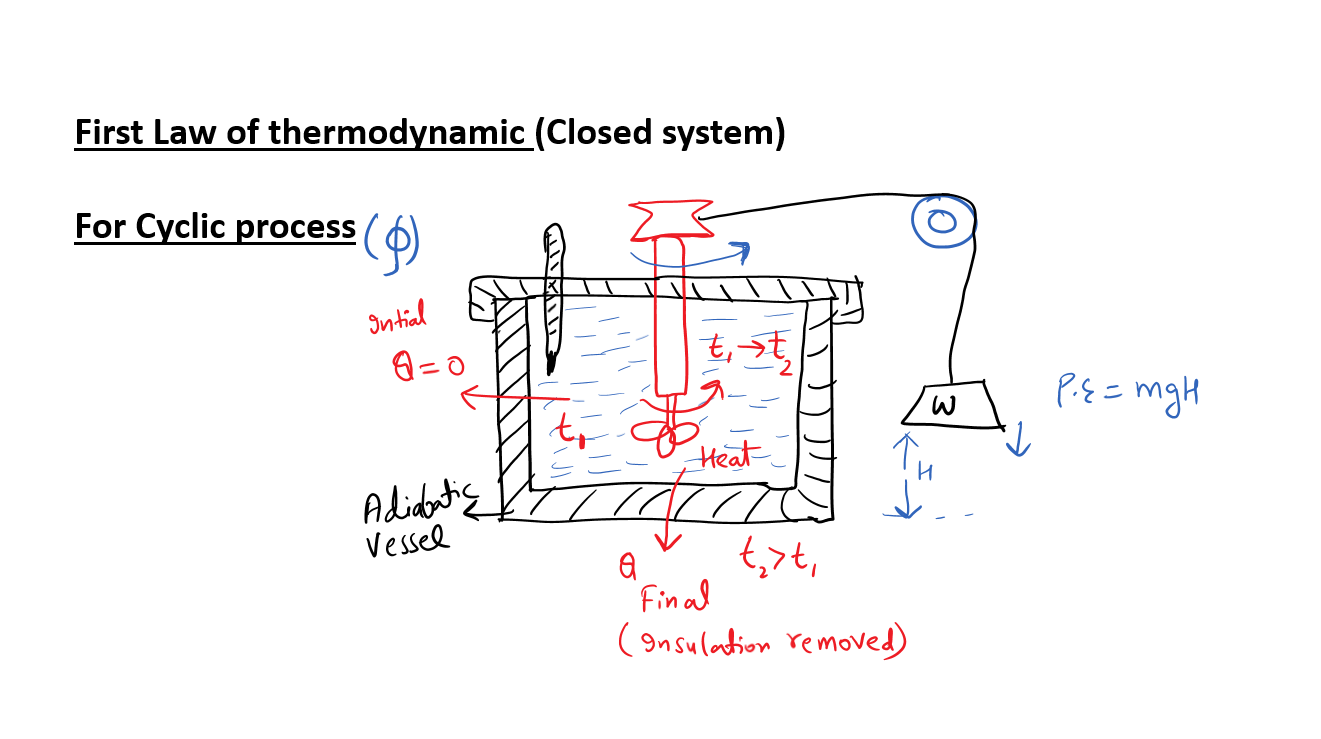
First Law for a Cyclic Process
In a thermodynamic cycle:
[
\Delta U = 0 \Rightarrow Q = W
]
Net heat supplied equals net work done.
First Law for an Open System (Control Volume)
For steady-flow systems like turbines, compressors, boilers:
Q - W = \Delta H + \Delta KE + \Delta PE
Where:
( H ) = Enthalpy
( KE ) = Kinetic energy
( PE ) = Potential energy
Practical Applications
Internal combustion engines
Steam turbines and boilers
Refrigeration and air conditioning
Compressors and pumps
Power plants and heat exchangers
Limitations of the First Law
Does not indicate the direction of heat flow
Does not explain why heat flows from hot to cold
Cannot predict feasibility of processes
Does not account for entropy
These are addressed by the Second Law of Thermodynamics.
Example
If 500 kJ of heat is supplied to a gas and the gas does 200 kJ of work:
\Delta U = Q - W = 500 - 200 = 300 \text{ kJ}
The internal energy increases by 300 kJ.


 Aug 29, 2026