

Article details
Flash Intercooling in Refrigeration Systems
Introduction
In multi-stage vapor compression refrigeration systems, managing the temperature and quality of refrigerant between compression stages is crucial for efficiency and compressor reliability. Flash intercooling is a technique used in two-stage (or multi-stage) systems where a portion of high-pressure liquid refrigerant is throttled to an intermediate pressure, producing a flash mixture of liquid and vapor. The vapor cools the refrigerant between compressor stages, reducing work input and improving system performance.
Flash intercooling is widely applied in large industrial refrigeration plants, cold storage facilities, and low-temperature applications where single-stage compression would lead to excessive discharge temperatures and poor efficiency.
Why Intercooling Is Needed
When refrigerant is compressed in a single stage across a large pressure ratio:
Discharge temperature becomes very high
Compressor work increases
Volumetric efficiency drops
Lubrication degrades due to overheating
By splitting compression into two stages and cooling the refrigerant between them, these issues are mitigated.
Principle of Flash Intercooling
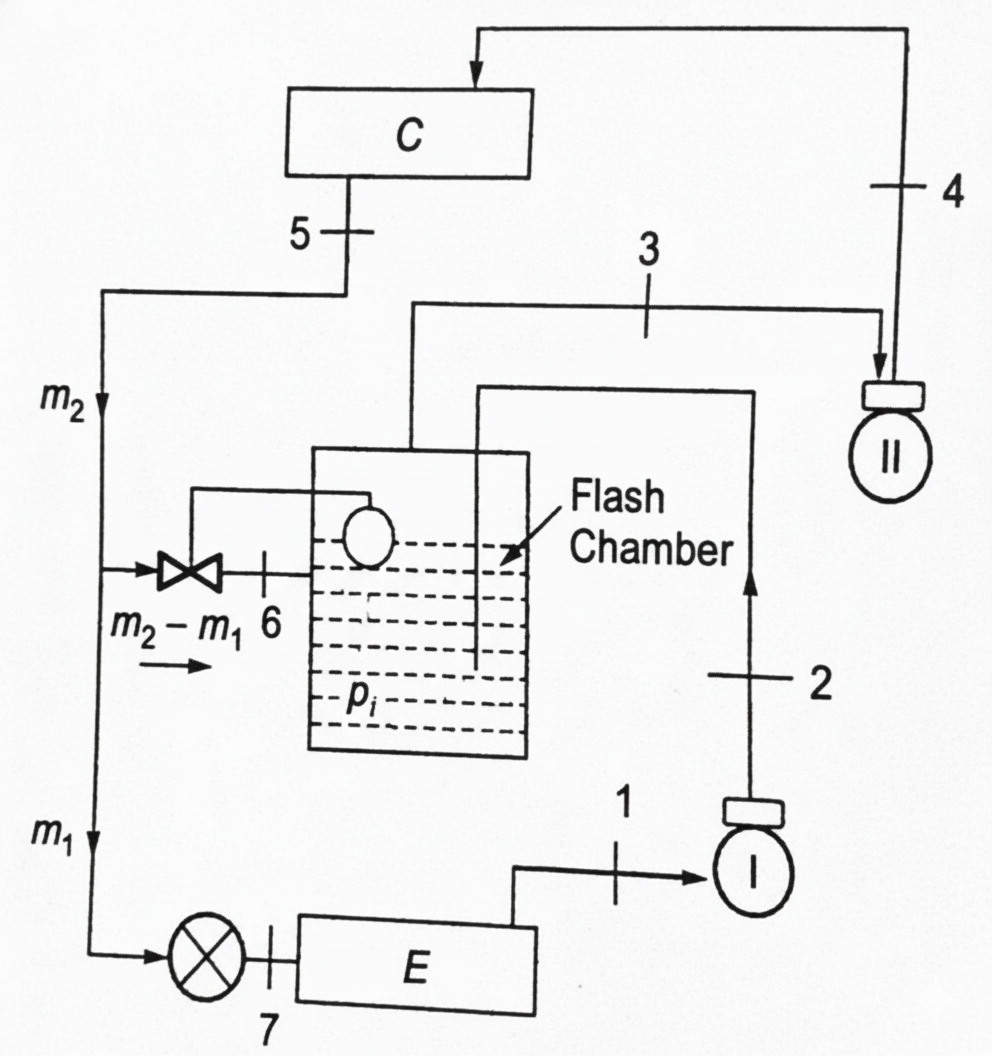
Flash intercooling uses a flash chamber (flash tank) at intermediate pressure:
High-pressure liquid from the condenser is throttled to an intermediate pressure.
Part of the liquid flashes into vapor due to pressure drop.
This cold vapor mixes with refrigerant coming from the low-stage compressor.
The mixture entering the high-stage compressor is at a lower temperature.
The process improves thermodynamic efficiency and protects the compressor.
Main Components
Low-stage compressor
High-stage compressor
Condenser
Expansion valves
Flash chamber (intercooler)
Evaporator
Working Process (Step by Step)
Low-stage compressor compresses refrigerant from evaporator pressure to intermediate pressure.
Refrigerant enters the flash chamber.
Liquid from condenser is expanded into the flash chamber.
Flash vapor cools the compressed vapor from the low stage.
Remaining liquid from flash chamber goes to evaporator through a second expansion valve.
Cooled vapor enters the high-stage compressor for final compression.
Thermodynamic Representation
On a Pressure–Enthalpy (P-h) diagram:
Two compression stages are visible.
Intercooling reduces enthalpy before second compression.
Net compressor work decreases.
Refrigeration effect increases.
Advantages of Flash Intercooling
Lower compressor discharge temperature
Reduced total compressor work
Higher Coefficient of Performance (COP)
Improved volumetric efficiency
Better lubrication and longer compressor life
Suitable for very low temperature applications (e.g., −30 °C and below)
Where Flash Intercooling Is Used
Large ammonia refrigeration plants
Industrial cold storages
Food processing units
Ice plants
Chemical processing refrigeration
Comparison with Water Intercooling
Feature | Flash Intercooling | Water Intercooling |
|---|---|---|
Cooling medium | Refrigerant itself | External water |
Efficiency | Higher | Moderate |
Complexity | Moderate | Simple |
Application | Industrial systems | Small systems |
Thermodynamic benefit | Significant | Limited |
Effect on COP
By reducing the enthalpy before second stage compression:
Work input decreases
Refrigeration effect remains same or increases
COP improves significantly
This is why flash intercooling is preferred in low-temperature refrigeration cycles.
Design Considerations
Correct selection of intermediate pressure (usually geometric mean of condenser and evaporator pressures)
Proper sizing of flash chamber
Accurate expansion valve control
Oil return management
Proper insulation of flash tank
Limitations
Increased system complexity
Higher initial cost
Requires precise control
Not economical for small refrigeration units


 Aug 29, 2026


