


Article details
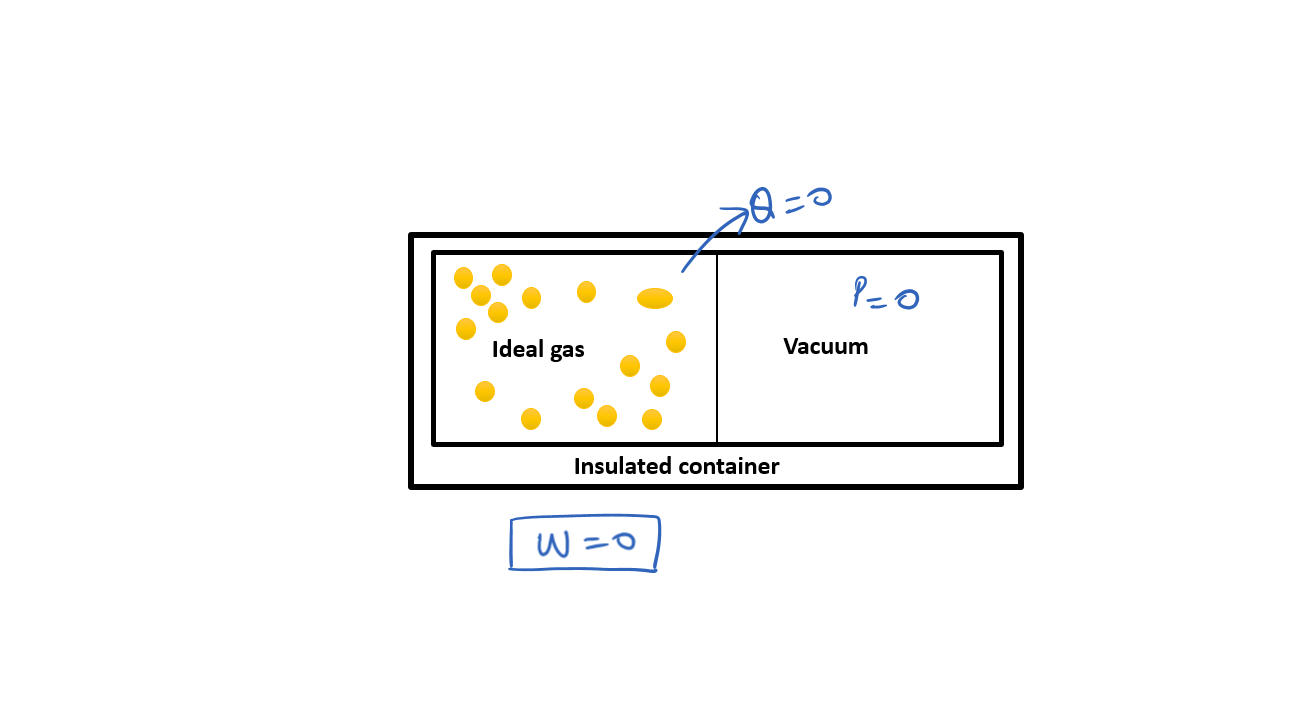
Free expansion (also called Joule expansion) is a thermodynamic process in which a gas expands into a vacuum without doing work and without heat transfer. It is a classic demonstration associated with James Prescott Joule, used to study how gases behave when allowed to expand freely.
Experimental Setup (Joule’s Experiment)
A rigid, insulated container is divided into two chambers by a valve:
One side contains gas at pressure (P_1)
The other side is a vacuum
When the valve is opened, the gas expands to fill the entire volume.
Key Characteristics
No heat transfer: (Q = 0) (insulated system)
No work done: (W = 0) (expansion against vacuum)
Rapid and irreversible process
Occurs in a closed, insulated system
First Law Analysis
Using the First Law of Thermodynamics:
Q = \Delta U + W
Since (Q = 0) and (W = 0):
\Delta U = 0
Internal energy remains constant.
Effect on Temperature (Ideal Gas)
For an ideal gas, internal energy depends only on temperature.
Since (\Delta U = 0):
\Delta T = 0
Temperature remains constant during free expansion of an ideal gas.
Effect on Pressure and Volume
Volume increases
Pressure decreases
Temperature remains constant (ideal gas case)
Why No Work Is Done?
Work is defined as:
W = \int PdV
In free expansion, external pressure (P_{ext} = 0), hence:
W = 0
Irreversibility of Free Expansion
Free expansion is highly irreversible because:
It occurs suddenly
No equilibrium states during the process
Cannot be reversed without external work
Real Gas Behavior
For real gases:
Slight temperature change may occur
Due to intermolecular forces
Basis of the Joule–Thomson effect
Practical Significance
Understanding gas behavior in vacuum systems
Basis for throttling and expansion devices
Important in refrigeration and cryogenics
Demonstrates limits of work extraction from expansion
Summary
Parameter | Observation |
|---|---|
Heat transfer (Q) | 0 |
Work done (W) | 0 |
Change in internal energy (\Delta U) | 0 |
Temperature change (ideal gas) | 0 |
Process type | Irreversible |