

Article details
Introduction
Frequency and wavelength bands are important concepts in electrical engineering, electronics, telecommunications, optics, and electromagnetic radiation. They help engineers classify waves according to their frequency or wavelength, making it easier to understand how different signals behave and how they can be used in practical applications.
From radio communication and wireless networks to visible light, infrared imaging, and medical equipment, frequency and wavelength bands play a major role in modern technology. Each band has specific characteristics that determine how waves travel, interact with materials, and transmit information.
Understanding these bands helps engineers select suitable operating frequencies, design communication systems, analyze electromagnetic signals, and improve the performance of electronic and optical devices.
What Is Frequency?
Frequency refers to the number of complete wave cycles that pass a fixed point in one second. It describes how rapidly a wave oscillates.
Frequency is measured in hertz (Hz). One hertz represents one complete cycle per second.
Higher frequency means more cycles occur every second, while lower frequency means fewer cycles occur during the same period.
Common frequency units include:
Hertz (Hz): One cycle per second.
Kilohertz (kHz): 1,000 cycles per second.
Megahertz (MHz): 1 million cycles per second.
Gigahertz (GHz): 1 billion cycles per second.
Terahertz (THz): 1 trillion cycles per second.
Frequency is particularly important in radio transmission, satellite communication, radar systems, wireless networks, and electronic circuit design.
What Is Wavelength?
Wavelength is the distance between two corresponding points on consecutive wave cycles, such as two neighboring peaks or troughs. It indicates the physical length of one complete wave cycle.
Wavelength is commonly represented by the Greek letter lambda (λ) and measured in metres (m). Depending on the application, it may also be expressed in centimetres, millimetres, micrometres, or nanometres.
For electromagnetic waves traveling in a vacuum, wavelength and frequency have an inverse relationship. Higher-frequency waves have shorter wavelengths, while lower-frequency waves have longer wavelengths.
This relationship allows engineers to calculate wavelength from a known frequency and use the result when designing antennas, optical systems, sensors, and communication equipment.
What Is a Frequency Band?
A frequency band is a defined range of frequencies grouped under a common name. Instead of identifying every signal by its exact frequency, engineers use bands to simplify communication, system design, and equipment classification.
For example, the radio spectrum is divided into several bands, including very low frequency (VLF), low frequency (LF), medium frequency (MF), high frequency (HF), and ultra-high frequency (UHF).
Each band has different propagation characteristics and practical uses. Some frequencies are suitable for long-distance communication, while others support high-speed data transmission, radar, or satellite services.
Frequency bands also help regulators and engineers coordinate spectrum use and reduce interference between systems.
Major Frequency Bands and Their Applications
The radio-frequency spectrum is commonly divided into bands based on increasing frequency and decreasing wavelength.
Frequency band | Approximate frequency range | Common applications |
|---|---|---|
Extremely Low Frequency (ELF) | 3–30 Hz | Specialized geophysical and electromagnetic studies |
Super Low Frequency (SLF) | 30–300 Hz | Specialized communication and research |
Ultra Low Frequency (ULF) | 300 Hz–3 kHz | Geophysical sensing and specialized communication |
Very Low Frequency (VLF) | 3–30 kHz | Navigation and specialized long-range communication |
Low Frequency (LF) | 30–300 kHz | Navigation and time-signal services |
Medium Frequency (MF) | 300 kHz–3 MHz | AM radio broadcasting |
High Frequency (HF) | 3–30 MHz | Shortwave and long-distance radio communication |
Very High Frequency (VHF) | 30–300 MHz | FM radio, aviation communication |
Ultra High Frequency (UHF) | 300 MHz–3 GHz | Television, mobile communication, wireless systems |
Super High Frequency (SHF) | 3–30 GHz | Radar, satellite links, microwave communication |
Extremely High Frequency (EHF) | 30–300 GHz | Millimetre-wave communication and advanced radar |
Note: These are commonly used band ranges. Exact classifications and boundaries can vary with the standards and application being used.
Extremely Low, Very Low, and Low Frequency Bands
Lower-frequency electromagnetic waves have longer wavelengths. Depending on the frequency, transmission conditions, and system design, these waves can support specialized communication over long distances.
VLF and LF bands are used in certain navigation, timing, and communication systems. Their propagation characteristics can be useful in environments where conventional higher-frequency communication has limitations.
However, transmitting at low frequencies may require large antennas, and available bandwidth is generally limited.
Medium and High Frequency Bands
The MF band is widely associated with AM radio broadcasting. These signals are suitable for audio transmission, and their coverage depends on factors such as transmission power, ground conditions, and atmospheric conditions.
The HF band supports shortwave radio and long-distance communication. Certain HF signals can travel beyond the horizon by interacting with the ionosphere, making them useful for communication across large geographical areas.
VHF and UHF Bands
VHF and UHF frequencies are widely used in everyday communication systems.
VHF supports FM radio broadcasting, aviation communication, and other radio services. UHF is used in television broadcasting, mobile communication, wireless devices, and various industrial applications.
These bands offer different combinations of antenna size, coverage, available bandwidth, and signal propagation characteristics.
Microwave and Millimetre-Wave Bands
SHF and EHF cover much of the microwave and millimetre-wave region. These frequencies are important in radar, satellite communication, wireless backhaul, and advanced high-capacity communication systems.
Higher frequencies can provide wider available bandwidths and support smaller antenna structures. However, signal attenuation, atmospheric absorption, rain, and obstacles can become important design considerations, depending on the frequency and environment.
Understanding Microwave Letter Bands
In radar and microwave engineering, letter-based designations provide another way to identify specific frequency ranges.
Band | Approximate frequency range | Typical applications |
|---|---|---|
L band | 1–2 GHz | Navigation, radar, satellite services |
S band | 2–4 GHz | Radar and selected communication systems |
C band | 4–8 GHz | Satellite communication and radar |
X band | 8–12 GHz | Radar, remote sensing, tracking |
Ku band | 12–18 GHz | Satellite television and satellite links |
K band | 18–27 GHz | Radar and specialized sensing |
Ka band | 27–40 GHz | High-capacity satellite communication |
V band | 40–75 GHz | High-frequency communication and research |
W band | 75–110 GHz | Imaging radar and advanced sensing |
These letter designations are particularly useful because engineers can refer to a band without repeatedly writing its full frequency range.
The exact range depends on the classification standard. Some applications also use slightly different boundaries, so the relevant standard should be checked during system design.
What Is a Wavelength Band?
A wavelength band is a defined range of wavelengths used to classify electromagnetic radiation. It is especially important in optics, spectroscopy, remote sensing, thermal imaging, and scientific instrumentation.
Unlike frequency bands, which are commonly used in radio communication, wavelength bands are often expressed in micrometres (µm) or nanometres (nm).
A wavelength band may be selected according to how a material absorbs or reflects radiation, how much energy a detector can measure, or which part of the electromagnetic spectrum an optical instrument needs to observe.
For example, an optical sensor designed for near-infrared radiation operates within a different wavelength region from a thermal camera designed to detect long-wave infrared radiation.
Major Wavelength Regions of the Electromagnetic Spectrum
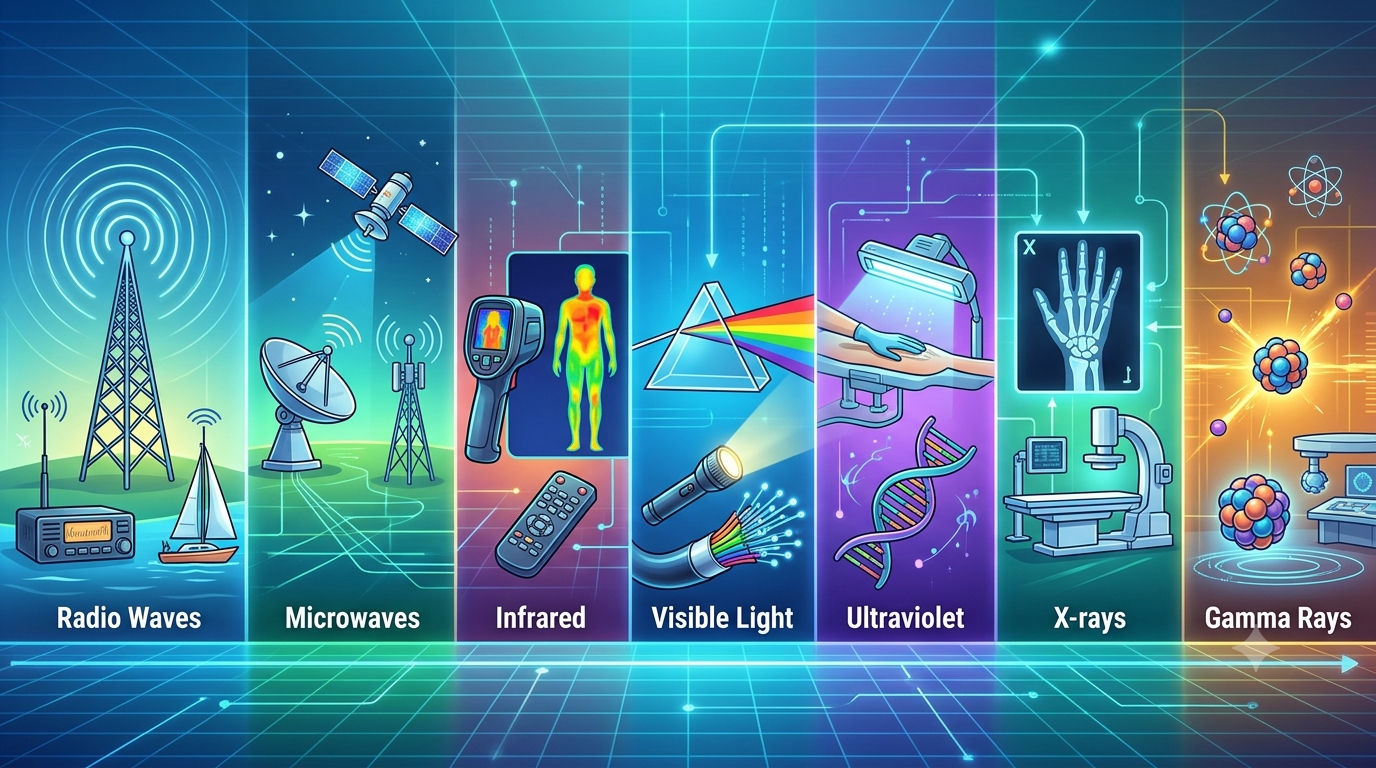
The electromagnetic spectrum includes radio waves, microwaves, infrared radiation, visible light, ultraviolet radiation, X-rays, and gamma rays.
These regions form a continuous spectrum. Their boundaries are conventional and may differ between scientific disciplines and engineering applications.
Radio Waves and Microwaves
Radio waves have relatively long wavelengths and are widely used for broadcasting, communication, navigation, and data transmission.
Microwaves occupy a shorter-wavelength portion of the spectrum and are used in radar, satellite links, wireless communication, and microwave heating.
Infrared Wavelength Bands
Infrared radiation lies beyond the red end of visible light. It is particularly useful in thermal imaging, industrial inspection, spectroscopy, and environmental monitoring.
Infrared is often divided into several sub-bands:
Near-infrared (NIR): Used in material analysis, optical sensing, and imaging.
Short-wave infrared (SWIR): Useful for inspecting materials, distinguishing moisture content, and remote sensing.
Mid-wave infrared (MWIR): Used in thermal imaging, gas detection, and specialized sensing.
Long-wave infrared (LWIR): Commonly used in thermal cameras and temperature-related inspections.
Far-infrared (FIR): Relevant to specialized spectroscopy, thermal radiation studies, and scientific research.
The exact wavelength boundaries vary according to the application and classification system.
Visible Light
Visible light is the portion of the electromagnetic spectrum detected by the human eye. It is commonly described as extending approximately from 380 to 750 nanometres, although the perceived limits vary.
Different wavelengths within this region correspond to different colours. Shorter visible wavelengths appear violet or blue, while longer wavelengths appear orange or red.
Visible-light bands are important in cameras, displays, optical sensors, machine vision, and illumination systems.
Ultraviolet Radiation
Ultraviolet (UV) radiation has shorter wavelengths than visible light. It is used in specialized applications such as fluorescence analysis, material inspection, scientific instruments, and certain disinfection systems.
Its effects depend on wavelength, exposure, and intensity. UV system design therefore requires appropriate optical materials, detectors, shielding, and safety controls.
X-Rays and Gamma Rays
X-rays and gamma rays occupy the high-frequency, short-wavelength end of the electromagnetic spectrum.
X-rays are widely used in medical imaging, industrial non-destructive testing, and material inspection. Gamma rays are used in specialized medical, scientific, and industrial applications.
These forms of radiation can be ionizing, meaning they have sufficient energy to remove electrons from atoms. Their use requires appropriate radiation protection and safety procedures.
Applications of Frequency and Wavelength Bands in Engineering
Frequency and wavelength classification supports many engineering activities.
Telecommunications: Engineers select operating bands for mobile networks, radio links, satellite communication, and wireless systems.
Antenna design: Frequency determines the wavelength, which influences antenna dimensions, radiation patterns, and operating characteristics.
Radar systems: Frequency selection affects target detection, resolution, propagation, and sensitivity to environmental conditions.
Optical engineering: Wavelength bands help engineers select light sources, optical filters, lenses, and detectors.
Industrial inspection: Infrared and other optical bands can reveal temperature variations, material differences, surface defects, and chemical characteristics.
Remote sensing: Satellite and airborne sensors use selected wavelength bands to monitor vegetation, water, soil, atmospheric conditions, and industrial activity.
Factors to Consider When Selecting a Frequency or Wavelength Band
Selecting the correct band requires more than identifying a suitable frequency or wavelength.
Engineers should consider the intended application, required coverage, transmission distance, available bandwidth, environmental conditions, interference, and regulatory requirements.
For optical systems, detector sensitivity, material absorption, illumination, and the optical properties of lenses and filters are also important.
Equipment availability, cost, power consumption, and system complexity must be evaluated before finalizing the design.
Conclusion
Frequency and wavelength bands provide a practical way to classify electromagnetic waves and understand their engineering applications. Frequency describes how rapidly a wave oscillates, while wavelength describes the distance covered by one complete cycle.
Radio and microwave bands are essential for communication, radar, and navigation, while infrared, visible, ultraviolet, X-ray, and gamma-ray regions support optical sensing, imaging, inspection, and scientific research.
A clear understanding of these classifications helps engineers select suitable components, improve system performance, and make informed decisions when designing communication, electronic, and optical systems.
