


Article details
Europe has entered a decisive phase of decarbonisation, where plans and goals are increasingly becoming real industrial projects, and the results of this shift are already visible.
According to recent data, EU greenhouse gas emissions have fallen by around 37% compared to 1990 levels (and remain on track to meet the 2030 goal of a 55% reduction), while the European economy has grown by more than 70% over the same period. In 2024, renewable energy sources accounted for approximately 47% of electricity generation in the EU, overtaking all other sources, while the share of fossil fuels declined to around 29%. These figures reflect not only policy momentum, but also years of investment in infrastructure, technology and industrial transformation.
However, progress remains uneven. Emissions reductions have been slower in energy-intensive industries, including refining, petrochemicals and transport-related activities - this is precisely where decarbonisation efforts are now becoming more determined and specific. Across Europe, oil and gas operators, refiners and chemical producers are moving beyond strategy documents towards operational projects focusing on energy efficiency, electrification, hydrogen integration, carbon capture and digital optimisation of existing assets. Companies are now prioritising solutions that can be deployed at scale, integrated into operating facilities and supported by a clear business case. Collaboration between asset owners, technology providers, equipment manufacturers and digital solution developers is playing a central role in making these projects viable.
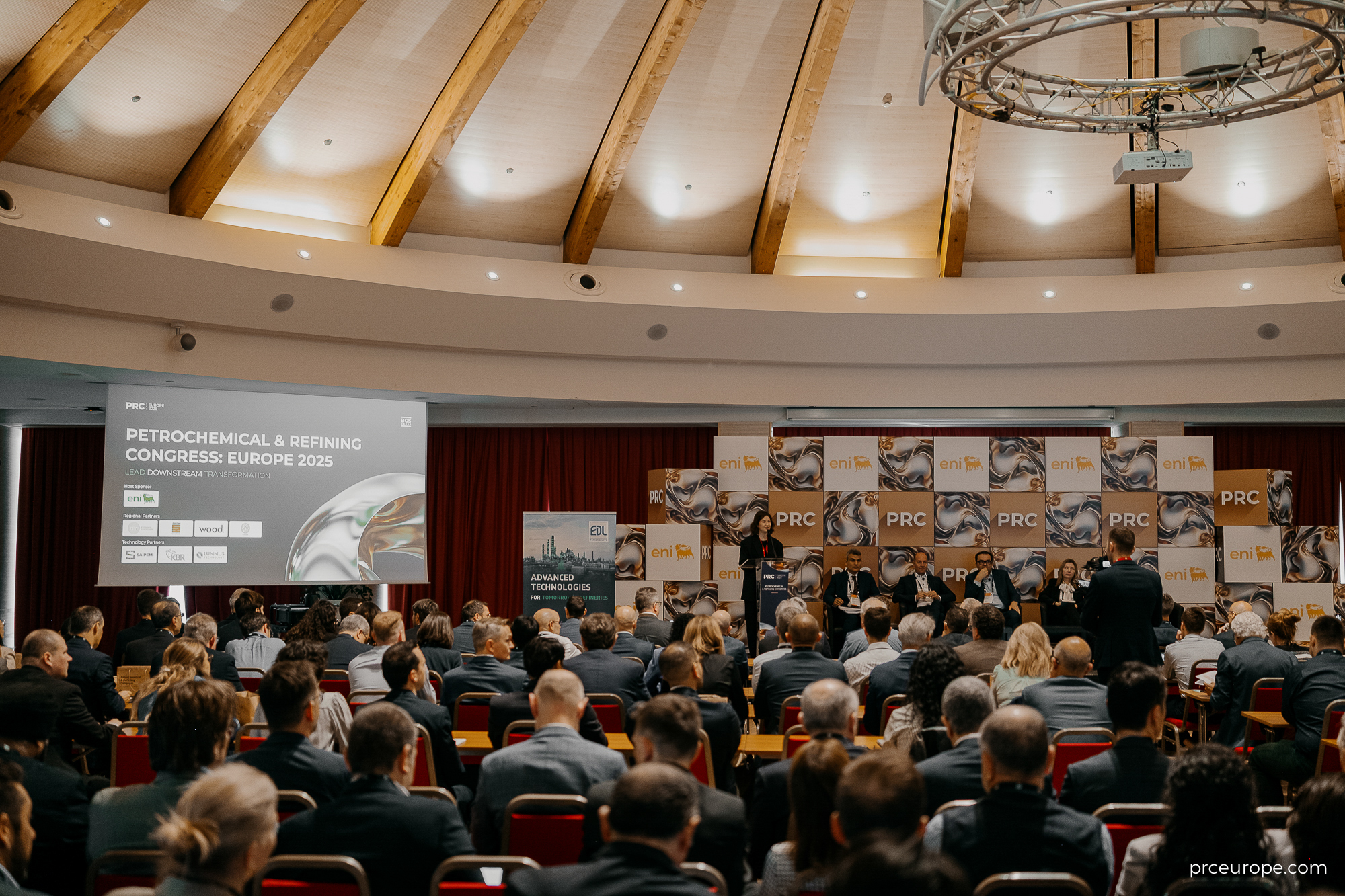
Decarbonisation challenges and success stories in the downstream sector are going to be discussed in depth at the Petrochemical and Refining Congress (PRC Europe) 2026 on 18-19 May in Amsterdam, where industry leaders spotlight ongoing and released projects as well as examine how decarbonisation strategies are being implemented across European refining and petrochemical assets. The Congress is going to focus on practical case studies, proven technologies and lessons learned from the projects that are already delivering measurable emissions reductions.
This article is going to explore several key topics that are presented and debated at PRC Europe 2026. Together, these examples demonstrate how the industry is shifting from long-term targets to real industrial action.
How Versalis is Recycling Plastic to Enable Decarbonisation
A clear example of how decarbonisation is being addressed through material circularity can be found in the work of Versalis (the chemical company of Eni). Fabio Assandri (General Manager at Novamont & Head R&D, Licensing & Projects Development at Versalis) is joining the PRC Europe 2026 to share how the company is utilising plastic recycling technologies to enable the decarbonisation of the petrochemical industry.
Plastic recycling plays a central role in Versalis’ strategy to support the transition toward a circular economy while directly contributing to emissions reduction across the value chain. Over the past several years, the company has significantly expanded its portfolio of recycling technologies and products, combining strong internal R&D capabilities with targeted partnerships across Europe.
“At Versalis, we are strongly committed to achieving the most difficult and demanding applications from advanced mechanical recycling, that complements chemical recycling - the proprietary Hoop® technology - with the aim of promoting a more circular use of plastic materials (from plastic waste to recycled polymers)”, - Fabio Assandri.
A particular emphasis is placed on food-contact plastic packaging, one of the most regulated and technically demanding segments. These applications require strict control over contaminants and material consistency to comply with both European and international regulations. Leveraging its deep expertise in polymer science and production technologies, Versalis began this development journey at laboratory scale, working in cooperation with Fraunhofer Institute to define performance criteria, testing methodologies and stability models capable of handling the wide variability of post-consumer plastic waste streams.
This work moved into industrial implementation through a partnership with an Italian recycling company Forever Plast, where an existing recycling facility was successfully retrofitted with a proprietary purification unit designed by Versalis. As a result, the plant has been producing recycled polystyrene suitable for direct food-contact applications, ranging from cold and short-term packaging to hot and long-term use. The materials fully comply with EU Regulation 1616/2022 as well as US Food and Drug Administration (FDA) requirements.
The purification technology, branded Newer®, and the resulting recycled polystyrene product range, Refence®, demonstrate how advanced mechanical recycling can deliver both environmental and industrial value. By enabling high-quality recycled plastics for sensitive applications, Versalis proves that circular economy projects can become a practical and scalable decarbonisation pathway.
Can E-Fuels Live up to the Hype? Saras has the Answer
E-fuels are increasingly highlighted as a key solution for decarbonising heavy transport and aviation under EU RED III, but the step from regulatory ambition to industrial deployment remains complex. Within this context, Saras is exploring how synthetic fuels can be integrated into existing refining operations while taking a realistic view of their potential as well as limitations. Enrico Giglioli (Chief New Initiatives Officer at Saras) is joining PRC Europe 2026 to analyse E-fuel production at work and discuss myths related to this process.
The Saras Sarroch refinery in Sardinia, a pioneering pilot project funded under the Italian National Recovery and Resilience Plan, is providing valuable insights into what E-fuel production looks like in practice. The pilot integrates an advanced synthesis loop based on Fischer-Tropsch technology, combined with a Catalytic Partial Oxidation (CPOx) unit designed to optimise syngas generation and maximise overall E-crude yields. The project is leveraging existing refinery infrastructure and demonstrating how conventional assets can be adapted to support next-generation synthetic fuel production.
“While the pilot successfully validates the technical feasibility of this configuration, it also serves as a necessary reality check. We will look beyond the engineering milestones to address the "myth vs. reality" of the sector: specifically, the high operational costs and energy requirements that currently hinder market scalability”, - Enrico Giglioli.
Saras’ work underscores a broader industry challenge: bridging the gap between a functioning prototype and a commercially viable E-fuel product. Addressing this gap will require further innovation, scale-up strategies and supportive regulatory frameworks capable of reducing the so-called “green premium” (the additional cost of low-carbon technologies and products compared to conventional alternatives). As discussions around synthetic fuels intensify across Europe, projects like this offer a grounded perspective on the concrete steps needed to turn promising pilot results into competitive solutions.
BORSIG ZM Compression: Improving CCUS Economics Through Compressor Efficiency
Rising CO₂ certificate costs and stricter emissions requirements are pushing refineries, petrochemical plants and energy-intensive industries to integrate Сarbon Сapture, Utilisation and Storage (CCUS) into their core business models, and at the heart of these systems lies a crucial and energy-intensive step - CO₂ compression.
For large CO₂ volumes, the most efficient solution remains integrally geared turbo compressors, widely used in CCUS applications. However, even with today’s high-efficiency designs, electricity consumption continues to dominate operating costs. Traditional manufacturing methods, largely based on CNC machining, limit further optimisation of compressor impellers effectively capping achievable efficiency gains.
BORSIG ZM Compression (PRC Europe 2026 Gold Sponsor) has developed new approaches to impeller design and manufacturing by combining advanced erosion techniques and 3D printing. These technologies enable geometries that are not feasible with traditional machining, unlocking additional aerodynamic improvements.
Andi Ziermann (General Manager at BORSIG ZM Compression GmbH) is joining the Congress to share tangible results: the new impeller designs deliver efficiency gains of approximately 1-1.5% per compression stage, making a significant impact at industrial scale.
“The first compressors have been tested in the BORSIG ZM Compression testbed under full load conditions and have already been delivered to clients in Europe … Depending on the overall power consumption of the compressor, this can achieve a saving of several hundred thousand euros per year per unit”, - Andi Ziermann.
By focusing on efficiency where it matters most - energy consumption - BORSIG ZM Compression illustrates an important principle of industrial decarbonisation: incremental improvements in core technologies can unlock large-scale impact.
From Pilot Projects to Scalable Industrial Solutions
The projects discussed in this article illustrate a clear shift from experimentation to industrial deployment in Europe’s decarbonisation agenda. Advanced recycling, E-fuel production and CCUS initiatives are no longer isolated pilots, but operating projects integrated into existing refining and petrochemical assets. Their real value lies not only in technical success, but in the lessons they provide on energy efficiency, cost control and scalability. The ability to reduce operating costs and narrow the green premium is going to determine which solutions can be replicated across the European downstream sector.
These questions, as well as the practical experience gained from projects already in operation, are going to be discussed at PRC Europe 2026. The Congress is bringing together industry leaders, technology providers and equipment manufacturers to exchange practical experience and define the next steps towards downstream transformation.
Learn more about PRC Europe 2026: https://sh.bgs.group/3p2