

Article details
Introduction
Industrial facilities that handle flammable gases, vapours, liquids, and combustible dusts face significant fire and explosion risks. A small leakage, equipment failure, or electrical spark can create a dangerous situation when combustible materials mix with air.
To prevent such incidents, industries use Hazardous Area Classification (HAC), an important engineering and process safety study. It helps identify locations where explosive atmospheres may develop and determines the precautions required to prevent ignition.
Hazardous Area Classification plays an essential role in oil and gas plants, refineries, chemical processing facilities, pharmaceutical industries, fuel storage terminals, and manufacturing units. It supports safer plant design, appropriate equipment selection, and compliance with industrial safety requirements.
This article explains the fundamentals of Hazardous Area Classification, different hazardous zones, classification methods, equipment protection techniques, and important considerations for industrial facilities.
1. What Is Hazardous Area Classification (HAC)?
Hazardous Area Classification is a systematic engineering process used to identify and classify locations where flammable gases, vapours, mists, or combustible dusts may form an explosive atmosphere.
The primary objective is to prevent electrical equipment, mechanical devices, and hot surfaces from becoming ignition sources.
During an HAC study, engineers examine the materials handled in a facility, possible leakage points, operating conditions, ventilation arrangements, and the likelihood of an explosive atmosphere developing.
The study produces classification drawings and technical documentation that help electrical, instrumentation, process, and safety engineers select suitable equipment for different locations.
Main objectives of HAC include:
Identifying areas where explosive atmospheres may occur.
Evaluating the frequency and duration of hazardous conditions.
Determining suitable equipment protection requirements.
Reducing the possibility of fires and explosions.
Improving personnel and equipment safety.
Supporting compliance with applicable safety standards.
2. Why Is Hazardous Area Classification Important?
Hazardous Area Classification is a critical part of industrial safety because it helps control ignition risks before equipment is installed or operations begin.
An unsuitable electrical device can generate sparks or excessive heat, potentially igniting a flammable atmosphere.
Proper classification ensures that equipment is selected according to the actual hazards present in a particular location.
Key benefits include:
Explosion Prevention: Helps reduce the possibility of ignition by identifying hazardous locations and controlling ignition sources.
Equipment Protection: Ensures that electrical and non-electrical equipment is suitable for the surrounding environment.
Personnel Safety: Reduces exposure to dangerous fire and explosion incidents.
Regulatory Compliance: Supports compliance with relevant international standards and local safety regulations.
Cost Management: Helps avoid unnecessary installation of expensive explosion-protected equipment in areas where it is not required.
Operational Reliability: Supports safer plant operations, maintenance, and equipment replacement.
3. Different Hazardous Area Classification Zones
Hazardous locations are classified according to the probability and duration of an explosive atmosphere.
The IEC and ATEX zone classification systems commonly divide gas and vapour hazards into three zones and combustible dust hazards into three additional zones.
3.1 Gas and Vapour Zones
Zone 0 – Continuous Hazard
Zone 0 refers to locations where an explosive gas or vapour atmosphere is present continuously, for long periods, or frequently.
Examples include the internal space of storage tanks containing flammable liquids and certain process vessels.
These locations require equipment with protection suitable for the highest level of exposure.
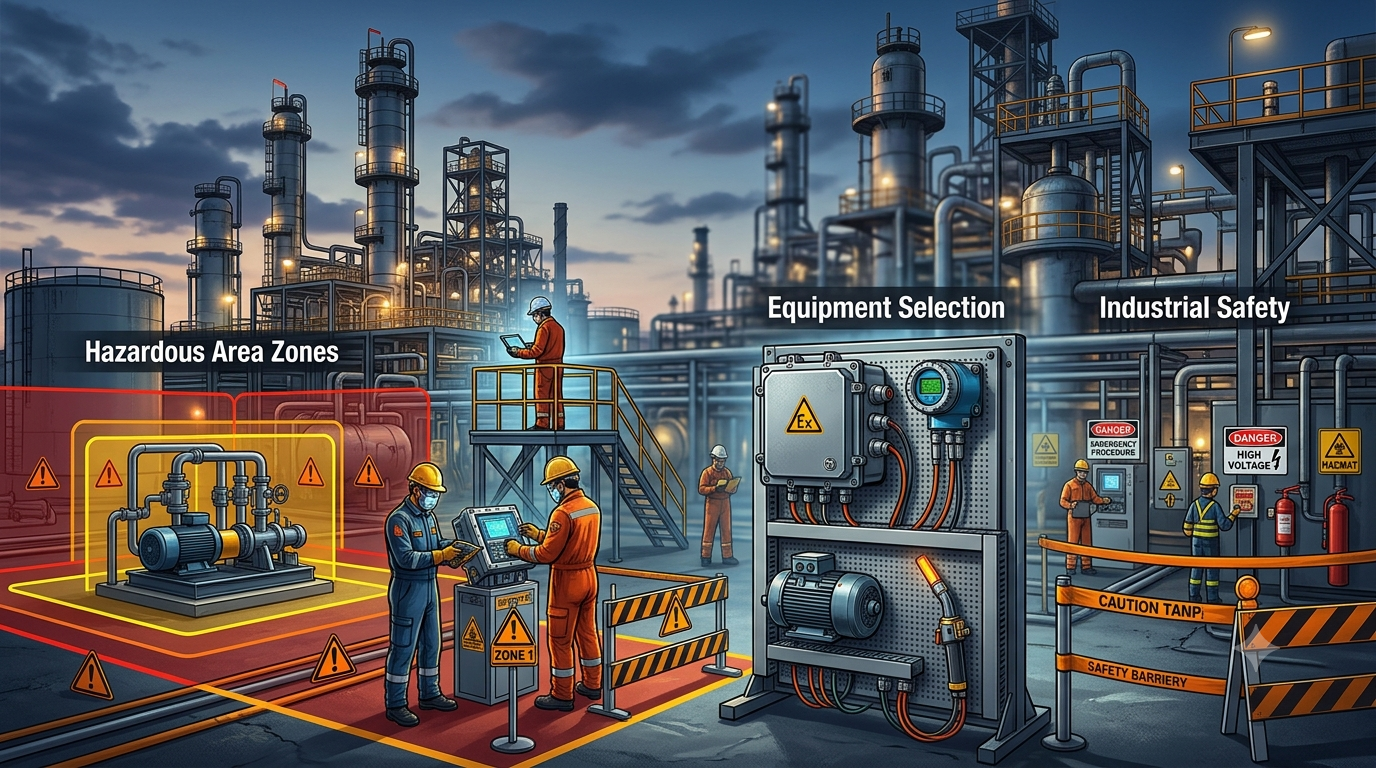
Zone 1 – Likely Hazard
Zone 1 describes locations where an explosive atmosphere is likely to occur occasionally during normal operating conditions.
Typical examples include areas around pump seals, sampling points, filling stations, and equipment handling flammable substances.
Electrical and instrumentation equipment installed in these locations must have appropriate explosion protection.
Zone 2 – Occasional or Short-Duration Hazard
Zone 2 refers to locations where an explosive atmosphere is not expected during normal operation. However, it may develop under abnormal conditions, such as leakage or equipment failure, and remain only for a short period.
Examples include certain areas around pipelines, flanges, and process connections.
3.2 Combustible Dust Zones
Dust-related hazards are classified separately because combustible particles can create explosive clouds when suspended in air.
Zone 20: Locations where combustible dust clouds are present continuously, frequently, or for long periods. Examples include the interiors of dust collection systems and certain storage silos.
Zone 21: Locations where combustible dust clouds are likely to occur occasionally during normal operations, such as near powder filling and transfer points.
Zone 22: Locations where combustible dust clouds are unlikely during normal operation and, if they occur, remain present only briefly.
These classifications are particularly important in food processing, pharmaceutical production, grain handling, and chemical manufacturing.
4. Hazardous Area Classification Systems
Different countries and industries follow different classification systems depending on their applicable electrical codes and safety regulations.
Two widely used approaches are the Zone System and the Division System.
4.1 Zone Classification System
The Zone System is widely used internationally and is associated with IEC 60079 standards and ATEX requirements.
It classifies hazardous locations based on how frequently and how long an explosive atmosphere may be present.
For gases and vapours, the classifications are Zone 0, Zone 1, and Zone 2. For combustible dust, they are Zone 20, Zone 21, and Zone 22.
4.2 Division Classification System
The Division System is commonly used in North America under standards such as the National Electrical Code (NEC).
It divides hazardous locations into two categories:
Division 1: Locations where flammable gases, vapours, or combustible dust may be present during normal operating conditions.
Division 2: Locations where hazardous materials are normally contained within closed systems and may become present only under abnormal conditions, such as equipment failure or accidental leakage.
Zone and Division classifications describe similar hazards, but they are not directly interchangeable. Equipment selection must follow the applicable certification and installation requirements.
5. Important Factors Considered During HAC Studies
Hazardous Area Classification requires a detailed assessment of process materials, equipment, and operating conditions.
Engineers consider several important factors before assigning a hazardous zone.
5.1 Properties of Hazardous Materials
The physical and chemical properties of flammable substances influence their ignition and explosion characteristics.
Important properties include:
Flash point
Auto-ignition temperature
Lower and upper explosive limits
Vapour density
Minimum ignition energy
Gas or vapour release characteristics
These properties help engineers evaluate how easily a substance can create an explosive atmosphere.
5.2 Sources of Release
A release source is any location from which flammable gases, vapours, or dust may escape into the surrounding environment.
Common examples include pump seals, compressor connections, valves, tank vents, flanges, and sampling points.
Engineers identify both normal operating releases and potential releases caused by foreseeable equipment failures.
5.3 Ventilation Conditions
Ventilation plays an important role in determining how quickly flammable gases or vapours disperse.
Natural ventilation depends on wind movement and the surrounding layout, while mechanical ventilation uses fans and ventilation systems to control air movement.
Poor ventilation can allow hazardous concentrations to accumulate and increase the extent or duration of a hazardous atmosphere.
5.4 Operating Conditions
Temperature, pressure, flow rate, equipment operating conditions, and maintenance activities can influence the possibility of a flammable release.
Engineers must evaluate actual operating conditions rather than relying only on equipment specifications or general assumptions.
6. Gas Groups and Temperature Classes
Apart from hazardous zones, equipment selection also depends on gas groups and temperature classifications.
These parameters ensure that electrical equipment does not create an ignition source when operating in a hazardous environment.
6.1 Gas Groups
Flammable gases are divided into groups according to their ignition characteristics and the requirements of explosion-protected equipment.
Gas Group | Typical Examples |
|---|---|
IIA | Propane |
IIB | Ethylene |
IIC | Hydrogen and acetylene |
Group IIC represents the most demanding gas group among these three. Equipment certified for IIC applications can generally be used in IIA and IIB gas environments, provided all other equipment requirements are satisfied.
6.2 Temperature Classes
Temperature classes specify the maximum surface temperature that equipment can reach during operation.
The equipment surface temperature must remain below the auto-ignition temperature of the surrounding hazardous substance.
Temperature Class | Maximum Surface Temperature |
|---|---|
T1 | 450°C |
T2 | 300°C |
T3 | 200°C |
T4 | 135°C |
T5 | 100°C |
T6 | 85°C |
For example, equipment with a T4 rating has a maximum surface temperature of 135°C under the applicable conditions.
Selecting the correct temperature class helps prevent ignition caused by overheated equipment.
7. Explosion Protection Techniques for Industrial Equipment
Electrical and instrumentation equipment used in hazardous locations must have suitable protection methods.
Some commonly used explosion protection techniques include:
1. Flameproof Protection (Ex d)
Flameproof equipment is designed to withstand an internal explosion and prevent flames from spreading into the surrounding hazardous atmosphere.
It is commonly used for motors, junction boxes, and electrical enclosures.
2. Intrinsic Safety (Ex i)
Intrinsic safety limits electrical energy within a circuit so that sparks or heat cannot ignite the surrounding explosive atmosphere under specified conditions.
It is commonly used for sensors, transmitters, and instrumentation systems.
3. Increased Safety (Ex e)
Increased safety equipment is designed to reduce the possibility of sparks, arcs, and excessive temperatures through additional construction and installation precautions.
It is commonly applied to terminal boxes and other electrical equipment.
4. Pressurisation and Purging (Ex p)
This method uses protective gas to maintain positive pressure inside an enclosure, preventing hazardous gases or vapours from entering.
It is used for certain control panels, electrical cabinets, and specialised equipment.
The protection method must be selected according to the hazardous zone, gas group, temperature class, and applicable certification requirements.
8. Steps Involved in a Hazardous Area Classification Study
A systematic HAC study helps engineers identify hazardous locations and develop suitable protection requirements.
The typical process includes the following steps:
Collect Process Information: Review process flow diagrams, P&IDs, equipment layouts, material safety data, and operating conditions.
Identify Hazardous Materials: Determine the properties of gases, vapours, liquids, and combustible dust handled within the facility.
Identify Release Sources: Locate potential leakage points, vents, seals, valves, and equipment connections.
Evaluate Release Conditions: Assess the likelihood, frequency, and duration of potential releases.
Assess Ventilation: Examine natural and mechanical ventilation conditions and their influence on gas or vapour dispersion.
Assign Hazardous Zones: Classify the identified locations according to the applicable standards.
Prepare HAC Drawings: Develop hazardous area classification drawings showing the extent and boundaries of classified areas.
Select Suitable Equipment: Specify equipment protection types, gas groups, temperature classes, and certification requirements.
Review and Update: Reassess the classification whenever significant process modifications or equipment changes occur.
A scenario-based assessment can provide a more realistic picture of hazardous area boundaries by considering individual release sources and actual operating conditions. This helps avoid unnecessarily classifying entire plant sections while ensuring that potential hazards beyond equipment boundaries are not overlooked.
9. Applicable Standards and Regulations
Hazardous Area Classification follows recognised international and national standards to maintain consistent safety practices.
Some important standards and regulatory frameworks include:
IEC 60079 Series: Covers equipment design, installation, inspection, and maintenance requirements for explosive atmospheres.
ATEX Directive 2014/34/EU: Establishes requirements for equipment and protective systems intended for use in potentially explosive atmospheres within the European Union.
NFPA 70 (NEC): Provides electrical installation requirements, including hazardous location classifications in North America.
API Standards: Provide industry-specific guidance for facilities handling petroleum and flammable materials.
DSEAR Regulations: Address the assessment and control of fire and explosion risks from dangerous substances in UK workplaces.
The applicable requirements depend on the facility location, industry, equipment type, and regulatory jurisdiction.
10. Common Mistakes in Hazardous Area Classification
Incorrect classification can create unnecessary costs and serious safety risks.
Some common mistakes include:
Using outdated process information during classification.
Ignoring potential leakage sources around equipment.
Incorrectly assessing ventilation conditions.
Selecting equipment without checking gas groups and temperature ratings.
Applying Zone and Division classifications as if they were directly interchangeable.
Ignoring combustible dust hazards.
Failing to update HAC drawings after plant modifications.
Not coordinating electrical, process, instrumentation, and safety engineering teams.
Regular reviews, accurate documentation, and multidisciplinary engineering coordination help prevent these problems.
Conclusion
Hazardous Area Classification is an essential part of industrial engineering and process safety. It provides a structured approach to identifying locations where explosive atmospheres may develop and determining the protection measures required to prevent ignition.
By evaluating hazardous materials, release sources, ventilation conditions, operating parameters, and equipment requirements, engineers can develop safer industrial facilities.
Proper implementation of HAC helps reduce fire and explosion risks, improve equipment reliability, protect personnel, and support regulatory compliance.
For engineers working in oil and gas, chemical processing, electrical design, instrumentation, and industrial safety, knowledge of hazardous area classification is an important skill for designing, operating, and maintaining safe industrial facilities.
Suggested SEO keywords: Hazardous Area Classification, HAC Zones, Hazardous Area Classification Study, Zone 0 Zone 1 Zone 2, Explosion Protection, ATEX Standards, IEC 60079, Gas Groups, Temperature Classes, Industrial Process Safety.
