


Article details
A heat exchanger is a device that enables thermal energy transfer between two fluids at different temperatures, without allowing them to mix. These systems are essential in power generation, HVAC, automotive, and chemical processing industries.
Types of Heat Exchangers
Double Pipe Heat Exchanger
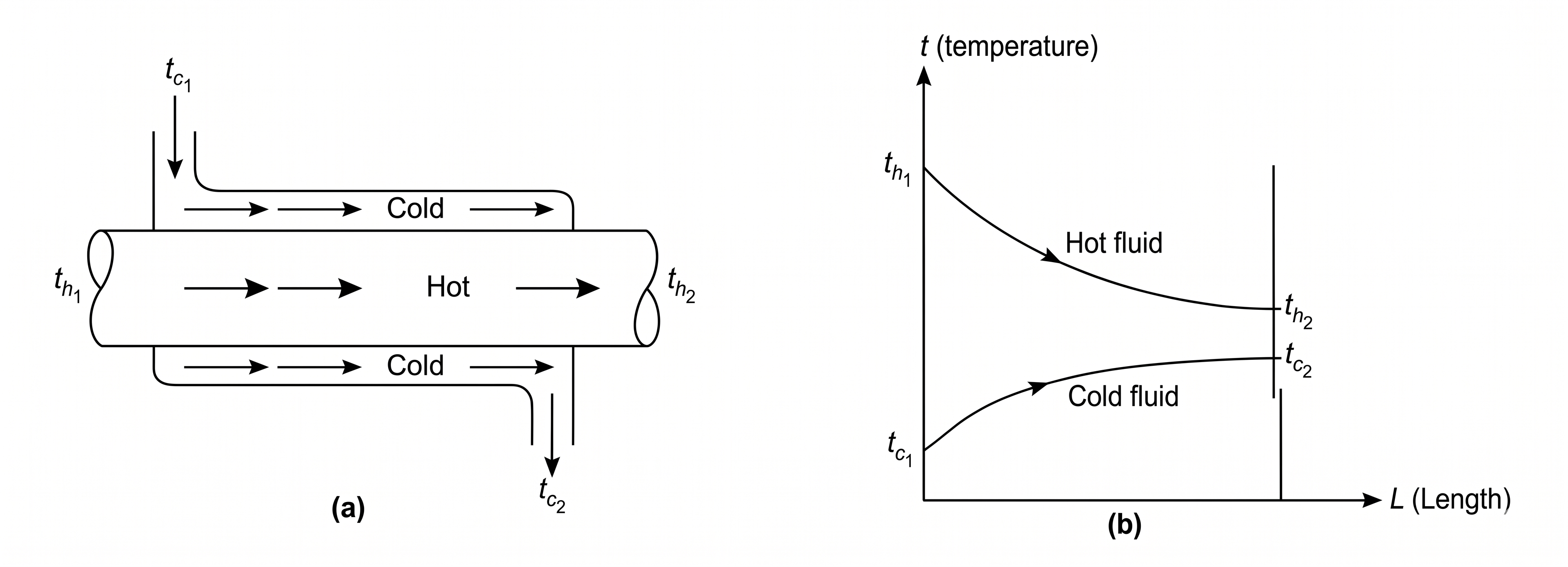
This is the most basic form, consisting of two concentric pipes. One fluid flows through the inner pipe, while the other moves through the annular space between the pipes. Heat is transferred across the pipe wall. Flow can be:
Parallel: Both fluids move in the same direction.
Counterflow: Fluids move in opposite directions, offering higher efficiency due to a sustained temperature gradient.
Compact Heat Exchanger
Designed for high surface area per unit volume, these are ideal when one fluid is a gas with a low heat transfer coefficient. The increased surface area boosts overall heat transfer. A compact heat exchanger typically has a surface area density exceeding 700 m²/m³. Common types include:
Plate-fin
Tube-fin
Microchannel exchangers

To enhance performance, these exchangers often use cross-flow configurations, where the two fluids move perpendicular to each other.
Cross-flow setups are further classified based on fluid mixing behavior:
Unmixed Flow: The fluid is restricted to specific channels (e.g., interfin spacing), preventing movement in the transverse direction.
Mixed Flow: The fluid is free to move laterally, allowing mixing across the flow path.

a) Both fluid unmixed b) one fluid one fluid unmixed
For example, in a car radiator, both fluids typically exhibit unmixed flow, which improves thermal efficiency by maintaining directional control and minimizing turbulence.
Shell-and-Tube Heat Exchangers

Shell-and-tube heat exchangers are among the most widely used designs, particularly in high-pressure applications. They consist of:
A tube bundle enclosed within a cylindrical shell.
One fluid flows through the tubes, while the other circulates around them within the shell.
This arrangement allows efficient heat exchange between the two fluids. Tube bundles may include plain tubes or enhanced designs like longitudinally finned tubes to improve heat transfer.
Shell-and-tube exchangers are further categorized based on the number of passes—how many times each fluid flows through the shell or tube side. Multiple passes increase heat transfer effectiveness by extending contact time and surface area.
Plate-and-Frame Heat Exchanger
This innovative design uses a series of corrugated plates stacked within a frame. Hot and cold fluids flow through alternate channels formed between the plates. Key advantages include:
Compact size
High heat transfer efficiency
Easy maintenance and scalability
The corrugated surface increases turbulence, which boosts thermal performance without requiring large volumes.
Regenerative Heat Exchanger
Unlike conventional designs, regenerative heat exchangers allow both hot and cold fluids to pass through the same flow path, but at different times.
There are two main types:
Static Regenerative: Uses a porous matrix with high heat storage capacity. The hot fluid heats the matrix, which then transfers heat to the cold fluid during its cycle.
Dynamic Regenerative: The matrix itself moves alternately between hot and cold fluid streams, acting as a temporary heat reservoir.
These systems are especially useful in applications requiring cyclical heat recovery, such as gas turbines or air preheaters.
Working Principle
Heat exchangers operate on the principle of conduction and convection. The hot fluid transfers heat to the exchanger surface, which then passes it to the cooler fluid. The efficiency depends on:
Surface area
Flow arrangement (parallel, counterflow, crossflow)
Material conductivity