

Article details
Chasing a low dew point with a cooling coil almost always creates a second problem right behind the first one, air that's now too cold for comfortable or process appropriate supply temperature, requiring a separate reheat step to bring it back up. Reheat costs real energy, whether it comes from electric resistance, hot water, or gas. Wrap around heat pipe systems solve this specific problem in a genuinely elegant way, using passive heat transfer to both boost dehumidification and provide reheat, without consuming additional energy to do either.
The Core Problem This Technology Solves
As covered in why refrigeration based dehumidification fails at low humidity, pulling more moisture out of air through a cooling coil generally means driving the coil to a lower, colder operating point. In many applications, particularly high ventilation systems, healthcare facilities, natatoriums, and spaces requiring genuinely low humidity, this creates air that's now colder than what's actually needed for the space, requiring reheat before that air can be delivered.
Reheat has traditionally meant a real, separate energy cost, an electric heating element, a hot water coil, or a gas fired heat source, deliberately warming air back up after the cooling coil already spent energy cooling it down further than comfort or process needs actually required. This is a genuinely wasteful pattern once you notice it clearly, energy spent over cooling, followed by more energy spent reheating, essentially fighting the system's own output.
How a Wrap Around Heat Pipe System Actually Works
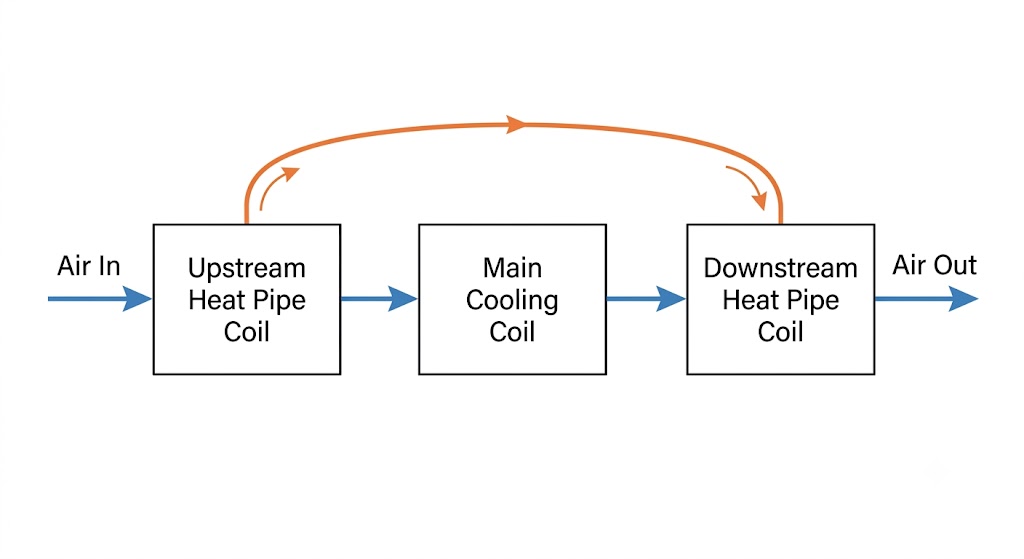
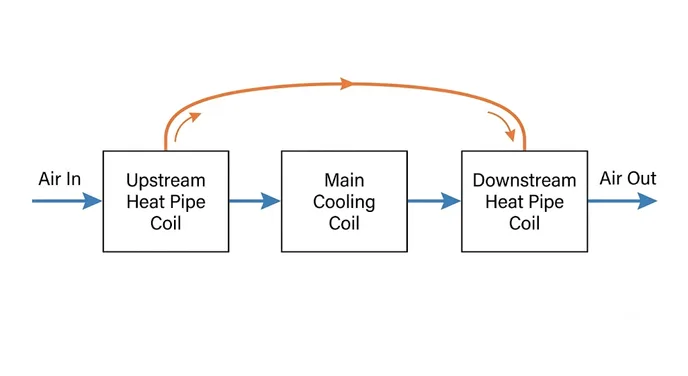
A wrap around heat pipe system places two heat pipe coils around the existing cooling coil, one positioned upstream, before the air reaches the cooling coil, and one positioned downstream, after the air leaves it. These two coils are connected to each other and filled with a refrigerant, forming a completely sealed, passive circuit that requires no pump, no compressor, and no external power source to operate.
The mechanism relies entirely on temperature difference to drive itself. As warm incoming air passes over the upstream heat pipe coil, refrigerant inside that coil absorbs heat and evaporates, cooling the air slightly before it even reaches the main cooling coil. That vaporized refrigerant then flows to the downstream heat pipe coil, positioned after the main cooling coil where the air is now considerably colder, and condenses there, releasing the heat it absorbed upstream directly back into that cold air stream, reheating it passively in the process.
Why This Actually Improves Dehumidification, Not Just Reheat
The upstream precooling effect is genuinely important on its own, separate from the reheat benefit. By lowering the air's temperature slightly before it reaches the main cooling coil, the wrap around heat pipe reduces the load that coil has to handle, effectively allowing the same cooling coil to reach a lower dew point than it could unassisted, or allowing an equivalent dew point to be reached with reduced chilled water or refrigerant capacity than would otherwise be required.
This means a wrap around heat pipe system doesn't simply solve the reheat problem after the fact, it genuinely improves the dehumidification performance of the existing cooling coil itself, while simultaneously providing the reheat that improved dehumidification would otherwise require, all through the same passive, unpowered mechanism.
Why This Is Entirely Passive
The genuinely elegant part of this design is that it requires no external energy input or active control to function at its core. The heat pipe circuit is activated purely by the temperature difference between the warm entering air and the cold air leaving the main cooling coil, when that difference exists, refrigerant naturally evaporates on the warm side and condenses on the cold side, without any pump moving fluid or any compressor doing mechanical work. Some systems add control valves to modulate or stage this effect for situations where full reheat isn't needed, but the core heat transfer mechanism itself remains passive regardless.
Where This Technology Actually Gets Used
This approach shows up specifically in applications where high ventilation rates, significant latent load, and genuine reheat requirements all combine, exactly the conditions where the energy cost of traditional reheat becomes large enough to justify the added equipment.
Dedicated outdoor air systems handling a high percentage of outside air are a natural fit, since these systems are processing air with genuinely high, variable moisture content and often need to deliver a neutral, comfortable discharge temperature rather than the cold air a cooling coil alone would produce.
Healthcare facilities and laboratories frequently require both low humidity and precise temperature control, conditions where the combination of enhanced dehumidification and passive reheat directly addresses two requirements simultaneously rather than needing separate equipment for each.
Natatoriums and fitness centers, which present unusually high latent loads from pool evaporation or occupant activity, are a commonly cited application, since these spaces need aggressive moisture control without delivering uncomfortably cold supply air to occupants.
Hospitality and multi family housing applications benefit similarly, particularly where consistent humidity control across many similar units matters for both comfort and building durability, moisture related material degradation being a genuine long term building concern beyond immediate comfort.
The Practical Energy Case
The value proposition here connects directly back to total cost of ownership for HVAC equipment. A wrap around heat pipe system adds real first cost, additional coils, refrigerant charge, and installation, but eliminates or substantially reduces an ongoing energy cost, active reheat, that would otherwise continue for the entire operating life of the system. Reported paybook periods for this technology are frequently cited in the range of two years or less in genuinely appropriate applications, precisely because the ongoing reheat energy savings accumulate quickly enough to offset the added equipment cost within a relatively short window, after which the passive energy savings continue essentially for free for the remainder of the system's service life.
The Practical Takeaway
A wrap around heat pipe system uses a simple, elegant piece of physics, a sealed refrigerant circuit driven purely by temperature difference, to solve two connected problems at once, boosting a cooling coil's effective dehumidification performance while simultaneously providing the reheat that improved dehumidification would otherwise require, all without consuming any additional energy to do either. In applications with genuine, sustained reheat requirements, high outdoor air systems, healthcare and lab spaces, natatoriums, this passive approach directly addresses the exact energy penalty that makes reheat one of the more wasteful, avoidable costs in conventional HVAC design.
EveryEng. For everyone in Engineering.