

Article details
1. Introduction: The Challenge of Multi-Hazard Structural Loading
As global urbanization drives architectural ambitions higher, structural engineers face the complex challenge of designing supertall buildings capable of withstanding simultaneous multi-directional loads. High-rise structures are subjected to complex combinations of static gravity loads, dynamic wind shear, and seismic ground accelerations.
While traditional structural engineering relied on fixed-base frames that absorbed lateral forces through plastic deformation, this approach risks permanent structural damage and high repair costs during extreme events. Modern supertall design requires an integrated approach combining aerodynamic exterior shaping, base isolation, and advanced mechanical damping systems to maintain both structural integrity and human comfort.
2. Technical Mechanism: Base Isolation and Tuned Mass Dampers
Effective high-rise design relies on two primary mechanical strategies to manage lateral forces: decoupling the building from ground motion and dissipating wind-induced kinetic energy.
A. Base Isolation Systems: Seismic Decoupling
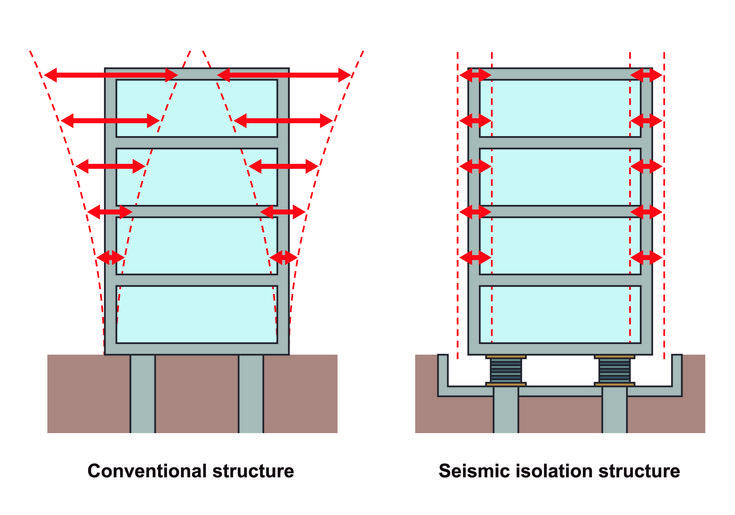
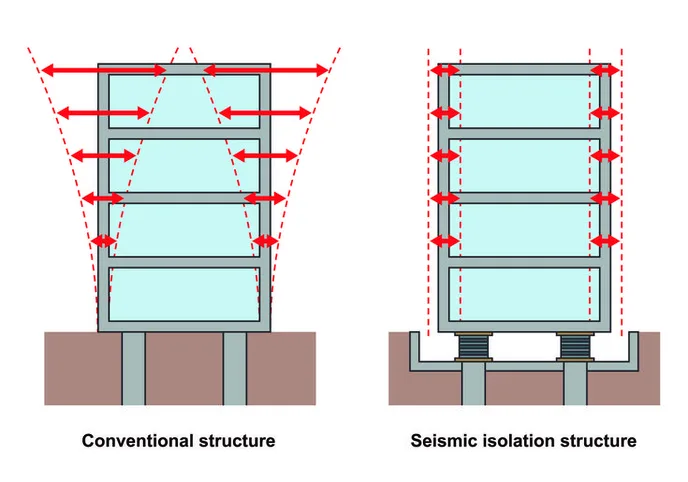
Base isolation inserts a flexible structural layer between a building's foundation and its superstructure.
Lead-Rubber Bearings (LRBs): Consisting of alternating layers of rubber and steel plates with a central lead core, LRBs provide high vertical load capacity while offering extremely low horizontal stiffness.
Friction Pendulum Systems (FPS): Articulated sliders resting on concave spherical stainless steel surfaces use pendulum physics to lengthen the building's natural vibration period.
By shifting the natural period of the building far away from the dominant high-frequency energy of earthquakes, base isolators act as seismic filters, reducing floor accelerations transmitted to upper levels by up to 70–80%.
B. Tuned Mass Dampers (TMDs): Aerodynamic Wind Damping
While base isolation effectively protects against earthquakes, slender supertall towers remain highly vulnerable to vortex shedding and cross-wind acceleration during severe windstorms. To control wind sway, engineers install Tuned Mass Dampers (TMDs) near the top of the structure.
Inertial Mass: A massive steel or concrete block (weighing hundreds of tons) is suspended by steel cables or supported by hydraulic actuators and springs.
Phase Shift: The TMD is tuned precisely to match the fundamental natural frequency of the building. When high-altitude wind gusts cause the tower to sway, the mass oscillates out of phase with the building's movement.
Energy Dissipation: The TMD absorbs kinetic energy and converts it into heat through damping devices, drastically suppressing building acceleration, inter-story drift, and motion sickness for occupants on upper floors.
3. Practical Applications in Supertall Engineering
Integrating base isolators and TMDs transforms how high-rise structures behave under extreme environmental loads:
A. Dual-Action Resilience in Seismic Zones
In active seismic zones subject to occasional high-wind typhoons or hurricanes, structures equipped with base isolation at the foundation and supplemental viscous damping walls in the lower stories achieve comprehensive protection, resisting both low-frequency ground motion and high-velocity wind loads safely.
B. Occupant Comfort in Supertall Towers
Beyond preventing structural collapse, limiting peak accelerations is critical for high-rise commercial and residential towers. TMD systems ensure that building drift remains well within acceptable human perception limits, maintaining comfort and operational continuity during major storms.
Conclusion
Managing high-rise performance under combined seismic and wind load combinations requires moving beyond rigid framing toward advanced dynamic control. By combining base isolation to decouple buildings from seismic ground motion with Tuned Mass Dampers to absorb aerodynamic wind energy, civil engineers can ensure that supertall structures achieve ultimate resilience, protecting both the asset and its occupants for generations to come.