

Article details
For most of HVAC's history, a building's climate control system has been fundamentally reactive: a thermostat measures a temperature, compares it to a setpoint, and turns equipment on or off. Maintenance has followed the same reactive logic — something breaks, then it gets fixed.
AI and IoT integration are changing both halves of that equation — turning HVAC from a passive, reactive system into something closer to a proactive, self-optimizing one.
From Passive Response to Predictive Control
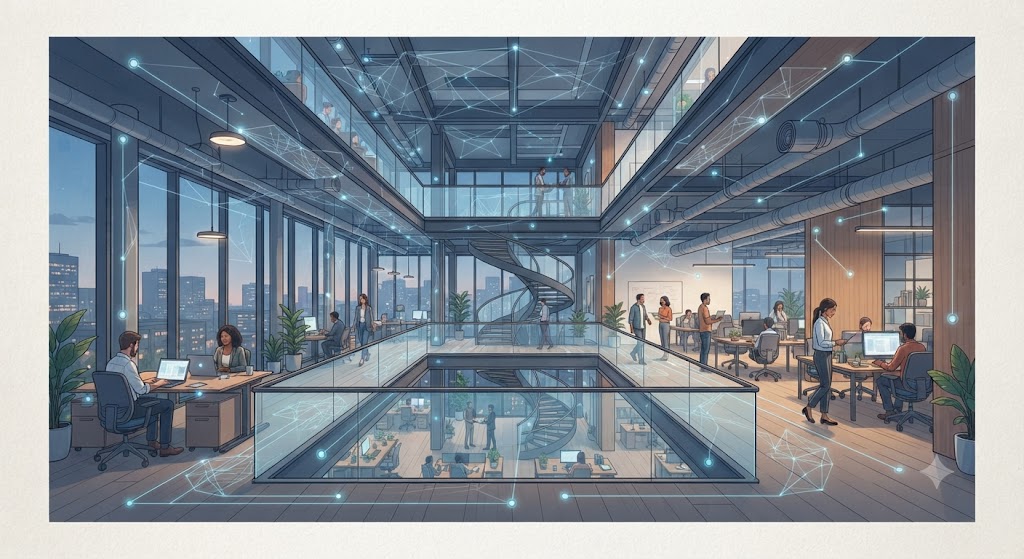
The shift starts with data. IoT sensors distributed through a building — measuring temperature, humidity, occupancy, equipment vibration, energy draw — give a system continuous visibility into conditions that a traditional thermostat simply can't see.
AI models trained on that sensor data can do two things a conventional system can't:
Learn and adapt to actual usage patterns. Rather than following a fixed schedule, a system can learn when spaces are actually occupied, how occupants prefer temperatures set, and adjust automatically — reducing energy waste from conditioning empty spaces or overshooting comfort setpoints.
Predict equipment problems before they cause downtime. By recognizing patterns in vibration, temperature, or power draw data that historically precede a failure, predictive maintenance models can flag a compressor or fan that's likely to fail weeks before it actually does — turning an unplanned outage into a scheduled repair.
Combined, this convergence of AI and IoT is commonly associated with meaningful reductions in energy consumption, alongside fewer unplanned equipment failures and lower associated carbon emissions.
Why Local Processing Matters as Much as the AI Itself
An easy-to-miss detail in how modern smart HVAC controls actually work is where the decision-making happens. Many newer systems are built to make adaptive control decisions locally, on the device itself, rather than depending on a constant connection to a cloud server.
This local-processing approach has a couple of concrete engineering benefits worth understanding on their own terms:
Faster response times. Decisions made on-device can happen in a second or two, rather than waiting on a round-trip to a remote server — which matters for maintaining stable comfort conditions where even short delays are noticeable.
Resilience to connectivity issues. A system that doesn't depend on a constant cloud connection keeps functioning reliably even in locations with intermittent or unreliable network access.
Lower bandwidth demands. Processing data locally means less raw sensor data needs to be transmitted to a centralized building management system, easing network load across a large facility with many sensors.
What This Changes for Building Operators
The practical effect of all this is a shift in where human attention goes. Instead of manually monitoring systems and responding to problems as they arise, operators increasingly work with systems that surface the problems worth their attention and handle routine optimization on their own — freeing up time for higher-value work rather than constant manual monitoring and adjustment.
That's a genuine shift in the skill set the role demands: less time spent on manual system monitoring, more time spent interpreting what a predictive system is flagging and deciding how to act on it.
An Open Question Worth Naming
None of this is without trade-offs. A system that's learned a building's patterns is only as good as the data and assumptions it was trained on — unusual events (a schedule change, an unexpected occupancy spike, a sensor malfunction) can confuse a predictive model in ways a simpler rule-based system wouldn't struggle with. And local, on-device processing means the intelligence embedded in that hardware needs its own maintenance and update path over the equipment's service life, which is a genuinely new category of upkeep for a building's mechanical systems.
Further Reading: www.coolingindia.in/advanced-desiccant-regeneration-methods/ , Cooling India