


Article details
Desiccant-based drying and dehumidification has always had one built-in advantage over conventional high-temperature drying: it works at lower temperatures, which matters enormously for anything heat-sensitive — food, pharmaceuticals, agricultural products. But that advantage has always come with a cost, and it's not in the drying itself. It's in regeneration.
Regeneration is the step where a moisture-loaded desiccant gets "reset" — the absorbed moisture is driven off, usually with heat, so the desiccant can go back to work. Historically, that's meant high-temperature air from fossil-fuel heaters or electric resistance elements, which quietly erodes the efficiency advantage desiccant systems are supposed to offer in the first place. If regeneration itself is energy-hungry, the whole system's case for existing gets weaker.
That's the problem a newer generation of regeneration methods is trying to solve.
The Core Idea: Lower-Grade Heat, Smarter Heat Transfer
Instead of relying purely on high-temperature electrical or fossil-fuel heat, several newer regeneration approaches share a common thread: use lower-grade or renewable heat sources, and improve how that heat actually moves through the desiccant material, rather than just applying more of it.
Broadly, these approaches fall into a few categories:
Renewable and waste-heat integration. Solar thermal collection and industrial waste heat can drive regeneration directly, cutting reliance on grid electricity or combustion. This is particularly attractive because regeneration doesn't typically need especially high temperatures — it needs sufficient, sustained heat, which lower-grade sources can often provide.
Heat pump-assisted regeneration. Rather than generating heat from scratch, heat pumps can upgrade low-grade waste heat to the temperature regeneration requires, improving overall energy efficiency compared to direct resistive or combustion heating.
Alternative heating mechanisms. Microwave and ultrasonic methods work differently from conventional convective heating — they can target moisture more directly within the desiccant material itself, which in principle speeds up desorption and can lower the temperature needed to drive moisture off.
Hybrid configurations. Several approaches combine more than one energy source — for instance, solar collection paired with a secondary heating method — to keep regeneration running even when the primary renewable source (like sunlight) isn't available.
Why This Matters More Than It Might Seem
The efficiency of the regeneration step doesn't just affect operating cost — it affects whether a desiccant system's overall coefficient of performance (COP) genuinely beats a conventional system, or just moves the energy cost from the drying stage to the regeneration stage. Inefficient heat transfer during regeneration can quietly undercut the low-temperature drying advantage that made the desiccant approach attractive to begin with.
That's part of why so much current research effort in this space is concentrated specifically on regeneration, rather than on the adsorption/absorption side of these systems — the desiccant materials themselves have been well understood for decades; the energy economics of resetting them is where the real gains are still being found.
A Worked Example
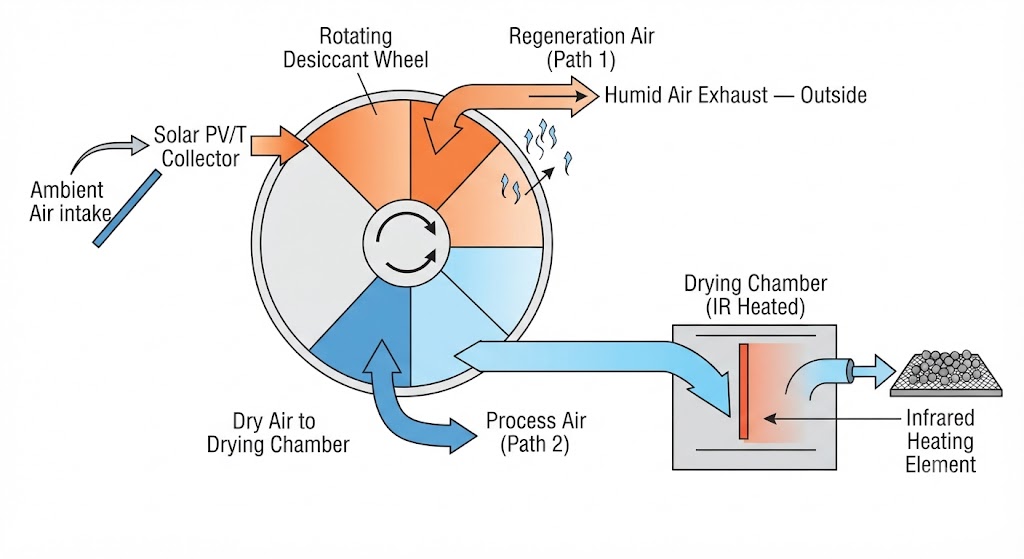
To see how these ideas come together in practice, it's worth looking at a specific configuration: Dr. D. B. Jani (Gujarat Technological University, GEC Bhavnagar), in a review of advanced regeneration methods, describes a hybrid solar-assisted system that pairs a photovoltaic-thermal air collector with a desiccant bed and an infrared drying chamber. The collector generates electricity to run the system's fans while simultaneously preheating air — the same component doing double duty, which is a fairly elegant way to make solar integration pay for itself twice over.
In testing, adding fins to the air collector channel improved heat transfer enough to noticeably boost both thermal and electrical performance compared to a plain-channel design. And the hybrid hot-air-plus-infrared drying approach reduced drying time and cut energy consumption substantially compared to conventional hot-air drying alone, while also producing better product quality — a meaningful result for anyone drying heat-sensitive materials.
A separate configuration Dr. Jani reviews uses liquid desiccant (calcium chloride solution) rather than a solid bed, regenerated in two stages — first boiled off at higher temperature, then further processed at lower temperature before returning to absorb moisture again. The specific engineering detail worth noting: redesigning the contacting surface where air meets liquid desiccant significantly increased the surface area available for moisture exchange, improving performance without needing more energy input.
These aren't the only configurations being explored, and they won't be the last — but they're a useful, concrete illustration of what "combining renewable heat sources with smarter heat transfer design" actually looks like in a working system.
What This Means for HVAC and Mechanical Engineers
Desiccant regeneration sits at an interesting intersection — part thermodynamics, part materials science, part renewable energy integration. As industries with strict moisture-control needs (food processing, pharmaceuticals, agricultural storage) continue looking for lower-carbon drying solutions, the ability to design or specify an efficient regeneration approach — not just an efficient desiccant bed — is becoming a genuinely valuable, somewhat underappreciated skill.
The broader lesson generalizes well beyond desiccant systems, too: in any thermal system, the "reset" or "regeneration" step is often where the real efficiency gains are hiding, simply because it gets less attention than the primary process it supports.