


Article details
Every data center faces the same basic physics problem: nearly all the electricity it consumes eventually becomes heat, and that heat has to go somewhere — continuously, for years on end. Most facilities solve this with mechanical cooling. A growing number are looking underground instead.
Geothermal cooling isn't new science. But applying it to a load as large and relentless as a data center raises engineering questions that are easy to get wrong. Here's how it actually works, and where the real challenges live.
Two Technologies, Often Confused
The first thing to separate is what "geothermal" actually means in this context, because it covers two genuinely different technologies.
Geothermal heat pumps don't generate electricity — they move heat. They use electricity to transfer heat more efficiently than a conventional system would, exchanging it with the relatively stable temperature underground instead of the more volatile temperature of outdoor air.
Enhanced geothermal systems (EGS), by contrast, are a power generation technology. Using drilling techniques adapted from oil and gas extraction, they tap deep underground heat to produce electricity around the clock — an entirely different application from cooling. Getting this distinction right matters, because the engineering, the cost structure, and the use case for each are completely different.
The Core Mechanism: Why the Ground Works So Well
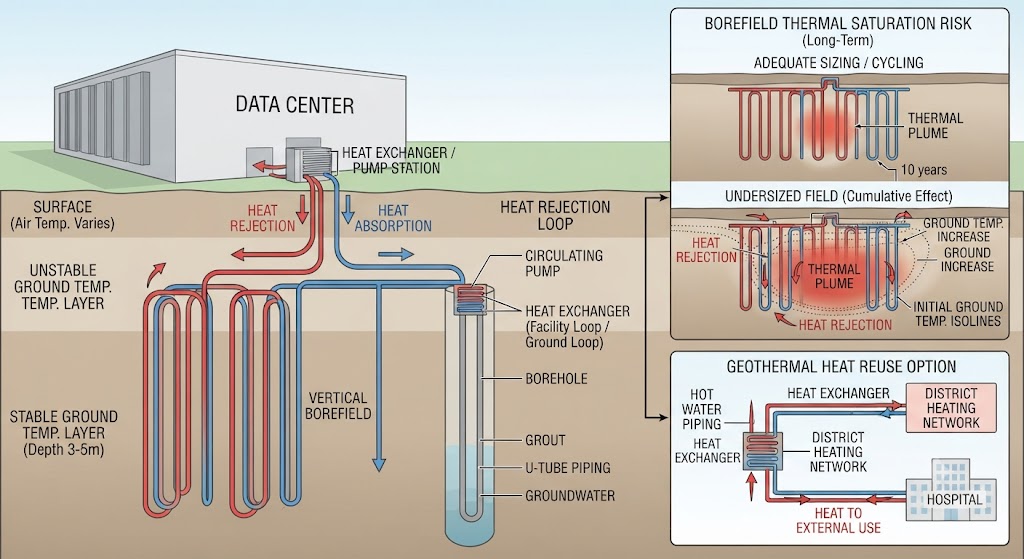
Air temperature swings dramatically with the seasons. A few meters underground, temperature stays remarkably stable year-round. That stability is what makes ground-source systems efficient — they're always exchanging heat with a moderate baseline, rather than fighting against extreme outdoor conditions.
In practice, this is done through:
Borefields — networks of vertical wells where fluid circulates, absorbing or releasing heat as it moves through pipe loops in the ground
Underground thermal energy storage — chilled water stored in the subsurface and drawn on during periods of peak cooling demand
Lake or aquifer loops — using existing or engineered underground water storage as a heat sink, particularly useful for facilities with land available on-site
The efficiency payoff is substantial. Ground-source heat pumps commonly achieve a coefficient of performance (COP) of 4 to 5 — meaning four to five units of thermal energy delivered for every unit of electricity consumed. That's a significant efficiency advantage over most conventional air-based systems.
The Engineering Challenge Most People Underestimate
Geothermal cooling isn't a matter of "dig a well and you're done." Two things determine whether a system actually works long-term:
1. Load analysis, not assumptions. A data center is a cooling-dominant load by definition — it runs hot constantly, not seasonally. A borefield sized on rough assumptions about ground conductivity, rather than a genuine load analysis, is a common way these systems underperform.
2. Thermal saturation risk. Ground isn't an infinite heat sink. Continuously rejecting heat into the same borefield without adequate sizing or cycling can gradually raise the surrounding ground temperature over years, degrading system performance. Proper design accounts for this from day one — it isn't something you can fix retroactively.
Geography also plays a bigger role than people expect. Ground-source cooling isn't limited to cold climates — it's been successfully deployed even in desert regions, since the technology works on temperature stability, not absolute temperature. What varies by location is water availability and subsurface conditions, which determine how efficiently heat can actually be exchanged.
The Overlooked Upside: Heat Reuse
One of the more interesting aspects of geothermal cooling is that the heat being rejected doesn't have to be wasted. If a facility is located near a use case for hot water — a hospital, a district heating network, another industrial process — that rejected heat can be piped out and put to use instead of dumped. This value proposition tends to be strongest in colder climates, where there's consistent year-round demand for heating, making the "waste" heat genuinely useful rather than incidental.
Why This Matters for HVAC and Mechanical Engineers
Ground-source systems require a different skill set than conventional HVAC work. Borefield design, in particular, isn't typically covered under general HVAC licensing — it sits closer to hydrogeology and civil engineering than traditional mechanical design.
As large-scale cooling loads keep growing — not just in data centers, but across commercial and industrial facilities looking to cut both emissions and long-term energy costs — that borefield competency is likely to become a genuinely valuable, differentiated skill. Engineers who understand both the thermal mechanics and the practical failure points (undersized fields, saturation risk, site-specific water conditions) will be positioned well ahead of the curve.
Further reading: https://www.achrnews.com/articles/166407-can-geothermal-technology-decarbonize-data-centers ,ACHR News.