


Article details
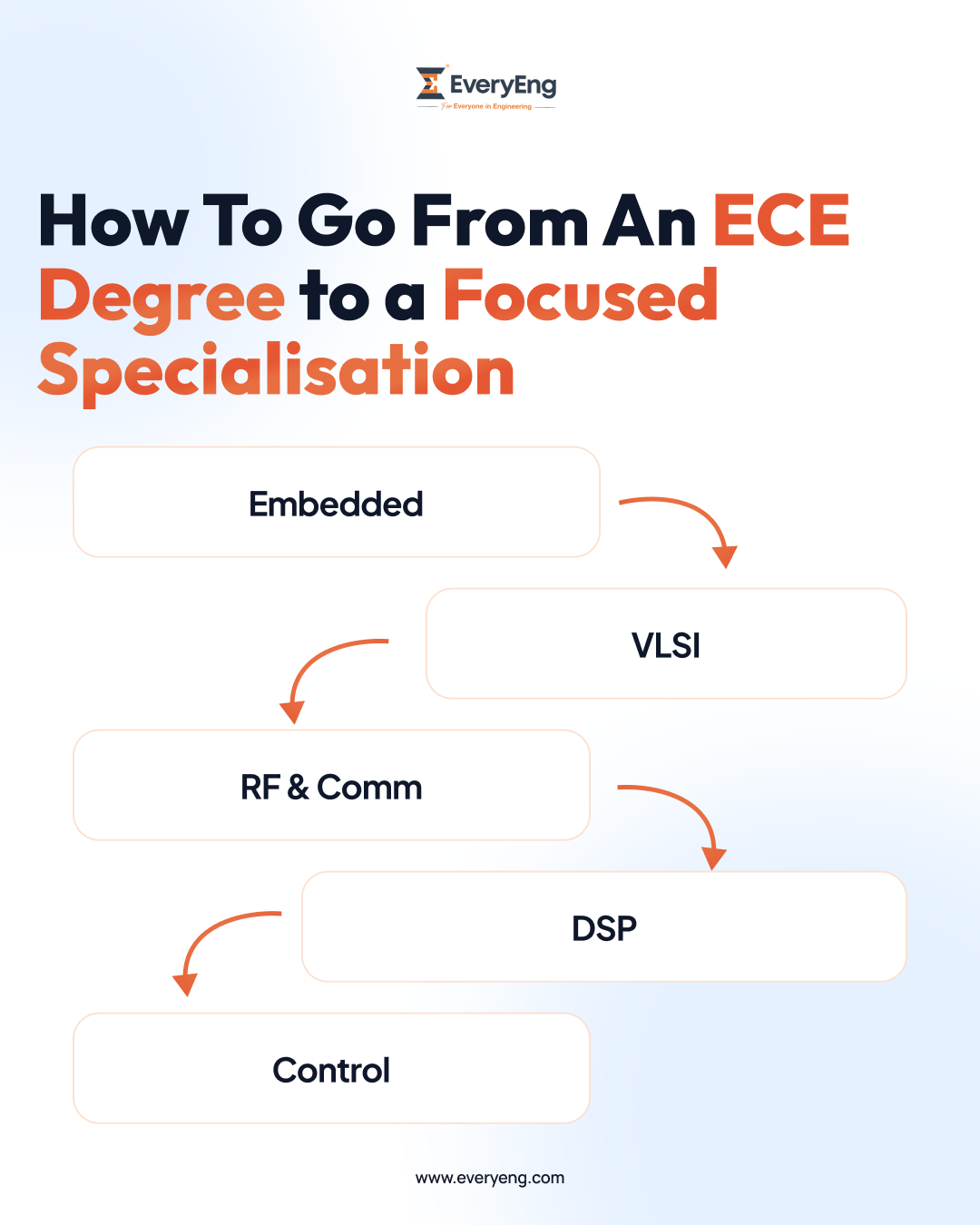
Embedded, VLSI, RF, DSP or Control: What Each ECE Specialisation Actually Looks Like Once You're On the Job
If you're an ECE student or a fresh grad who still doesn't have a solid answer to "so what do you want to specialise in," this is the ten-minute version of that answer.
Somewhere around the fifth or sixth semester, every ECE student hits the same quiet crisis. You've cleared Signals and Systems, sat through Digital Communication, survived Control Systems, maybe built one project with an 8051 or an Arduino that you're still a little proud of. Then a placement coordinator, a senior, or a recruiter asks the question "so, what do you want to do, embedded or VLSI or what?" and you realise nobody actually told you that ECE was never one job. It was always five or six different careers, taught together because they share some maths and a syllabus, not because they lead anywhere similar.
This isn't a detail you can sort out later without cost. Companies hiring for core engineering roles aren't impressed that you've "done ECE" that part's assumed the moment your resume lands on the desk. They want someone who can read a datasheet and get a peripheral working, or close timing on a block of chip logic, or explain what actually happens to a signal between an antenna and a baseband chip. The degree gets you shortlisted. A real, specific skill gets you hired.
So here's what each of the big five tracks actually looks like once you're past the interview and sitting at a desk or a lab bench, doing the job.
Embedded Systems
This is the track most people already have a rough feel for, even without knowing its name. If you've made an LED blink using an 8051 or gotten a sensor talking to an Arduino over I2C, you've done a small, toy version of embedded work.
The real job is writing the software that lives directly on hardware firmware, mostly in C, sometimes C++ for microcontrollers sitting inside actual products: a car's ECU, a smart thermostat, a pacemaker, a Bluetooth speaker, an industrial sensor. There's no friendly operating system underneath you most of the time. You're often the closest thing the device has to one.
Expect a lot of datasheet reading genuinely more than people expect going in, since a single peripheral register can eat your entire morning plus debugging with an oscilloscope or logic analyzer instead of a debugger with breakpoints that behave perfectly. And there's a very specific, very common frustration: four hours of blaming your code before discovering the actual bug was a floating pin or a missing pull-up resistor.
Bosch, Continental, and most automotive suppliers hire heavily here right now, thanks to the ADAS (Advanced Driver Assistance Systems) and EV boom, alongside STMicroelectronics, Texas Instruments, consumer electronics companies, IoT firms, and medical device makers.
You'll probably like this if the hardware labs were your favourite part of college, and you didn't mind staying back to actually debug something instead of copying a senior's working code five minutes before submission. You'll probably struggle with it if you need fast feedback loops embedded debugging is slow, physical, and occasionally turns into genuine detective work with a multimeter in hand.
VLSI (Chip Design)
VLSI is usually where the "wait, what does this even involve" confusion starts, mostly because unlike embedded, most students never touch it hands-on beyond one or two Verilog assignments that don't resemble the actual job at all.
At its core, VLSI is about designing the chip itself the silicon rather than the software running on it. It splits further into digital design (writing RTL, or Register Transfer Level code, in Verilog or VHDL to describe what the chip should logically do), verification (proving the design does exactly that before fabrication, since a bug caught after the chip is manufactured can cost months and millions), physical design (turning that logic into an actual layout on silicon while wrestling with timing, power, and area), and analog design a smaller, harder-to-enter, generally higher-paying specialisation dealing with things like amplifiers and data converters instead of pure logic.
Day to day revolves around EDA (Electronic Design Automation) tools Cadence, Synopsys, Siemens EDA, the company formerly known as Mentor Graphics and a rhythm that's completely different from software. You write something, kick off a simulation or synthesis run, and then wait. Sometimes minutes. Sometimes overnight. Patience here is a genuine, practical job skill, not just a nice personality trait to have.
India has quietly become one of the largest VLSI hubs in the world Bangalore, Hyderabad, and Noida all host serious design centres for Qualcomm, Intel, NVIDIA, AMD, Texas Instruments, Broadcom, Samsung, Micron, and MediaTek, among others. A good GATE score also matters more here than in most other tracks, since a large share of people get into VLSI through an M.Tech rather than a straight B.Tech placement.
If you liked the precision of digital electronics and don't mind reading a spec three times before writing a single line of code, this fits well. If you need to see your work run instantly to feel like you're making progress, the long feedback loops here can wear you down.
RF and Communication
This track deals with how signals actually get from one place to another phone to tower, satellite to ground station, one WiFi device to the next. It sits right at the intersection of hardware and fairly serious maths.
Depending on where you land, the job leans one of two ways. On the hardware side, you're designing RF circuits amplifiers, filters, mixers, antennas using tools like ADS (Advanced Design System) or HFSS, and thinking in Smith charts and impedance matching (yes, that thing from your third-year RF course actually gets used on the job). On the systems side, you're closer to the communication stack itself modulation schemes, coding, the physical layer of things like 5G which leans more on probability and information theory than on hardware.
ISRO is a major name here, especially if satellite communication interests you, alongside Qualcomm, Nokia, Ericsson, Samsung R&D, DRDO, and a growing set of Indian space-tech and satcom startups.
This one rewards people who actually enjoyed communication theory rather than just surviving it. If modulation and demodulation made intuitive sense to you, rather than feeling like formulas to cram the night before an exam, take that as a real signal.
Digital Signal Processing (DSP)
DSP is about extracting, cleaning up, or transforming information from signals audio, images, video, sensor data, radar, anything that can be turned into a stream of numbers. It's turned into one of the more future-facing ECE tracks lately, since a large chunk of what gets marketed as "AI" in speech recognition, camera processing, and audio enhancement is, underneath, DSP with a new label stuck on top.
Work usually starts in MATLAB or Python to prototype an algorithm, then moves toward optimising it in C or targeting specific hardware a DSP chip, an FPGA, or just an efficient implementation on a general processor so it can run in real time on an actual device instead of just on your laptop.
Qualcomm does a massive amount of DSP work for its chipsets, and beyond that, camera and audio companies, healthcare imaging firms, and pretty much any company doing on-device AI for vision or speech will have DSP-heavy roles open. It's also the track with the smoothest exit into pure machine learning or data science later on, if that ends up pulling at you.
The honest test for this one: did you actually enjoy the maths Fourier transforms, filter design, statistics or did you just get through it? This is probably the most consistently maths-heavy of all five tracks on a daily basis, even more than RF for most roles, so a genuine yes here counts for more than it does elsewhere.
Control Systems
Control gets an unfair reputation in college as the dry subject full of Bode plots and root locus diagrams nobody enjoys. On the job, it shows up almost everywhere something physical needs to behave predictably on its own: robotics, industrial automation, aerospace, drones, and a large part of automotive work, from cruise control to stability control to the control stacks inside autonomous driving systems.
Day to day involves plenty of MATLAB/Simulink for designing and simulating controllers, and PID control the proportional-integral-derivative kind you sat through in class is still everywhere, more relevant today than your professor's dry delivery probably suggested. Eventually, someone has to put that controller onto real hardware, which is where this track often overlaps directly with embedded systems.
Automotive companies working on ADAS, robotics firms, process industries like oil, gas, and manufacturing automation, aerospace players (ISRO, HAL, and a growing number of private space companies), and industrial automation giants like Siemens, ABB, Honeywell, and Emerson all hire seriously here.
If you genuinely liked control theory, not just tolerated it, or you're drawn to robotics and automation as an application regardless of how the underlying maths feels, this is worth a serious look. It also pairs unusually well with a later M.Tech if you want to go deeper into the theory.
So How Do You Actually Pick?
Not from whichever subject you scored highest in. A grade from a three-hour exam doesn't predict whether you'll enjoy eight hours a day of the real work. Plenty of people top a Control Systems paper and would hate an automation job, and plenty of people barely scrape through Digital Communication and end up loving RF work once it's hands-on instead of on paper.
A better test: think about the labs, projects, or debugging sessions you didn't mind doing badly, or doing for free, or staying up late for without anyone asking you to. That's a far more honest signal than any grade sheet.
It also helps to think about which bad day you can tolerate, not just which good day sounds exciting. Every one of these tracks has a frustrating side. VLSI has long tool runtimes where you're just waiting. Embedded has hours lost chasing a bug that turns out to be a loose wire. RF and DSP both have maths that refuses to click on the first pass. Control has simulations that behave perfectly right up until you try them on actual hardware. Whichever frustration you can shrug off easiest is probably your track.
If you can, talk to two or three people actually working in the fields you're weighing up, and ask one boring, specific question: what did you do between 10 am and 6 pm last Tuesday? Job descriptions and career posts yes, including this one tend to make everything sound more exciting than the daily reality is. A short, honest answer to that one question usually tells you more than an hour of reading around the topic.
And if none of this resolves things before placement season, that's fine too. These tracks are far more permeable in the first two or three years of a career than people assume. Embedded engineers move into control. DSP engineers move into machine learning. VLSI verification engineers switch domains entirely. The first job matters a lot less than the first skill you actually go deep on, whichever track it happens to be in.
None of these five is the "best" one in any general sense they're just different bets on what kind of problems you want to spend your working hours solving. The only real mistake is staying generic long enough that nobody, including you, can say what you're actually good at. Pick one, go deep enough to be useful, and let the specifics sort themselves out from there.

 Oct 2, 2026