


Article details
How Operating Conditions Affect COP in a Vapour Compression Refrigeration Cycle
Introduction
The Coefficient of Performance (COP) is the primary measure of efficiency for a Vapour Compression Refrigeration Cycle. It expresses how much refrigeration effect is obtained per unit of compressor work:

Because both the refrigeration effect and the compressor work depend strongly on operating conditions, even small changes in temperatures, pressures, and heat-transfer conditions can significantly alter COP. Understanding these effects helps engineers optimize plant performance, reduce energy consumption, and prevent common inefficiencies.
1. Effect of Evaporator Temperature (Evaporating Pressure)
Trend: Increasing evaporator temperature increases COP.
Why:
Higher evaporator temperature → higher suction pressure.
Compression ratio decreases.
Compressor work reduces.
Refrigeration effect per kg of refrigerant increases.
Practical note: Dirty evaporator coils, poor airflow, or frost formation lower the effective evaporator temperature and reduce COP.
2. Effect of Condenser Temperature (Condensing Pressure)
Trend: Increasing condenser temperature decreases COP.
Why:
Higher condensing temperature → higher discharge pressure.
Compression ratio increases.
Compressor work increases significantly.
Net COP drops.
Causes of high condenser temperature:
Fouled condenser tubes
Inadequate cooling water/airflow
High ambient temperature
3. Effect of Compression Ratio

Trend: Higher compression ratio reduces COP.
A large pressure lift demands more work from the compressor and raises discharge temperature, lowering efficiency.
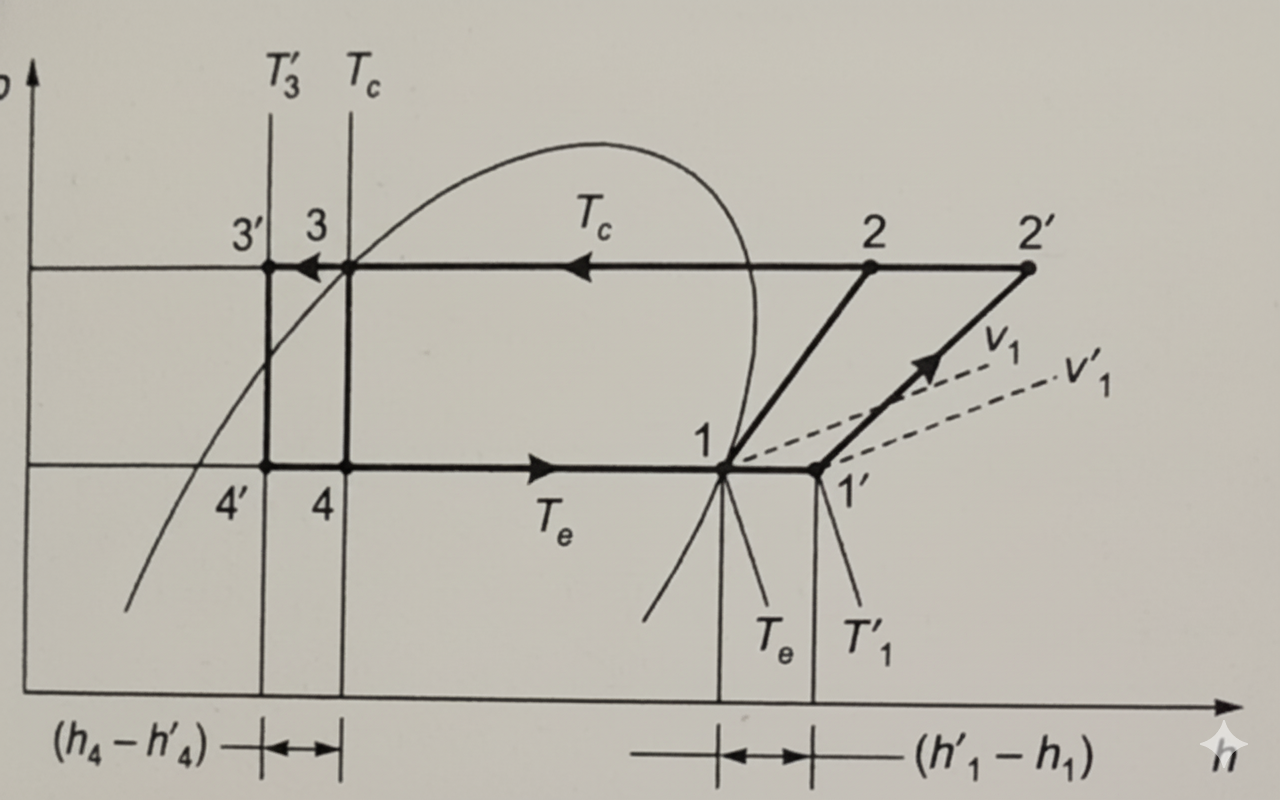
4. Effect of Superheating at Compressor Inlet
Small superheating: Slightly increases refrigeration effect and is safe for the compressor.
Excessive superheating:
Increases specific volume at suction.
Reduces mass flow rate.
Increases compressor work.
Reduces COP.
5. Effect of Subcooling Before Expansion Valve
Trend: Subcooling increases COP.
Why:
Increases refrigeration effect without increasing compressor work.
Prevents flash gas formation before evaporator.
Subcooling is often achieved using liquid–suction heat exchangers.
6. Effect of Refrigerant Charge
Undercharge: Starved evaporator, low suction pressure → low COP.
Overcharge: Flooded condenser, high head pressure → low COP.
Correct refrigerant charge is essential for optimal performance.
7. Effect of Heat Transfer Efficiency
Evaporator side
Poor airflow, scaling, or frost → low heat absorption → reduced COP.
Condenser side
Dirty condenser → high condensing temperature → reduced COP.
Regular maintenance directly improves COP.
8. Effect of Expansion Valve Operation
If the expansion valve is not properly adjusted:
Too much flow → liquid carryover, compressor damage.
Too little flow → evaporator underfed, low refrigeration effect.
Both conditions reduce COP.
9. Effect of Ambient Conditions
High ambient air or cooling water temperature:
Raises condenser temperature.
Increases compressor work.
Decreases COP.
This is why refrigeration systems consume more power in summer.
10. Effect of Intercooling and Multistaging
Using intercooling (such as flash intercooling) between compression stages:
Reduces compressor work.
Improves volumetric efficiency.
Increases COP, especially in low-temperature systems.
11. Effect of Compressor Efficiency
Mechanical losses, valve leakage, and poor lubrication:
Increase power consumption.
Reduce actual COP compared to theoretical COP.
Summary Table
Operating Condition | Change | Effect on COP | Reason |
|---|---|---|---|
Evaporator temperature ↑ | Suction pressure ↑ | COP ↑ | Lower work, higher effect |
Condenser temperature ↑ | Discharge pressure ↑ | COP ↓ | Higher work |
Compression ratio ↑ | — | COP ↓ | More power needed |
Superheating (excess) | — | COP ↓ | Higher work, low mass flow |
Subcooling ↑ | — | COP ↑ | Higher refrigeration effect |
Dirty evaporator | — | COP ↓ | Poor heat absorption |
Dirty condenser | — | COP ↓ | High head pressure |
Incorrect refrigerant charge | — | COP ↓ | Improper pressures |
High ambient temperature | — | COP ↓ | Higher condensing temp |
Intercooling used | — | COP ↑ | Reduced compressor work |
Practical Engineering Insights
To maintain high COP in real systems:
Keep evaporator and condenser clean.
Ensure proper airflow and water flow.
Maintain correct refrigerant charge.
Avoid excessive superheating.
Promote subcooling where possible.
Monitor suction and discharge pressures regularly