

Article details
Refrigeration based dehumidification removes moisture by condensing it on a cold coil. Desiccant systems remove moisture by adsorbing it into a hygroscopic material. Membrane dehumidification does something genuinely different from both, separating water vapor from air using a selective barrier that lets water molecules through while blocking the rest of the air stream entirely, without a phase change and without a chemical desiccant material at all.
The Core Mechanism: Selective Permeability
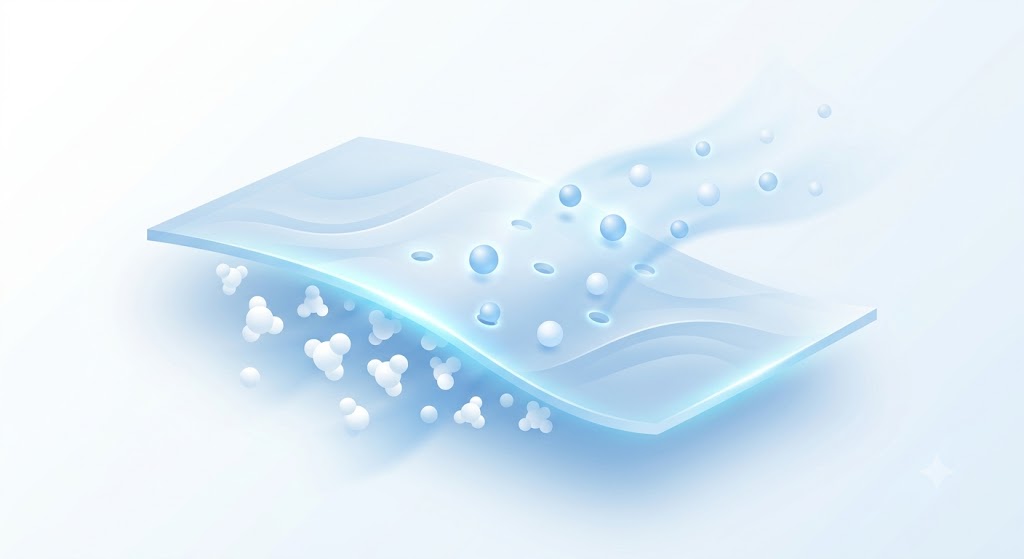
A dehumidification membrane is built from a material that's deliberately permeable to water vapor while remaining largely impermeable to the nitrogen and oxygen that make up the bulk of air. When humid air contacts one side of this membrane, water molecules pass through to the other side while the surrounding air itself is mostly blocked from following.
What actually drives this movement is a difference in water vapor partial pressure across the two sides of the membrane, water vapor naturally moves from the higher pressure side to the lower pressure side, exactly the same basic principle behind diffusion generally, just applied specifically to water vapor moving through a material engineered to let it through selectively. As long as a lower vapor pressure is maintained on the far side of the membrane, whether through a purge air stream, a vacuum, or another pressure reducing method, water vapor continues moving across, steadily drying the air on the original side.
Why This Genuinely Differs From Desiccant Systems
This distinction is worth stating plainly, since membrane dehumidification is sometimes casually lumped in with desiccant technology despite working on a fundamentally different principle. Desiccant systems rely on a hygroscopic material's chemical attraction to water, and that material has to be regenerated, typically using heat, once it's absorbed as much moisture as it can hold. Membrane dehumidification doesn't involve a material becoming progressively saturated at all, water vapor continuously passes through the membrane and is removed on the other side, without any material needing periodic regeneration in the way a desiccant wheel or liquid desiccant solution does.
This is a genuinely meaningful practical difference. A membrane system's continuous operation, without a regeneration cycle to manage, represents a real simplification compared to the regeneration heat source, control logic, and cycling covered in how desiccant systems are getting more energy efficient.
Why This Genuinely Differs From Refrigeration Based Dehumidification
The distinction from refrigeration based dehumidification is equally important. Cooling coil dehumidification requires a phase change, cooling air below its dew point so water vapor condenses into liquid, a process that consumes real cooling capacity and, as covered in why refrigeration based dehumidification fails at low humidity, becomes progressively less efficient as relative humidity drops.
Membrane dehumidification doesn't require this phase change at all. Water vapor moves through the membrane while remaining in vapor form throughout the process, meaning the membrane's effectiveness isn't tied to driving air temperature down toward an increasingly extreme dew point the way condensation based dehumidification is. This is genuinely significant for low humidity applications specifically, the same category of applications where refrigeration based systems struggle most.
Maintaining the Pressure Differential
Since water vapor movement across the membrane depends entirely on a genuine pressure differential existing, different practical approaches exist for actually maintaining that differential during operation.
Purge or sweep air streams use a separate, drier air stream flowing on the far side of the membrane, continuously carrying away the water vapor that's passed through and keeping vapor pressure on that side low enough to sustain the pressure differential driving further moisture transfer.
Vacuum based systems use a vacuum pump connected to the far side of the membrane, actively creating and maintaining a low pressure environment there, which can achieve a stronger, more consistent driving force than a purge stream alone, though at the cost of the energy required to run the vacuum pump itself.
Pressure increasing devices in some system designs actively compress the water vapor collected on the far side of the membrane, both maintaining the necessary low pressure at the membrane surface and simultaneously raising the collected vapor's pressure enough that it can subsequently be condensed into liquid water for disposal or recovery, combining the membrane separation step with a controlled condensation step downstream.
Where This Technology Genuinely Fits
Membrane dehumidification is still a comparatively emerging technology relative to well established desiccant and refrigeration based approaches, but it's finding genuine application in a few specific areas.
Electronics protection is one of the more mature applications, using membrane technology to keep sensitive electronic enclosures dry and prevent condensation related corrosion or short circuiting, without needing a full mechanical dehumidification system built into a small, sealed enclosure.
Aerospace and specialized environmental control systems have used membrane based vapor separation for years, since the technology's compact size and lack of a phase change or chemical regeneration cycle suit applications where weight, complexity, and reliability all carry unusually high stakes.
Emerging HVAC applications are actively exploring membrane technology specifically for the low relative humidity, high latent load scenarios covered throughout this series, situations where both refrigeration based and conventional desiccant approaches carry real efficiency penalties that a membrane approach, still developing toward broader commercial HVAC deployment, aims to avoid.
Genuine Limitations Worth Naming
Membrane technology isn't without real challenges. Selectivity and permeability, how effectively a given membrane passes water vapor while blocking other gases, and how much vapor flux it can actually achieve for a given membrane area, directly determine how much dehumidification capacity a practically sized membrane system can deliver, and improving both simultaneously remains an active area of materials research rather than a fully solved problem. Systems relying on vacuum pumps or pressure increasing devices to maintain the necessary pressure differential also introduce their own energy consumption, meaning the technology's genuine efficiency advantage over refrigeration or desiccant approaches depends significantly on how efficiently that pressure differential can actually be maintained in a specific system design.
The Practical Takeaway
Membrane dehumidification offers a genuinely distinct third mechanism for removing moisture from air, selective vapor permeability driven by a pressure differential, rather than condensation or chemical adsorption. It avoids the dew point limitations that constrain refrigeration based systems at low humidity, and avoids the regeneration cycle that desiccant systems require, though it remains a comparatively emerging technology whose broader commercial HVAC adoption is still actively developing rather than fully established. Understanding it as a genuinely separate category, not simply a variant of desiccant technology, is what allows an accurate comparison against the more established approaches it's ultimately trying to complement or improve upon.
EveryEng. For everyone in Engineering.