

Article details
1. Introduction: The Vulnerability of Concrete to Micro-Cracking
Concrete is the world's most consumed man-made material, prized for its high compressive strength and versatility. However, concrete is inherently weak in tension, making it susceptible to micro-cracking during early-age curing, thermal contraction, and structural loading.
In marine environments, tunnels, and deep subterranean foundations, these micro-cracks act as open pathways for moisture, oxygen, chloride ions, and aggressive chemicals to infiltrate the concrete matrix. Once these elements reach internal steel reinforcement, they trigger rapid corrosion, rust expansion, spalling, and eventual structural degradation. Traditional repair methods—such as manual injection or epoxy sealing—are often labor-intensive, costly, and ineffective for inaccessible subterranean or underwater assets.
To overcome these limitations, materials scientists and civil engineers have pioneered Microbial Self-Healing Concrete, a bio-based technology that enables concrete to autonomously repair its own cracks from within.
2. Technical Mechanism: Bacterial Spores and Calcium Carbonate Precipitation
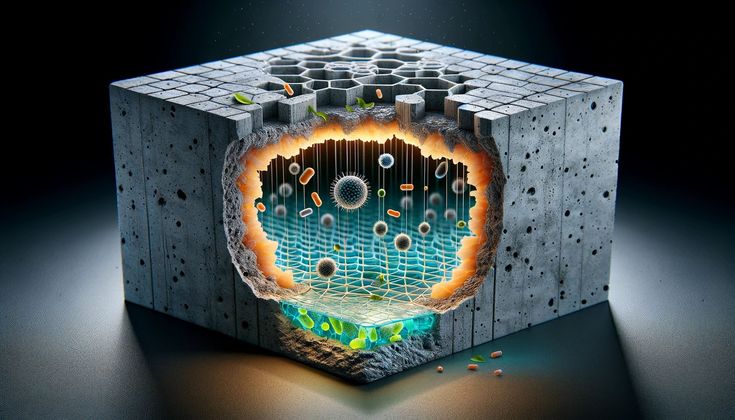
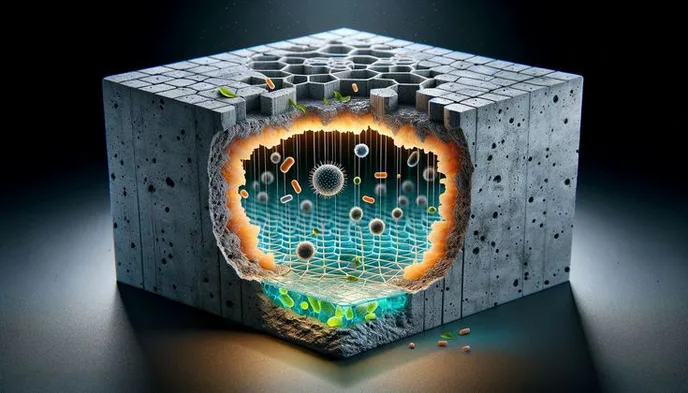
Microbial self-healing concrete mimics biological biomineralization processes found in nature, embedding dormant bacterial spores and organic nutrients directly into the concrete mix batch.
A. Encapsulated Bio-Agents
The self-healing system relies on specialized, highly resilient components:
Alkaliphilic Bacteria: Spores of alkali-resistant bacteria (such as Bacillus pseudofirmus or Bacillus cohnii) capable of surviving the extreme high-pH, alkaline environment of curing cement paste.
Nutrient Precursor: Compounds such as calcium lactate mixed alongside the bacterial spores inside protective micro-capsules or porous expanded clay particles.
B. The Autogenous Healing Process
When structural stress induces a micro-crack, external moisture and oxygen penetrate the void:
Capsule Rupture: Ingress water dissolves and ruptures the protective micro-capsules, awakening the dormant bacterial spores.
Metabolic Reaction: The activated bacteria consume the calcium lactate nutrient and oxygen, effectively scavenging corrosive oxygen away from internal steel rebar.
Limestone Precipitation: Through their metabolic cycle, the bacteria react with dissolved calcium ions to precipitate insoluble limestone (calcium carbonate, $CaCO_3$) crystals.
Void Sealing: Over a few weeks, these growing crystals completely fill and physically seal micro-cracks up to 0.8 mm in width, restoring water-tightness.
3. Practical Applications in Substructure Engineering
Integrating self-healing microbial agents into concrete mix designs offers profound benefits for critical, high-exposure infrastructure:
A. Marine Structures and Port Facilities
Wharves, seawalls, bridge piers, and offshore caissons endure constant exposure to aggressive seawater chlorides and tidal wet-dry cycles. Microbial concrete prevents chloride ion ingress, drastically extending the service life of marine substructures and reducing costly underwater maintenance.
B. Tunnels and Underground Foundations
Deep underground transit tunnels and basement substructures face high external hydrostatic water pressure. Self-healing concrete provides an internal waterproofing safety net, automatically sealing hairline seepage cracks before they can cause structural dampness or rebar corrosion.
Conclusion
Microbial Self-Healing Concrete represents a transformative convergence of biotechnology and civil engineering materials science. By embedding dormant bacteria and nutrients that activate upon water ingress to precipitate limestone crystals, structural elements can autonomously repair micro-cracks from the inside out. This biological innovation enhances long-term durability, slashes maintenance expenditures, and ensures resilient infrastructure in aggressive marine and subterranean environments.