

Article details
In the metal casting process, a pattern is a crucial tool that serves as a replica of the object to be manufactured. This replica, which incorporates necessary modifications or "allowances," is used to create the mold cavity into which molten material is poured.
Patterns can be fabricated from various materials, including wood, plastic, or metal. The selection of an appropriate pattern type is a critical decision that depends on several factors:
The size and shape of the final casting.
The required dimensional accuracy.
The total quantity of parts to be produced.
The specific molding process being used.
Several types of patterns exist, each designed for specific applications and production scales.
Classification of Casting Patterns
1. Single Solid Piece Pattern
Also known as a solid pattern, this is the simplest design. It is fabricated as a single piece and is primarily used for producing very simple casting shapes where complexity and production volume are low.
2. Loose Piece Pattern
The loose piece pattern is a more complex design used when the final part features internal webs, undercuts, or projections. These loose pieces are part of the main pattern but are designed to remain in the mold when the main pattern body is withdrawn. They are then removed from the mold separately.
3. Cope and Drag Pattern
This pattern is constructed in two separate halves that are molded independently.
The top half of the pattern creates the cope (top) section of the mold.
The bottom half creates the drag (bottom) section of the mold.
The two mold halves are then assembled, using guide and locating pins for precise alignment. This pattern type is generally used for large and heavy castings or for parts that are inconvenient for continuous production.
4. Match Plate Pattern


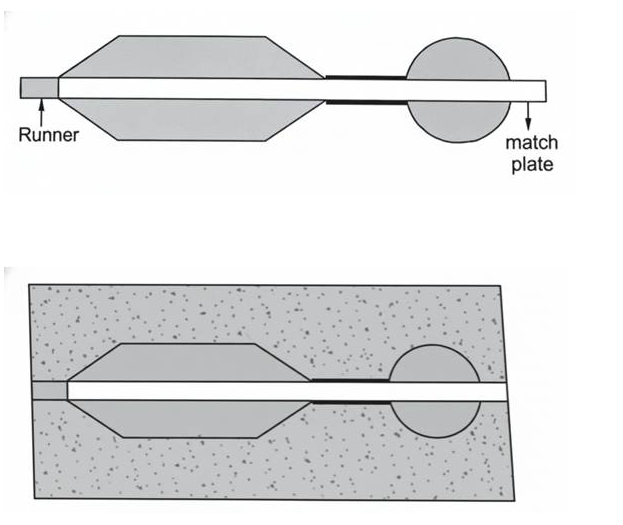
Similar to the cope and drag, the match plate pattern also consists of two pattern halves. In this design, the halves are mounted directly on opposite sides of a single match plate (made of wood or metal), which conforms to the parting surface of the mold.
The plate is accurately positioned between the cope and drag flasks using locating pins. This method is highly efficient for producing small castings, and several patterns can be mounted on the same plate to increase production volume significantly.
5. Gated Pattern
In a gated pattern, the gating system and runners—the channels through which molten metal flows into the cavity—are an integral part of the pattern itself. This design offers a major productivity advantage as it eliminates the need for hand-cutting the gates and runners into the mold, which is a time-consuming manual step.
6. Sweep Pattern
The sweep pattern is used to generate surfaces of revolution for large, circular castings like rings or flanges.

Typically made of wood, the "sweep" is a 2-dimensional profile or section of the casting.
This pattern is rotated 360° around a central axis or edge.
As it sweeps through a "paste-like" molding material (such as loam sand, a mixture of 50% silica and 50% clay), it carves out a 3-dimensional complex cavity.
This method significantly reduces the cost and complexity associated with fabricating a full, large-scale 3D pattern.
7. Skeleton Pattern
When producing very large, simple shapes like shells, drums, or large cylinders, a skeleton pattern is used to minimize pattern material consumption.


This pattern consists of a basic 3-dimensional wooden framework (the "skeleton").
This framework is often covered with wire mesh to help hold the molding sand.
A small wooden piece may be used as a strickle or guide to define the part's final contour.
Molding sand is then packed around this framework to complete the mold.
8. Follow Board Pattern
A follow board is a support tool used for patterns that are thin, weak, or have overhanging sections. These delicate patterns could distort, bend, or break under the force of ramming the molding sand. The follow board is a custom-shaped wooden board that supports the pattern from inside the mold, ensuring it maintains its correct shape during the molding process.
Conclusion
Understanding the application, advantages, and limitations of each pattern type is essential for selecting the correct method to achieve efficient, economical, and accurate casting production.


 Aug 29, 2026