


Article details
In the world of manufacturing, casting processes are generally divided into two categories: expendable molds (like sand casting) and permanent molds. Permanent Mold Casting, often referred to within the industry as "hard mold casting," is a distinct process where the mold is reused repeatedly, offering significant advantages for high-volume production.
What is Permanent Mold Casting?
Unlike sand casting, where the mold is destroyed to remove the final part, permanent mold casting utilizes a reusable mold typically comprised of two halves. These molds are machined from durable, high-strength materials such as:
Cast Iron
Steel
Bronze
Graphite
Refractory Metal Alloys
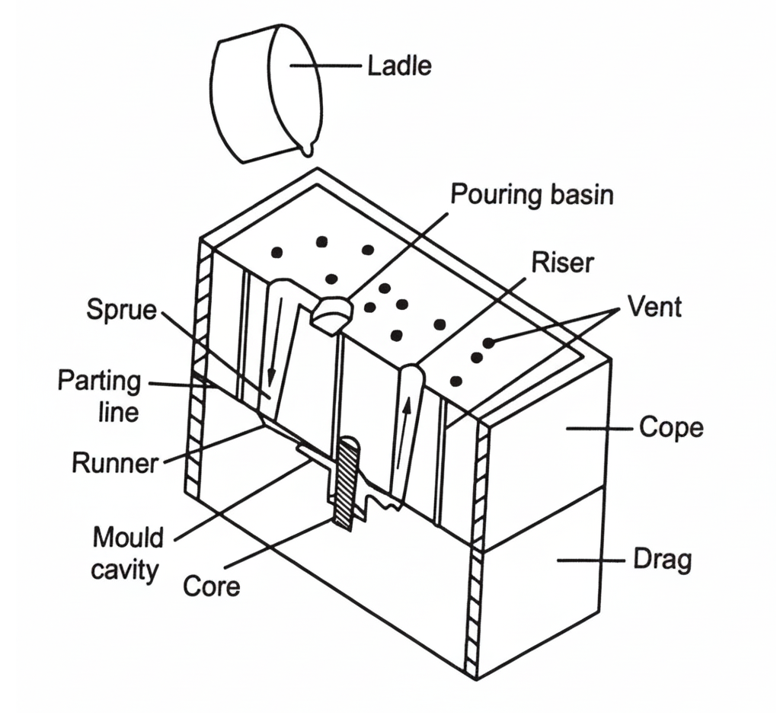
The internal geometry of the part, including the mold cavity and the gating system (the channels through which molten metal flows), is machined directly into these blocks, making them an integral part of the tooling. When a casting requires internal hollows or cavities, engineers insert "cores" into the mold before pouring. These cores can be made of metal (if the geometry allows for withdrawal) or sand aggregates.
Classifications of the Process
The text identifies several specific techniques that fall under or relate to the permanent mold category:
Centrifugal Casting: Uses spinning forces to distribute metal.
Die Casting:
Gravity Die Casting: Relies on gravity to fill the mold.
Pressure Die Casting: Uses external pressure to force metal into the mold. This is further divided into Hot Chamber and Cold Chamber die casting.
Shell Moulding: (Note: While often associated with permanent patterns, the mold itself is a resin-sand shell).
Material Suitability
Permanent mold casting is not suitable for every metal. Because the mold is made of metal, it must have a higher melting point than the material being cast. Therefore, this process is predominantly used for metals with lower melting points, including:
Aluminum Alloys
Magnesium Alloys
Copper Alloys
Gray Iron
While it is more challenging, steels can be cast using this method if the molds are constructed from specialized graphite or heat-resistant metal alloys.
Advantages
This method is preferred in industrial settings for several reasons:
Production Rate: It allows for rapid cycling and high-speed production.
Surface Quality: The parts produced have a superior surface finish compared to sand casting.
Precision: It achieves close dimensional tolerances.
Mechanical Integrity: The metal mold causes rapid solidification (chilling), which generally results in a finer grain structure and uniform mechanical properties.
Limitations
Despite its benefits, the process has constraints:
Cost: It is generally not economical for small production runs due to the high cost of making the metal mold.
Complexity: Intricate shapes, particularly those with complex undercuts, are difficult to cast because the rigid metal mold cannot be removed from the part easily.
The Solution:
Semi-Permanent Mold Casting
To overcome geometry limitations, manufacturers use a variation called Semi-Permanent Mold Casting. In this method, the outer mold is reusable metal, but the internal cores are made of collapsible sand. After casting, the sand core can be easily broken down and removed, allowing for the creation of intricate internal cavities that would otherwise be impossible with a solid metal core.
Applications
Due to the strength and finish of the resulting parts, permanent mold casting is widely used in the automotive and consumer goods sectors. Typical components include:
Automobile pistons and cylinder heads
Connecting rods
Gear blanks
Various appliances and kitchenware