

Article details
Introduction
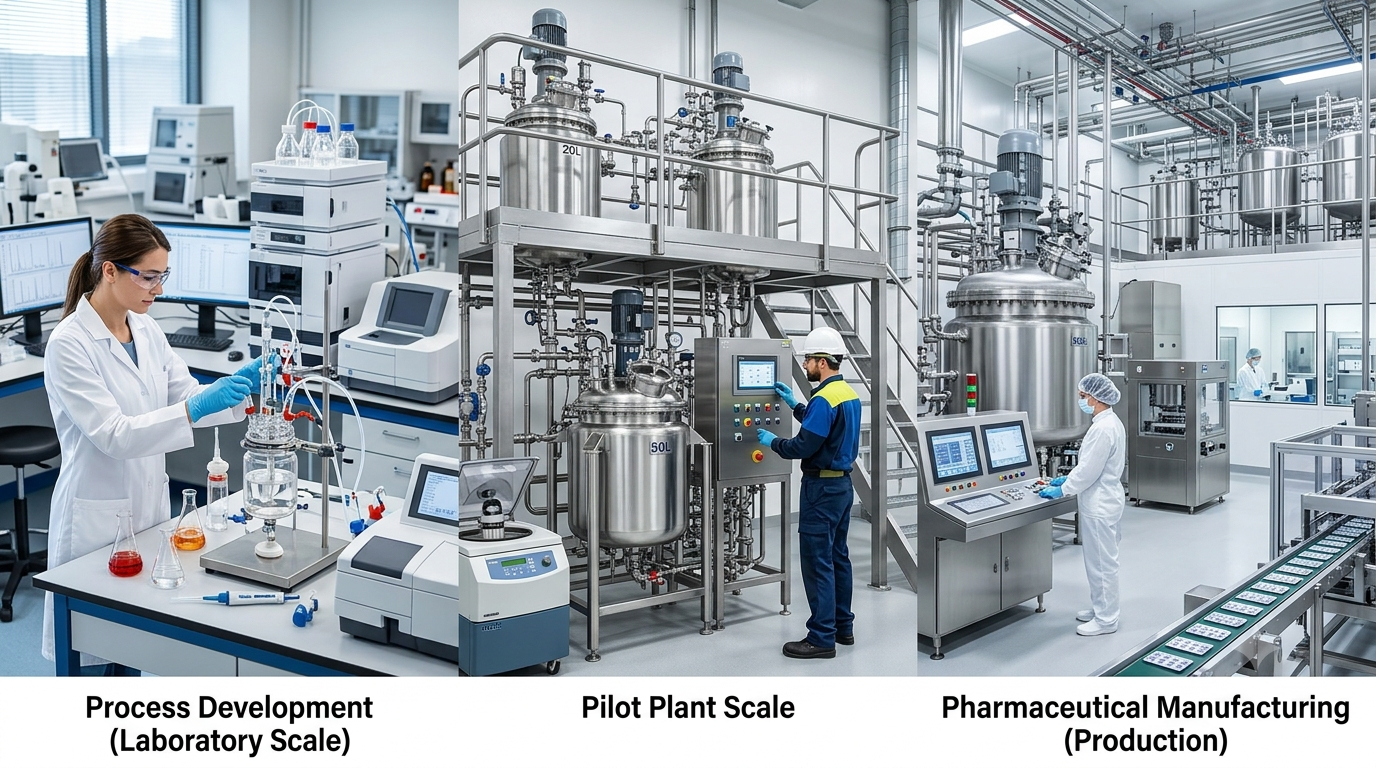
Pilot plant scale-up techniques play an important role in the pharmaceutical industry by helping manufacturers convert laboratory-developed formulations into products suitable for commercial production. A formulation that performs successfully in a laboratory may behave differently when manufactured in larger quantities. Changes in equipment size, processing conditions, material handling and production capacity can affect the quality, stability and performance of the final product.
A pilot plant provides an intermediate production environment where these challenges can be identified and addressed before moving towards full-scale manufacturing. It allows researchers, formulation scientists and production engineers to evaluate manufacturing procedures, select suitable equipment and establish reliable process parameters.
The main purpose of pilot plant scale-up is to develop a consistent, economical and reproducible manufacturing process while maintaining the required product quality and safety standards.
What Is a Pilot Plant?
A pilot plant is a small-scale or intermediate manufacturing facility used to test and evaluate production processes before commercial implementation. It acts as a link between research and development (R&D) laboratories and large-scale manufacturing facilities.
In pharmaceutical manufacturing, pilot plants are used to transform laboratory formulations into practical production procedures. They help determine whether a product can be manufactured consistently using industrial equipment and standard operating conditions.
Pilot plant operations generally involve five important manufacturing elements:
Man: Skilled personnel responsible for operating and monitoring processes.
Machine: Equipment used for manufacturing, processing and testing.
Material: Raw materials and ingredients required for production.
Method: Standardized procedures followed during manufacturing.
Money: Financial resources required for equipment, materials and operations.
What Is Pilot Plant Scale-Up?
Pilot plant scale-up is the process of increasing the production capacity of a formulation or manufacturing procedure while maintaining its original quality and performance characteristics.
During laboratory development, products are usually prepared in small quantities using specialized equipment. However, commercial manufacturing requires larger batches, higher production rates and different equipment configurations.
Scale-up studies help determine how processing conditions should be adjusted when production volume increases. Factors such as mixing speed, mixing time, temperature, pressure, drying conditions and material flow must be carefully evaluated.
The objective is to establish a manufacturing process that produces consistent results at different production scales.
Objectives of Pilot Plant Scale-Up Techniques
Pilot plant studies are conducted to identify potential manufacturing problems and establish reliable production procedures before investing in large-scale facilities.
The major objectives include:
1. Maintaining Product Quality
The primary objective is to produce pharmaceutical formulations with consistent physical, chemical and functional properties. Product stability, uniformity and performance must be maintained throughout the scale-up process.
2. Evaluating Manufacturing Equipment
Pilot plants help identify equipment that is compatible with the formulation. Mixing machines, granulators, dryers, mills and filling systems are evaluated based on their efficiency, reliability and operating costs.
3. Identifying Critical Process Parameters
Important manufacturing variables are identified and controlled. These may include mixing speed, processing time, temperature, drying rate and material addition rate.
4. Reducing Manufacturing Risks
Testing a process at an intermediate scale helps identify problems before commercial production begins. This reduces material wastage, production delays and unexpected equipment-related difficulties.
5. Developing Manufacturing Guidelines
Pilot plant studies help establish standard operating procedures, process control guidelines and master manufacturing formulas for routine production.
6. Supporting Process Validation
Equipment and manufacturing procedures are evaluated to confirm that they can consistently produce products within the required specifications.
7. Estimating Production Requirements
The studies help determine raw material quantities, equipment capacity, production space, labour requirements and expected manufacturing rates.
General Considerations in Pilot Plant Development
Successful pilot plant development requires careful planning of personnel, equipment, raw materials, manufacturing space and documentation.
1. Personnel Requirements
A pilot plant requires trained scientists, technicians, engineers and production personnel who understand both laboratory development and industrial manufacturing operations.
Employees should have practical knowledge of formulation development, equipment operation, process control, quality assurance and Good Manufacturing Practices (GMP).
Clear communication between R&D, production, engineering and quality control teams is essential for a smooth transition into commercial manufacturing.
2. Space and Facility Requirements
The pilot plant layout should provide sufficient space for equipment installation, material movement, product testing and storage.
Common facility areas include:
Administration and information area: For documentation, planning and technical records.
Physical testing area: For routine product testing and evaluation.
Equipment and operating area: For installing and operating manufacturing machinery.
Storage area: For raw materials, intermediate products, finished products and retained samples.
A properly planned layout improves workflow, reduces material handling difficulties and supports safe manufacturing operations.
3. Raw Material Selection
Raw materials used during laboratory development may behave differently when processed in larger batches. Their physical and chemical properties can influence mixing, granulation, drying and product stability.
Therefore, raw materials must be evaluated for quality, availability, consistency and suitability for large-scale manufacturing.
4. Equipment Selection
Equipment selection is an important part of pilot plant scale-up. The selected machinery should be capable of producing the required product quality while maintaining operational efficiency.
Equipment should also be evaluated based on capacity, maintenance requirements, cleaning procedures, reliability and overall manufacturing costs.
Pilot Plant Scale-Up Techniques for Different Dosage Forms
Different pharmaceutical dosage forms require different manufacturing techniques. The process parameters and equipment must be selected according to the physical and chemical characteristics of the formulation.
1. Scale-Up Techniques for Solid Dosage Forms
Solid dosage forms include tablets, capsules and powders. Their manufacturing processes involve several operations, such as weighing, mixing, granulation, drying, milling, compression and packaging.
Wet Granulation
Wet granulation involves mixing powders with a suitable granulating liquid to form granules. These granules are dried and processed further before tablet compression.
During scale-up, mixing conditions, liquid addition rate, granulation time and drying temperature must be controlled. Changes in these parameters can affect granule size, flow properties and tablet quality.
Dry Granulation
Dry granulation is used when the formulation is unsuitable for wet processing. Powder materials are compressed into compact masses or ribbons, which are subsequently milled into granules.
Important parameters include compression force, roller pressure, milling conditions and particle size distribution.
Direct Compression
Direct compression involves blending the required ingredients and compressing the mixture directly into tablets without a granulation stage.
During scale-up, powder flow, blending uniformity, lubrication and compression force require careful evaluation to maintain consistent tablet weight, hardness and content uniformity.
2. Scale-Up Techniques for Capsule Manufacturing
Capsule manufacturing involves preparing a uniform powder or granule mixture and filling it into suitable capsule shells.
The main operations include:
Mixing of ingredients.
Granulation, when required.
Lubrication and blending.
Capsule shell preparation.
Capsule filling.
Uniformity testing.
Packaging and labelling.
During scale-up, filling accuracy, powder flow, capsule weight variation and content uniformity must be monitored.
3. Scale-Up Techniques for Liquid Oral Dosage Forms
Liquid oral formulations include syrups, suspensions and solutions. These products require controlled mixing, ingredient dissolution and suitable processing conditions.
The manufacturing process generally involves raw material weighing, measuring, mixing, dissolution, filtration where applicable, filling and packaging.
Important parameters include mixing speed, mixing time, temperature, ingredient addition sequence and filtration conditions.
For suspensions, particle distribution and physical stability are particularly important. For solutions, complete dissolution and uniform concentration must be maintained.
4. Scale-Up Techniques for Semisolid Dosage Forms
Semisolid pharmaceutical products include creams, ointments, gels and pastes. Their manufacturing requires controlled mixing and suitable processing conditions to achieve the desired consistency and uniformity.
Common manufacturing methods include:
Trituration method: Ingredients are mixed and reduced into a uniform preparation through grinding.
Fusion method: Ingredients are melted and combined before cooling.
Chemical reaction method: Components undergo a controlled chemical reaction to form the desired preparation.
Emulsification method: Oil and water phases are combined using suitable mixing conditions and emulsifying agents.
During scale-up, temperature control, mixing speed, cooling rate, viscosity and product homogeneity must be monitored carefully.
These parameters help maintain the desired texture, stability and quality of the final product.
Important Process Evaluation Parameters
Process evaluation helps determine whether the manufacturing procedure can be repeated successfully at a larger production scale.
The following parameters require attention during pilot plant studies:
Mixing speed and time: Ensure proper blending and uniform distribution of ingredients.
Material addition rate: Control the addition of powders, liquids, solvents and granulating agents.
Heating and cooling rates: Maintain suitable temperature conditions throughout processing.
Drying temperature and time: Achieve the required moisture content without affecting product quality.
Particle size: Maintain suitable particle distribution through milling and screening.
Filtration conditions: Select appropriate filter sizes for liquid formulations.
Product stability: Evaluate the physical and chemical stability of finished products during storage.
These parameters should be documented and monitored to ensure consistency between pilot-scale and commercial manufacturing batches.
Documentation and Master Manufacturing Formula
Documentation is essential for maintaining manufacturing consistency and meeting regulatory requirements.
A Master Manufacturing Formula provides detailed instructions for producing a pharmaceutical product. It includes ingredient quantities, processing steps, equipment requirements and important operating parameters.
Batch manufacturing records should contain information such as:
Raw material specifications and quantities.
Equipment identification and operating conditions.
Mixing speed and processing time.
Heating and cooling temperatures.
Granulation and drying conditions.
In-process quality checks.
Finished product specifications.
Packaging and storage instructions.
Proper documentation supports traceability, process monitoring, quality assurance and compliance with GMP requirements.
SUPAC Guidelines in Pharmaceutical Scale-Up
SUPAC stands for Scale-Up and Post-Approval Changes. These guidelines provide a framework for evaluating changes made to approved pharmaceutical products after their initial approval.
Such changes may involve formulation composition, manufacturing processes, production equipment or manufacturing locations.
The major SUPAC categories include:
SUPAC-IR: Covers immediate-release solid oral dosage forms and related post-approval manufacturing changes.
SUPAC-MR: Addresses modified-release solid oral dosage forms, including changes that may affect drug release characteristics.
SUPAC-SS: Covers non-sterile semisolid dosage forms such as creams, ointments, gels and lotions.
Depending on the nature and impact of a proposed change, additional testing and documentation may be necessary. These can include in-vitro dissolution studies, product quality testing and, where required, in-vivo evaluation.
The purpose is to ensure that manufacturing changes do not negatively affect product quality, safety or performance.
Challenges in Pilot Plant Scale-Up
Moving from laboratory development to commercial manufacturing can introduce several technical and operational challenges.
1. Equipment Differences: Laboratory equipment and industrial machinery may operate differently, affecting mixing, heat transfer and material movement.
2. Batch Uniformity: Maintaining consistent product characteristics becomes more difficult when manufacturing quantities increase.
3. Raw Material Variations: Differences in material properties and supplier specifications can influence manufacturing performance.
4. Process Control: Temperature, pressure, mixing and drying conditions require accurate monitoring at larger production scales.
5. Production Costs: Equipment installation, facility requirements, material consumption and skilled labour contribute to the overall cost of scale-up.
6. Product Stability: Changes in manufacturing conditions may affect the physical and chemical stability of the finished formulation.
Careful evaluation, process optimization and validation help minimize these challenges before commercial production begins.
Importance of Pilot Plant Scale-Up in Pharmaceutical Manufacturing
Pilot plant scale-up provides several advantages to pharmaceutical manufacturers.
Reduces the risk of manufacturing failures during commercial production.
Helps optimize equipment selection and manufacturing procedures.
Improves product consistency and batch uniformity.
Supports quality assurance and regulatory compliance.
Helps estimate production capacity and infrastructure requirements.
Reduces unnecessary material wastage and operational costs.
Supports smooth technology transfer from R&D to manufacturing.
Provides valuable data for future production improvements.
It also helps organizations evaluate whether a formulation can meet production requirements while maintaining the desired quality standards.
Conclusion
Pilot plant scale-up techniques are an essential part of pharmaceutical product development and commercial manufacturing. They provide a controlled environment for evaluating formulations, testing equipment, optimizing process parameters and identifying potential manufacturing difficulties before large-scale production.
From tablet compression and capsule filling to liquid formulation and semisolid manufacturing, every dosage form requires specific scale-up considerations. Proper equipment selection, raw material evaluation, process validation and manufacturing documentation help maintain product quality and production consistency.
By applying systematic pilot plant studies, pharmaceutical manufacturers can reduce production risks, improve operational efficiency and establish reliable processes for commercial manufacturing.
SEO Keywords: Pilot Plant Scale-Up Techniques, Pharmaceutical Scale-Up, Pilot Plant Technology, Pharmaceutical Manufacturing Process, Process Validation, SUPAC Guidelines, Solid Dosage Form Manufacturing, Liquid Dosage Form, Semisolid Manufacturing.
