


Article details
While the Otto Cycle rules the roads, the Rankine Cycle rules the electrical grid. Named after William John Macquorn Rankine, a Scottish polymath and pioneer of thermodynamics, this cycle is the idealized mathematical blueprint for steam power plants.
Whether a power plant burns coal, utilizes natural gas, splits atoms in a nuclear reactor, or captures concentrated solar energy, it almost certainly uses the Rankine Cycle to turn heat into the electricity running your home right now.
The Four Stages of the Rankine Cycle
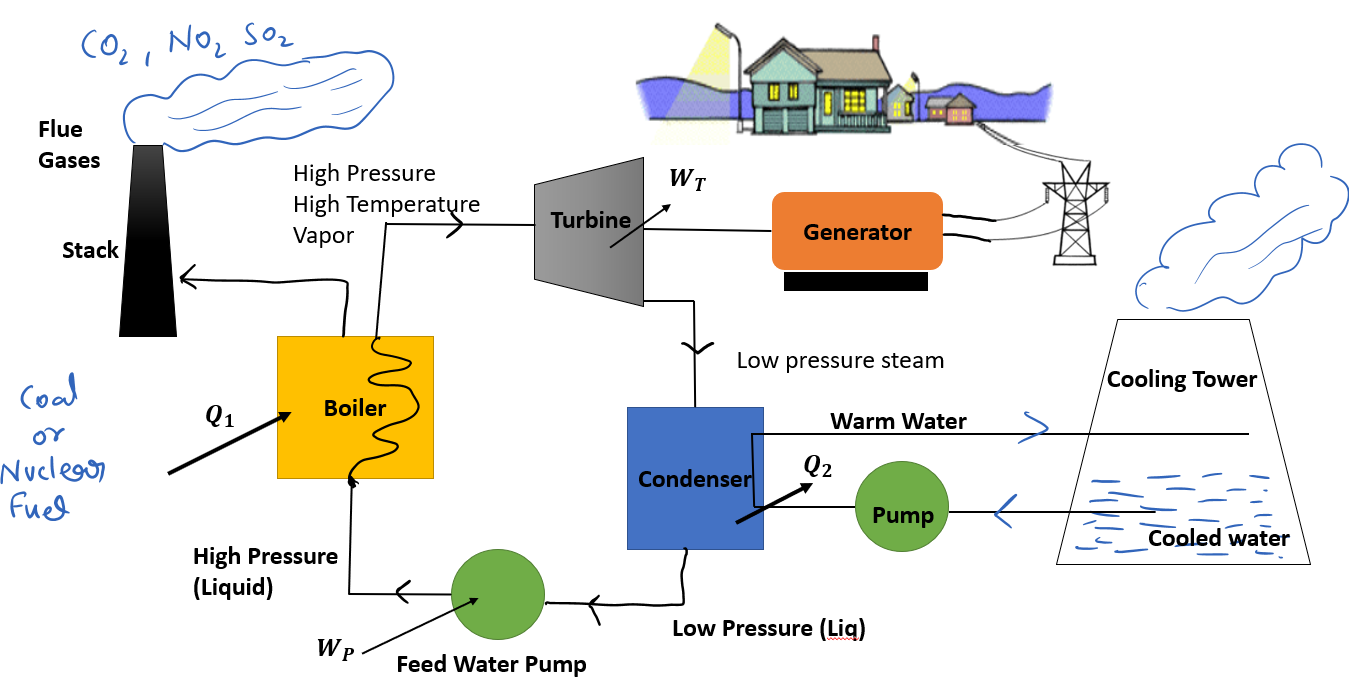
Unlike an internal combustion engine where everything happens inside a single cylinder, the Rankine Cycle is a closed-loop system where a working fluid (typically water) physically circulates through four separate, specialized components.
1. Isentropic Compression (The Pump)
The cycle begins with low-pressure liquid water. A mechanical pump consumes a small amount of work (W_{in}) to compress the liquid to high pressure. Because liquids are highly incompressible, this requires very little energy, and the temperature rises only slightly.
2. Constant-Pressure Heat Addition (The Boiler)
The high-pressure liquid enters a boiler, where an external heat source (Q_{in}) boils the water. The water changes phase from a liquid to a saturated vapor, and is usually heated further into a superheated vapor (steam). This process happens at a constant, high pressure.
3. Isentropic Expansion (The Turbine)
The high-pressure, superheated steam rushes out of the boiler and expands through a turbine. As the steam forces the turbine blades to spin, it drives a generator to produce electricity (W_{out}). During this expansion, the pressure and temperature drop significantly, and the steam often transitions into a wet vapor mixture (steam with tiny water droplets).
4. Constant-Pressure Heat Rejection (The Condenser)
The low-pressure steam enters a condenser, where it flows around tubes of cold water (usually sourced from a nearby river, lake, or cooling tower). The steam dumps its remaining latent heat (Q_{out}) and condenses completely back into a saturated liquid. This liquid is then fed back into the pump, closing the loop.
The Thermodynamic P-V and T-S Diagrams
To analyze the performance of a steam power plant, engineers plot the state changes on Pressure-Volume (P-V) and Temperature-Entropy (T-S) diagrams. The vapor dome represents the boundary where water transitions between liquid, mixture, and vapor states.
The ideal Rankine cycle traces these steps:
1-->2: Isentropic compression in the pump (represented by a vertical line going upward on the T-S diagram, as entropy $S$ is constant).
2-->3: Constant-pressure heat addition in the boiler (moving horizontally through the liquid region, across the vapor dome, and up into the superheated region).
3-->4: Isentropic expansion in the turbine (a straight vertical line downward, dropping back toward or into the vapor dome).
4-->1: Constant-pressure heat rejection in the condenser (moving horizontally from right to left back to a pure liquid state).
Thermal Efficiency of the Rankine Cycle
The thermal efficiency (η) is the ratio of the net useful work output to the total heat energy put into the system

Using the enthalpy ($h$) at each point of the cycle (which measures the total heat content of the fluid), the efficiency can be written as:

How Engineers Boost Rankine Efficiency:
Because power plants operate on a massive scale, even a 1% increase in efficiency saves millions of dollars in fuel costs. Engineers use a few classic techniques to maximize output:
Superheating: Heating the steam well above its boiling point before it hits the turbine. This puts more energy into the steam and prevents liquid droplets from forming inside the turbine, which can erode the blades.
Reheating: Taking the steam out of the turbine halfway through its expansion, sending it back to the boiler to get reheated, and running it through a secondary, lower-pressure turbine.
Regeneration: Bleeding off a small amount of hot steam from the turbine to pre-heat the cold liquid water before it enters the boiler, reducing the amount of fuel energy required to boil it.