

Article details
A single chilled water loop, one set of pumps moving water from the chiller to every cooling coil in a building and back, seems like the obvious, simplest design. For a long time, it mostly was. But as buildings grew larger and cooling loads became more variable, this simple approach ran into a genuine problem, chillers need a fairly constant flow rate to operate properly, while the actual building load, and therefore the flow a variable system naturally wants to deliver, changes constantly throughout the day. Primary secondary pumping exists specifically to resolve this conflict.
The Core Problem: Chillers Want Constant Flow, Buildings Want Variable Flow
A chiller's evaporator is designed and rated around a specific flow rate of chilled water passing through it. Operating well below that design flow rate risks a genuine mechanical problem, inadequate flow can lead to freezing risk in the evaporator, reduced heat transfer efficiency, and in many chillers, an automatic safety trip specifically designed to shut the chiller down before flow drops low enough to cause damage.
Meanwhile, the actual cooling load a building presents varies considerably across a day, a season, and depending on occupancy, and the coils and control valves serving that variable load naturally want to vary how much chilled water flows through them in response, more flow when more cooling is needed, less flow when it isn't. A single loop system, where the same water moving through the chiller is also the water directly serving every variable coil in the building, creates a direct conflict, the coils want flow to vary with load, but the chiller needs flow to stay relatively constant regardless of load.
The Solution: Splitting Into Two Distinct Loops
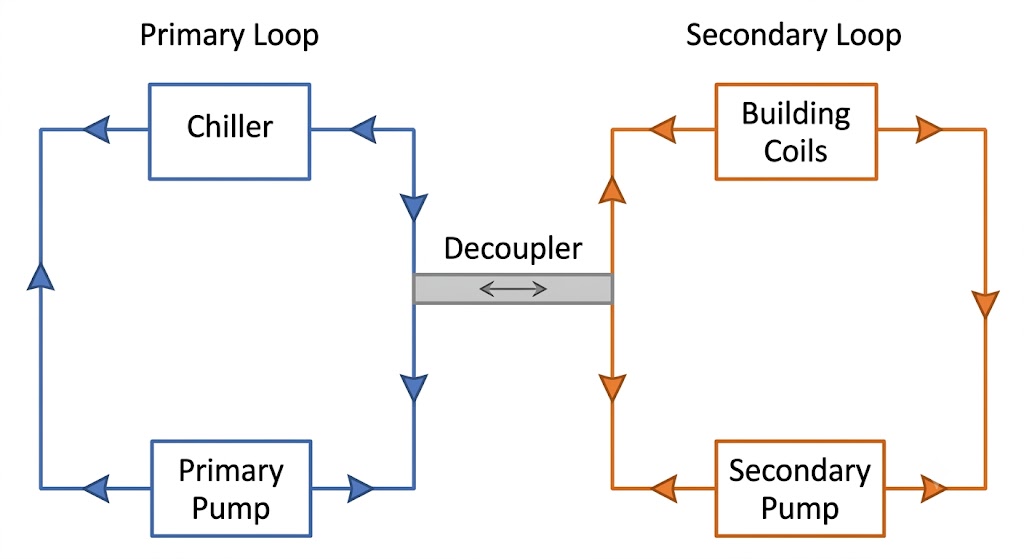
Primary secondary pumping resolves this by dividing the system into two hydraulically separate loops, each allowed to behave differently, connected to each other at a specific point that lets them interact without forcing either loop's flow behavior onto the other.
The primary loop contains the chiller itself and a dedicated primary pump, sized and controlled specifically to maintain the constant flow rate the chiller actually needs, regardless of what the rest of the building is doing. This loop's entire purpose is protecting the chiller's operating requirements.
The secondary loop contains the actual building distribution piping, the coils, control valves, and air handling units that serve the real, variable cooling load. This loop's pump, typically a variable speed pump, is free to speed up or slow down in response to actual building demand, since it's no longer directly constrained by what the chiller itself requires.
The Decoupler: Where the Two Loops Actually Meet
The genuinely clever part of this arrangement is the connection point between the two loops, commonly called the decoupler line or neutral bridge, a short section of pipe connecting the primary loop's return side to the secondary loop's supply side, allowing water to pass between the two loops as needed without either loop's pump directly working against the other's.
This connection point is what actually allows the two loops to have different flow rates simultaneously without creating a conflict. When the secondary loop's demand, and therefore its flow rate, is lower than what the primary loop is producing, some water simply flows through the decoupler in one direction, effectively recirculating a portion of the primary flow without it ever needing to pass through the building's coils. When secondary demand exceeds primary flow, water flows through the decoupler in the opposite direction instead, the secondary loop drawing additional flow from the primary side to make up the difference. The decoupler is what makes the whole arrangement work, it's the pressure relief point that lets each loop's pump operate according to its own loop's actual requirements.
Why Constant Flow Through the Chiller Actually Matters This Much
It's worth being specific about why chiller manufacturers care so much about maintaining consistent evaporator flow, since this requirement is really the entire reason primary secondary pumping exists as a design pattern in the first place.
Reduced flow through an operating evaporator means less water is available to absorb the same amount of heat the chiller's refrigeration cycle is removing, which can drive the water temperature drop across the evaporator to an unsafe extreme, risking localized freezing inside the evaporator tubes even when the chiller's overall setpoint seems entirely reasonable. This is a genuine equipment protection issue, not just an efficiency concern, which is exactly why most chillers include a low flow protection trip specifically designed to shut the unit down automatically before this becomes a real mechanical problem, and why maintaining adequate primary flow isn't optional or a mere best practice suggestion but a genuine operational requirement.
Balancing Load Between the Two Loops
In a properly designed and operating primary secondary system, the cooling load actually gets balanced between the two loops, the heat being absorbed on the secondary side, through the building's actual coils and cooling demand, matches the heat being rejected on the primary side, through the chiller's evaporator, under normal, fully loaded operating conditions. The decoupler's role in this balance is really about accommodating the moments when primary and secondary flow rates don't precisely match, rather than being where the actual heat transfer or load balancing itself takes place.
Why This Design Pattern Became Standard
Primary secondary pumping became a widely adopted design pattern specifically because it let engineers increase the allowable temperature differential across a chilled water system considerably beyond what earlier, simpler system designs comfortably permitted, while still protecting chillers from the flow variation that a directly connected, fully variable system would otherwise impose on them. This combination, genuine flexibility on the building distribution side, genuine flow protection on the chiller side, is exactly what made the approach durable enough to remain a standard reference design pattern for chiller plants for decades.
The Practical Takeaway
Primary secondary pumping exists to resolve a genuine, unavoidable conflict, chillers need consistent flow to operate safely and effectively, while buildings need variable flow to efficiently match their actual, constantly changing cooling demand. By splitting the system into two hydraulically separate loops, connected through a decoupler that lets water pass between them as needed, the design allows each loop's pump to do exactly what its own side of the system actually requires, without forcing either the chiller or the building's coils to compromise on what they each genuinely need to operate correctly.
EveryEng. For everyone in Engineering.