

Article details
Introduction
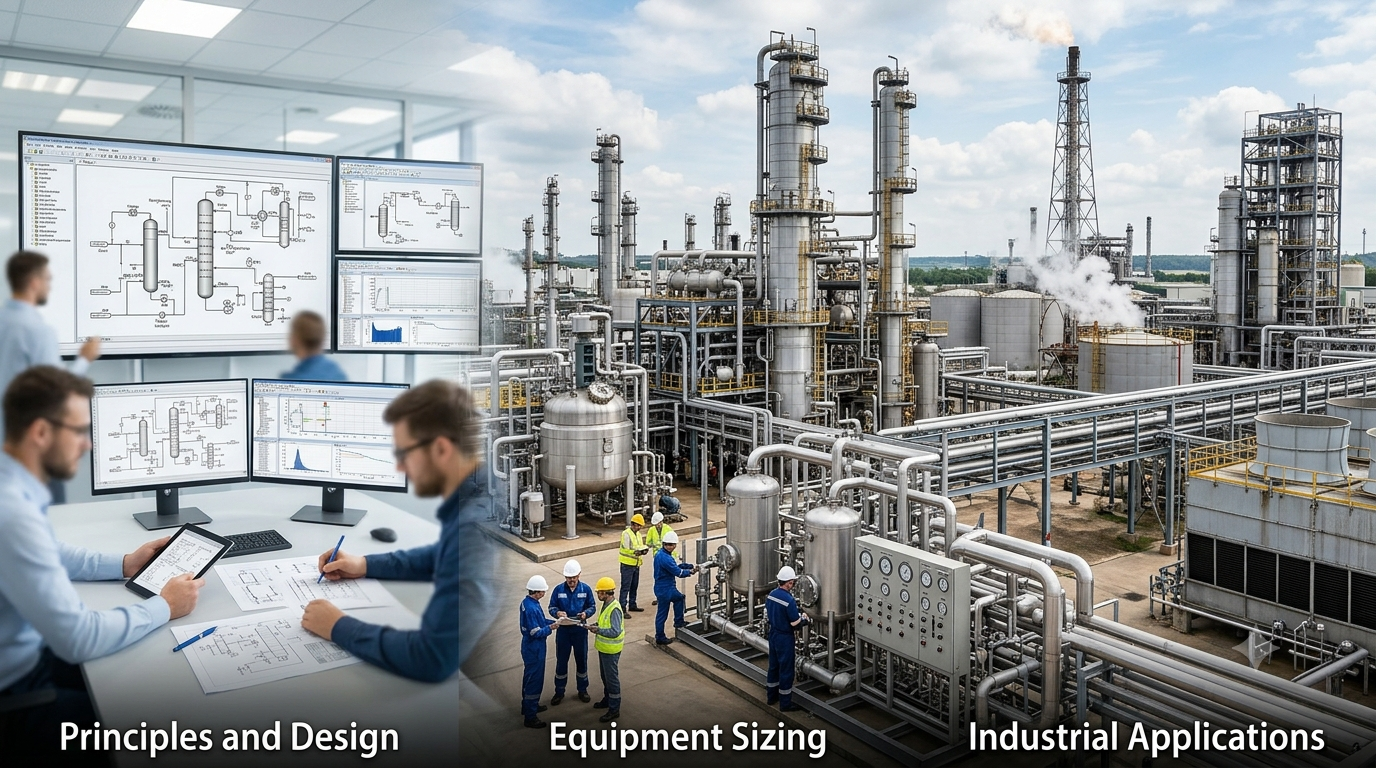
Process design and equipment sizing are essential activities in chemical, oil and gas, petrochemical, pharmaceutical, and manufacturing industries. They help engineers develop safe, reliable, and cost-effective industrial facilities that meet production requirements. Every processing plant requires properly selected equipment to handle raw materials, control operating conditions, transfer heat, maintain pressure, and produce the desired output.
Equipment sizing involves calculating the appropriate dimensions, capacity, and operating specifications of machinery based on process requirements. Equipment selection focuses on identifying the most suitable type of equipment, materials, and design features for a particular application.
Both activities are closely connected. Incorrect equipment selection or sizing can result in poor performance, excessive energy consumption, increased maintenance costs, and serious operational risks.
What Is Process Design?
Process design is the engineering activity of developing a complete process system that converts raw materials into useful products through a series of controlled operations.
It involves studying process requirements, identifying operating conditions, selecting suitable equipment, performing engineering calculations, and preparing technical documents.
The main objective is to ensure that the entire facility operates safely and efficiently while meeting production targets.
Process design generally includes:
Defining the production capacity and process requirements.
Identifying raw materials and product specifications.
Establishing operating temperature and pressure.
Selecting suitable process equipment.
Performing material and energy balance calculations.
Developing process flow diagrams (PFDs).
Preparing piping and instrumentation diagrams (P&IDs).
Evaluating safety, utilities, and environmental requirements.
Process simulation tools and engineering calculations help designers evaluate different operating conditions before equipment is purchased or installed.
What Is Equipment Sizing and Selection?
Equipment sizing and selection determine the correct type and capacity of machinery required for a particular industrial process.
Engineers consider parameters such as flow rate, pressure, temperature, fluid properties, heat transfer requirements, equipment capacity, and operating conditions.
For example, a pump must be selected based on the required flow rate, discharge pressure, fluid characteristics, and total dynamic head. Similarly, a heat exchanger must provide sufficient heat transfer capacity to achieve the required heating or cooling duty.
The selection process also considers equipment availability, material compatibility, maintenance requirements, installation space, and overall project cost.
Major Factors Affecting Equipment Sizing and Selection
1. Process Requirements
The first step is to identify the specific requirements of the process. Engineers must understand the materials being handled, production capacity, operating conditions, and expected output.
Fluid composition, density, viscosity, corrosiveness, and hazardous characteristics can significantly influence equipment design.
2. Flow Rate and Capacity
Flow rate is one of the most important parameters in equipment sizing. It determines how much liquid, gas, or solid material must pass through the equipment within a specific period.
Equipment with insufficient capacity may restrict production, while oversized equipment can increase capital investment and operating expenses.
3. Pressure and Temperature
Operating pressure and temperature influence the mechanical design, material selection, and safety requirements of equipment.
Pressure vessels, compressors, pumps, and heat exchangers must be designed to withstand their specified operating and design conditions.
Engineers also consider pressure fluctuations, temperature variations, and possible abnormal operating conditions.
4. Material Selection
Materials of construction must be compatible with the process fluids and operating environment.
Carbon steel, stainless steel, alloy steel, and other specialised materials may be considered depending on corrosion resistance, mechanical strength, temperature limits, and chemical compatibility.
Selecting unsuitable materials can cause corrosion, leakage, equipment damage, and premature failure.
5. Cost and Maintenance
Equipment selection should consider the complete lifecycle cost rather than only the initial purchase price.
Installation, energy consumption, spare parts, maintenance, inspection, and replacement costs influence the overall economics of a project.
Types of Process Equipment Used in Industrial Plants
Different types of equipment perform specific functions in industrial processing facilities.
1. Pressure Vessels and Separators
Pressure vessels are designed to store or process fluids under specified pressure conditions. Separators are commonly used to separate gas, oil, water, or other phases.
Vertical and horizontal separators are selected based on fluid properties, available space, flow rates, and separation requirements.
Important sizing considerations include vessel diameter, length, residence time, gas capacity, liquid capacity, and internal components.
2. Heat Exchangers
Heat exchangers transfer thermal energy between two or more fluids without necessarily mixing them.
Common types include:
Shell and tube heat exchangers.
Plate heat exchangers.
Air-cooled heat exchangers.
Double-pipe heat exchangers.
Sizing calculations consider heat duty, inlet and outlet temperatures, overall heat transfer coefficient, effective temperature difference, fouling resistance, and allowable pressure drop.
Proper selection improves thermal performance and reduces energy consumption.
3. Pumps and Compressors
Pumps transfer liquids from one location to another, while compressors increase the pressure of gases.
Common pump types include centrifugal, reciprocating, and rotary pumps. Compressor types include centrifugal, reciprocating, rotary, and axial compressors.
Important design parameters include flow rate, suction pressure, discharge pressure, differential head, efficiency, power requirement, and operating characteristics.
Engineers must also evaluate Net Positive Suction Head (NPSH) to minimise the risk of cavitation in pumps.
4. Distillation Columns and Absorbers
Distillation columns separate liquid mixtures based on differences in volatility. Absorption columns transfer selected components from a gas stream into a liquid solvent.
Their design depends on feed composition, operating pressure, temperature, reflux ratio, number of theoretical stages, and product specifications.
Column diameter, height, trays, packing, and internal components are important sizing considerations.
5. Storage Tanks
Storage tanks hold raw materials, intermediate products, and finished products before further processing or transportation.
Their capacity depends on storage requirements, production rates, pumping rates, available space, and operating conditions.
Engineers also consider tank overflow protection, ventilation, structural design, and applicable safety requirements.
Important Steps in the Equipment Sizing Process
A systematic approach helps engineers achieve accurate and reliable equipment sizing.
Step 1: Establish the Design Basis
Define the process objectives, production capacity, feed characteristics, product specifications, and operating conditions.
Step 2: Perform Process Simulation
Use suitable process simulation tools to evaluate material balance, energy balance, thermodynamic properties, and operating conditions.
Step 3: Identify Equipment Requirements
Determine the equipment needed for each process operation, including pumps, vessels, compressors, heat exchangers, and separation systems.
Step 4: Perform Engineering Calculations
Calculate equipment capacity, dimensions, pressure drop, heat transfer area, flow velocity, power requirements, and other relevant parameters.
Step 5: Evaluate Equipment Options
Compare available equipment based on performance, material compatibility, reliability, cost, availability, and maintenance requirements.
Step 6: Prepare Technical Specifications
Develop equipment datasheets and specification sheets containing process conditions, design parameters, materials of construction, control requirements, and other relevant details.
Step 7: Review and Finalise the Design
Verify calculations, confirm compliance with applicable engineering standards, and review the equipment specifications before procurement and installation.
Hydraulic Calculations and Line Sizing
Hydraulic calculations are important for ensuring that fluids move through pipelines and equipment at the required flow conditions.
Engineers calculate pressure losses, flow velocity, friction losses, and required pumping or compression capacity.
Single-phase and two-phase flow conditions require different calculation approaches.
For pump circuits, important parameters include suction pressure, discharge pressure, differential head, minimum flow, and NPSH.
For compressor circuits, engineers evaluate suction and discharge conditions, compression stages, efficiency, and power requirements.
Accurate line sizing helps prevent excessive pressure drop, vibration, erosion, and unnecessary energy consumption.
Relief Systems and Industrial Safety
Relief and safety systems protect industrial equipment against excessive pressure and other abnormal operating conditions.
Pressure relief devices are selected and sized based on credible overpressure scenarios, such as blocked outlets, cooling water failure, instrument air failure, and external fire exposure.
Engineers evaluate relief pressure, relieving conditions, back pressure, and the physical properties of the released fluid.
Flare systems and knockout drums are also important components of many oil and gas facilities. Their design helps manage process releases safely and reduces potential risks to personnel, equipment, and the environment.
Importance of Equipment Sizing and Selection in Industrial Operations
Correct equipment sizing and selection provide several operational benefits.
Improved Safety: Properly designed equipment reduces the possibility of mechanical failure, leakage, and unsafe operating conditions.
Higher Efficiency: Suitable equipment improves process performance and helps reduce unnecessary energy consumption.
Cost Reduction: Accurate sizing prevents unnecessary investment in oversized equipment and reduces long-term operating expenses.
Operational Reliability: Proper selection improves equipment availability and reduces unexpected downtime.
Better Maintenance: Selecting suitable materials and standard equipment can simplify inspection, maintenance, and spare-parts management.
Future Expansion: Considering future production requirements helps facilities accommodate changing operational demands.
Challenges in Process Design and Equipment Sizing
Engineers may face several challenges while designing industrial equipment. Changes in feed composition, fluctuating operating conditions, limited installation space, material compatibility, and project budget constraints can affect design decisions.Another challenge is balancing equipment performance with capital and operating costs. Selecting specialised equipment may be necessary for certain applications, but standard equipment can often provide advantages in availability, procurement, maintenance, and cost.Collaboration between process, mechanical, piping, instrumentation, and safety engineers is therefore essential for successful project execution.
Conclusion
Process design and equipment sizing are fundamental to developing efficient, safe, and reliable industrial facilities. From pressure vessels and heat exchangers to pumps, compressors, storage tanks, and distillation columns, every equipment item must meet specific process and operational requirements.Accurate engineering calculations, suitable material selection, hydraulic analysis, equipment datasheets, and safety evaluations help ensure that industrial systems perform as intended.For chemical, petroleum, process, and production engineers, developing practical knowledge of equipment sizing and selection is valuable for working on plant design, engineering projects, equipment procurement, and process optimisation.
