


Article details
Psychrometry is the study of the thermodynamic properties of moist air and the physical and thermodynamic processes involving air-water vapor mixtures. It is essential in the field of Heating, Ventilation, Air Conditioning, and Refrigeration (HVAC&R) for designing air-conditioning systems and analyzing air properties.
Atmospheric Air, Moist Air, Dry Air:
- Atmospheric Air: The mixture of gases surrounding the Earth, primarily composed of nitrogen (78%) and oxygen (21%), along with trace amounts of other gases.
- Dry Air: Air without any water vapor content.
- Moist Air: A mixture of dry air and water vapor. The amount of water vapor can vary depending on conditions like temperature and pressure.
What is a Psychrometric Chart?

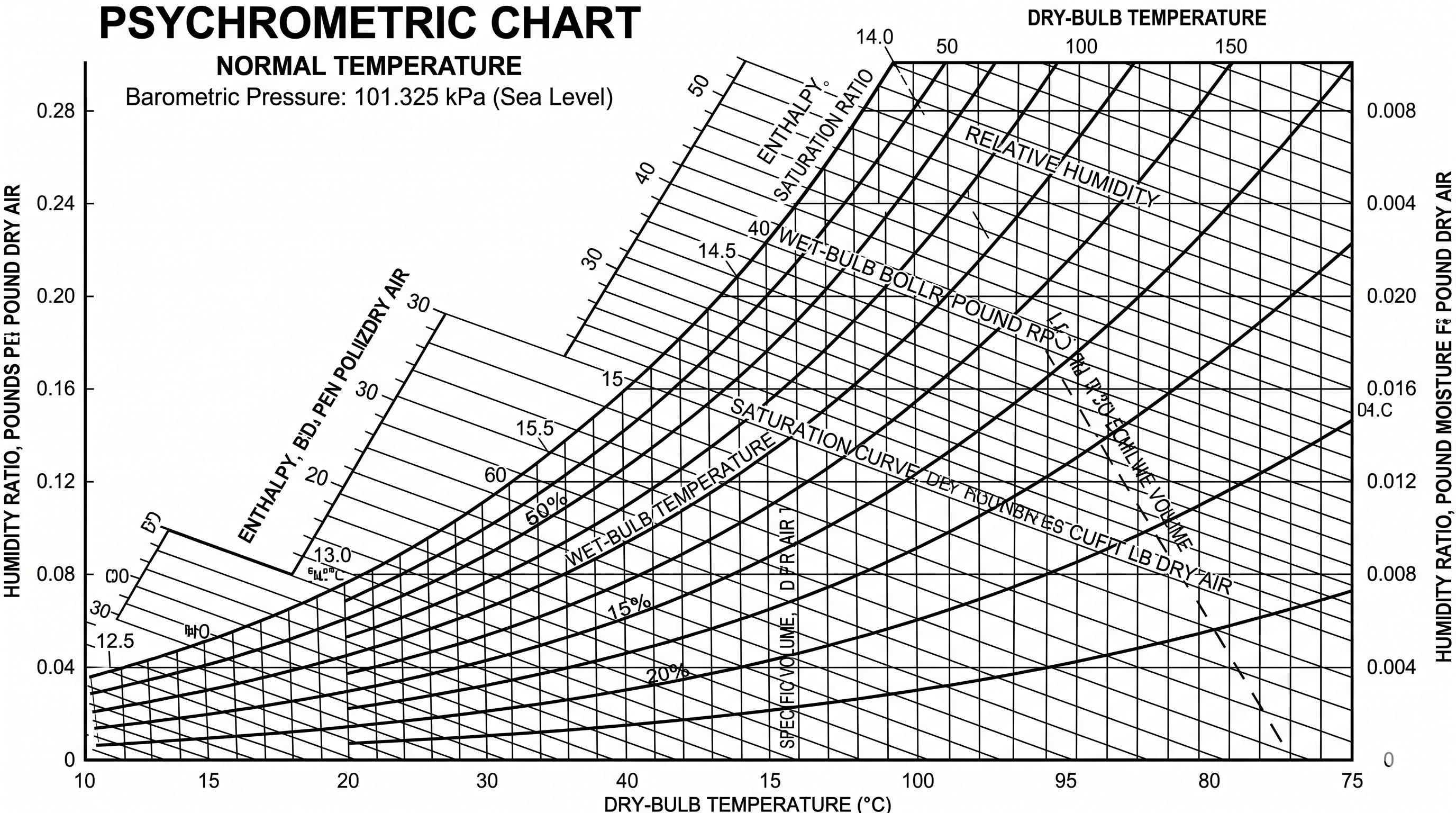
A Psychrometric Chart is a graphical representation of the physical and thermal properties of moist air. It allows engineers to visualize and calculate properties such as temperature, humidity, enthalpy, and others. The chart is typically derived from the Mollier Diagram, which plots enthalpy vs. absolute humidity.
Formation from Mollier Chart:
The Mollier Chart (h-x diagram) shows enthalpy (h) versus specific humidity (x). A Psychrometric Chart expands this to include other parameters such as dry bulb temperature, wet bulb temperature, relative humidity, and specific volume.
Terms in Psychrometry
Saturation, Saturated & Unsaturated Air:
- Saturation: The condition where air holds the maximum amount of water vapor possible at a given temperature.
- Saturated Air: Air at saturation point, relative humidity = 100%.
- Unsaturated Air: Air with a relative humidity below 100%.
Superheated & Supersaturated Air:
- Superheated Air: Air at a temperature above its saturation temperature at a given pressure.
- Supersaturated Air: Air containing more water vapor than the saturation limit, generally unstable and prone to condensation.
Important Psychrometric Properties
Dry Bulb Temperature (DBT): The actual temperature of air measured by a standard thermometer, expressed in °C or °F.
Wet Bulb Temperature (WBT): The temperature read by a thermometer with a wet wick covering the bulb. It reflects the cooling effect due to evaporation and helps determine moisture content.
Relative Humidity (RH):
RH = (Actual Vapor Pressure / Saturation Vapor Pressure) × 100%
Indicates how close the air is to being saturated.
Absolute Humidity: Mass of water vapor per unit volume of air, typically expressed in g/m³.
Specific Humidity & Humidity Ratio:
- Specific Humidity (ω): Ratio of the mass of water vapor to the total mass of air.
- Humidity Ratio: Mass of water vapor per unit mass of dry air (kg/kg).
Degree of Saturation (ϕ):
ϕ = ω / ω_sat
Dew Point Temperature: The temperature at which air becomes saturated and water vapor begins to condense into liquid water.
Specific Volume (v): Volume occupied by unit mass of air (m³/kg).
Specific Enthalpy (h): Total heat content of air per unit mass (kJ/kg), combining sensible and latent heat:
h = h_dry_air + ω × h_vapor
Specific Entropy (s): Measure of disorder or randomness of the moist air system, expressed in kJ/kg·K.
Vapor Pressure (P_v): Partial pressure exerted by water vapor in the air mixture, expressed in kPa.
Bypass Factor: Defines the fraction of air that bypasses a cooling or heating coil without being treated. Used in system performance calculations:
Bypass Factor = (T_exit - T_coil) / (T_entry - T_coil)
Contact Factor: Represents the efficiency of heat and mass transfer between air and surface, especially in cooling towers or evaporative systems.
How to Read a Psychrometric Chart
1. Locate the Dry Bulb Temperature (DBT) on the horizontal axis.
2. Find the Relative Humidity (RH) curved lines.
3. The vertical axis can represent specific humidity or enthalpy.
4. Saturation line (100% RH) is the upper curved boundary.
5. Wet Bulb Temperature lines run diagonally.
6. Enthalpy lines are also sloped diagonals.
7. By locating two properties (e.g., DBT and RH), other properties like specific humidity, enthalpy, and dew point temperature can be found.
Example Calculation
Given:
- Dry Bulb Temperature = 35°C
- Relative Humidity = 60%
- Atmospheric Pressure = 101.325 kPa
Steps:
1. From the psychrometric chart, locate DBT = 35°C and RH = 60%.
2. Read corresponding values:
- Wet Bulb Temperature ≈ 27.5°C
- Specific Humidity ≈ 0.020 kg/kg
- Dew Point ≈ 24°C
- Specific Enthalpy ≈ 80 kJ/kg
- Specific Volume ≈ 0.89 m³/kg
3. Calculate vapor pressure:
Pv = φ × P_vs
Where P_vs is saturation vapor pressure at 35°C ≈ 5.63 kPa.
Pv = 0.6 × 5.63 = 3.38 kPa
Conclusion
Psychrometry and the psychrometric chart are indispensable tools for HVAC engineers to analyze air properties and air-conditioning processes. Understanding key parameters such as temperature, humidity, enthalpy, and specific volume allows for efficient design and operation of air-conditioning systems.